
What Is the Profitability Index?
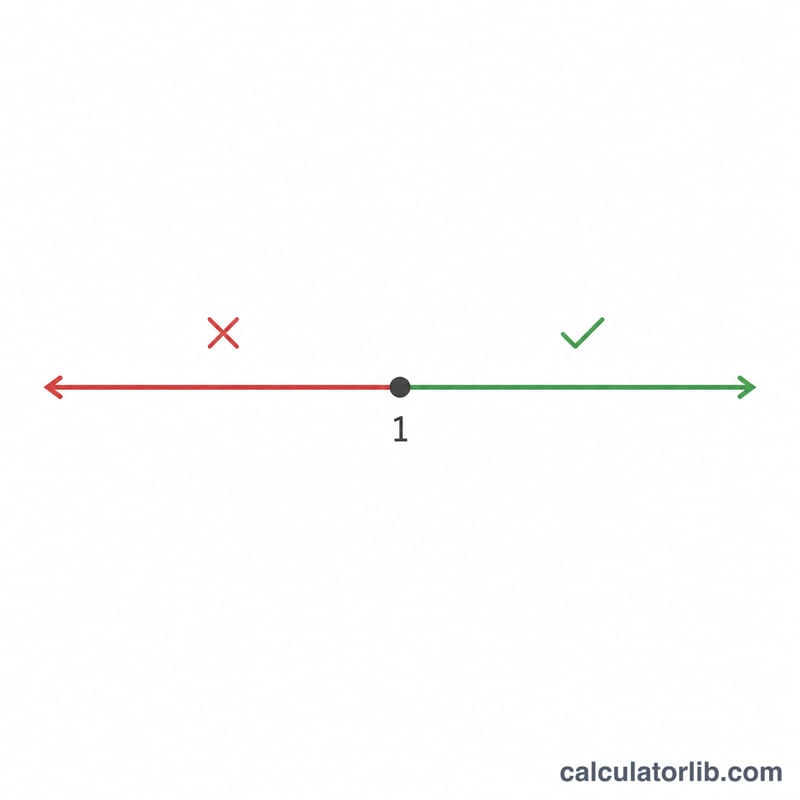
The Profitability Index (PI), also called the profit investment ratio or value investment ratio, is a capital-budgeting metric that measures how much value a project creates per dollar invested. It is calculated by dividing the present value (PV) of a project's expected future cash flows by the initial investment required to start it. A PI greater than 1 means the project is expected to generate more value than it costs, while a PI below 1 signals an unprofitable project.
How to Use This Calculator
Enter two figures: the present value of all future cash flows (already discounted to today using your required rate of return) and the initial investment outlay. The calculator instantly returns the profitability index, the implied net present value (NPV), and a clear accept/reject recommendation based on the \(\text{PI} = 1\) threshold.
The Formula Explained
$$\text{PI} = \frac{\text{PV of Future Cash Flows}}{\text{Initial Investment}}$$ Because PI and NPV use the same discounted cash flows, they always agree on whether to accept a single project: \(\text{PI} > 1\) is equivalent to \(\text{NPV} > 0\). The advantage of PI is that it normalizes value creation by project size, making it useful for ranking projects when capital is limited.
Worked Example
Suppose a project requires an initial investment of $100,000 and the present value of its future cash flows is $120,000. Then $$\text{PI} = 120{,}000 \div 100{,}000 = 1.2.$$ Each dollar invested returns $1.20 in present-value terms, and the NPV is $$120{,}000 - 100{,}000 = 20{,}000.$$ Since \(\text{PI} > 1\), the project should be accepted.
How to Calculate the Profitability Index by Hand
- Estimate the cash flows the project is expected to produce in each period.
- Choose the discount rate \(r\), usually the required rate of return or the firm's weighted average cost of capital (WACC).
- Discount each cash flow with \(\frac{CF_t}{(1+r)^t}\), where \(t\) is the period number.
- Sum the discounted cash flows to get the present value (PV) of future cash flows.
- Divide by the initial investment: \(\text{PI} = \frac{\text{PV of future cash flows}}{\text{Initial investment}}\).
- Subtract the investment from the PV to get NPV, then apply the rule: accept if PI > 1 (NPV > 0).
Numeric illustration
A project costs $100,000 and returns $50,000 at the end of each of 3 years. The discount rate is 10%.
- Year 1: \(\frac{50000}{1.10^1} = 45454.55\)
- Year 2: \(\frac{50000}{1.10^2} = 41322.31\)
- Year 3: \(\frac{50000}{1.10^3} = 37565.74\)
Sum: 45,454.55 + 41,322.31 + 37,565.74 = about $124,343 (PV of future cash flows).
$$\text{PI} = \frac{124343}{100000} \approx$$ 1.24
NPV = 124,343 − 100,000 = about $24,343. Since PI is above 1 and NPV is positive, the project is accepted at a 10% required return.
FAQ
What is a good profitability index? Any PI above 1.0 indicates a value-adding project; the higher the better. A PI of exactly 1.0 means the project breaks even on a present-value basis.
How is PI different from NPV? NPV gives the absolute dollar value added, while PI gives the relative value per dollar invested. PI is better for ranking projects under capital rationing.
Do I discount the cash flows first? Yes. The numerator must be the present value of future cash flows, discounted at your required rate of return or cost of capital, not the raw undiscounted totals.