

What Is the Software Contract Value Calculator?
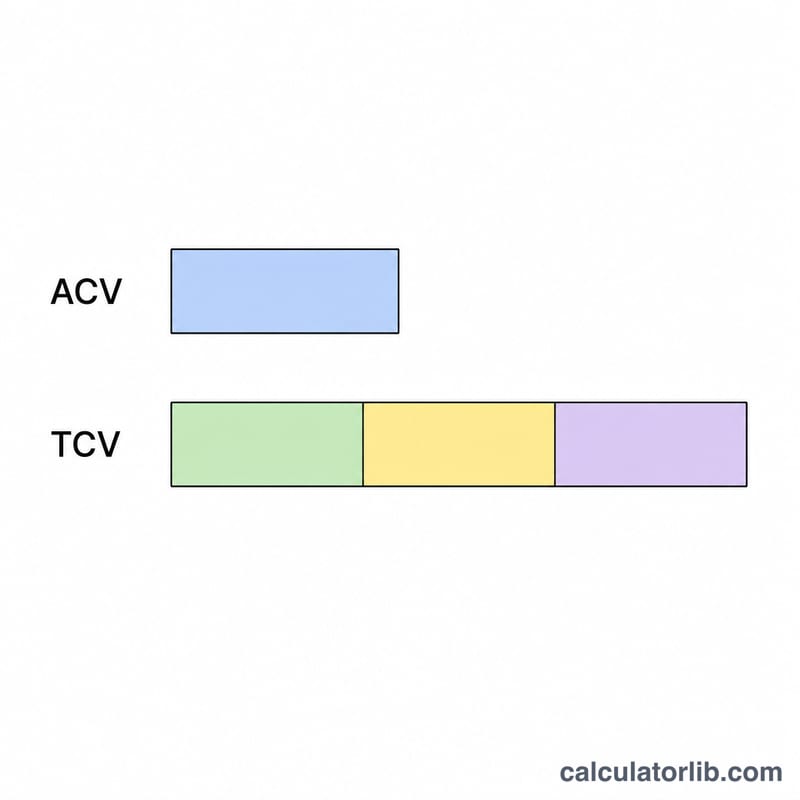
This calculator helps SaaS and software vendors quantify the worth of a deal using two industry-standard metrics: Total Contract Value (TCV) and Annual Contract Value (ACV). TCV captures everything a customer is contractually committed to pay over the full term, while ACV expresses that value on a normalized per-year basis so contracts of different lengths can be compared fairly.
How to Use It
Enter the Monthly Recurring Revenue (MRR) the customer pays each month, the contract length in months, and any one-time or setup fees (such as onboarding or implementation charges). The tool returns TCV, ACV, and your Annual Recurring Revenue (ARR = MRR × 12) instantly.
The Formula Explained
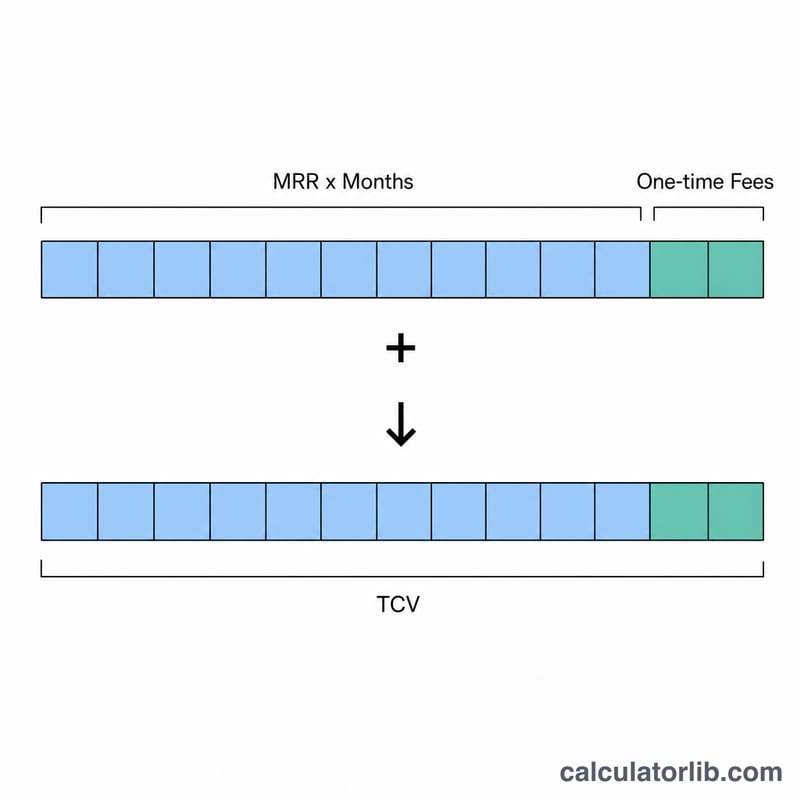
TCV multiplies the monthly recurring fee by the number of months in the term, then adds non-recurring fees: $$\text{TCV} = \left(\text{MRR} \times \text{Months}\right) + \text{One-Time Fees}$$ ACV divides TCV by the contract length expressed in years (Months ÷ 12). $$\text{ACV} = \frac{\text{TCV}}{\text{Months} / 12}$$ Note that ACV includes amortized one-time fees, which is why a short contract with large setup fees can have an inflated ACV.
Worked Example
A customer pays $5,000/month on a 36-month contract with a $10,000 setup fee. $$\text{TCV} = (5{,}000 \times 36) + 10{,}000 = 180{,}000 + 10{,}000 = \$190{,}000$$ The term is \(36 \div 12 = 3\) years, so $$\text{ACV} = 190{,}000 \div 3 \approx \$63{,}333.33$$ $$\text{ARR} = 5{,}000 \times 12 = \$60{,}000$$
FAQ
What's the difference between ACV and ARR? ARR counts only recurring revenue in a year. ACV is TCV averaged per year and may include amortized one-time fees, so they can differ.
Should I include one-time fees in TCV? Yes — TCV represents total committed spend. Many teams also track a "recurring-only" TCV separately.
Does this handle annual billing? Convert annual price to a monthly figure (annual ÷ 12) and enter it as MRR, or enter the term in months accordingly.