

What Is Employee Turnover Rate?
Employee turnover rate measures the percentage of your workforce that leaves an organization during a given period — a month, quarter, or year. It is one of the most important HR metrics because high turnover signals problems with engagement, compensation, management, or culture, and it carries real costs in recruiting and lost productivity.
How to Use This Calculator
Enter three numbers: how many employees left (separations), the headcount at the start of the period, and the headcount at the end. The calculator computes the average number of employees, the turnover rate as a percentage, and the corresponding retention rate.
The Formula Explained
The turnover rate divides the number of separations by the average number of employees, then multiplies by 100. The average headcount is simply the start figure plus the end figure divided by two, which smooths out growth or shrinkage during the period. Retention rate is 100% minus the turnover rate.
$$\text{Turnover Rate} = \frac{\text{Employees Who Left}}{\dfrac{\text{Start} + \text{End}}{2}} \times 100\%$$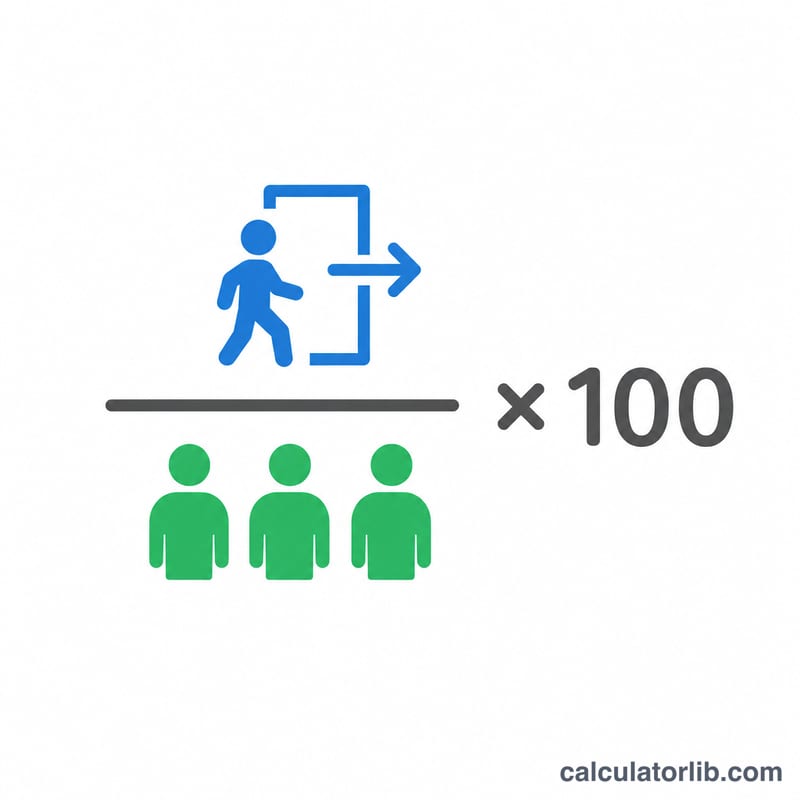
Worked Example
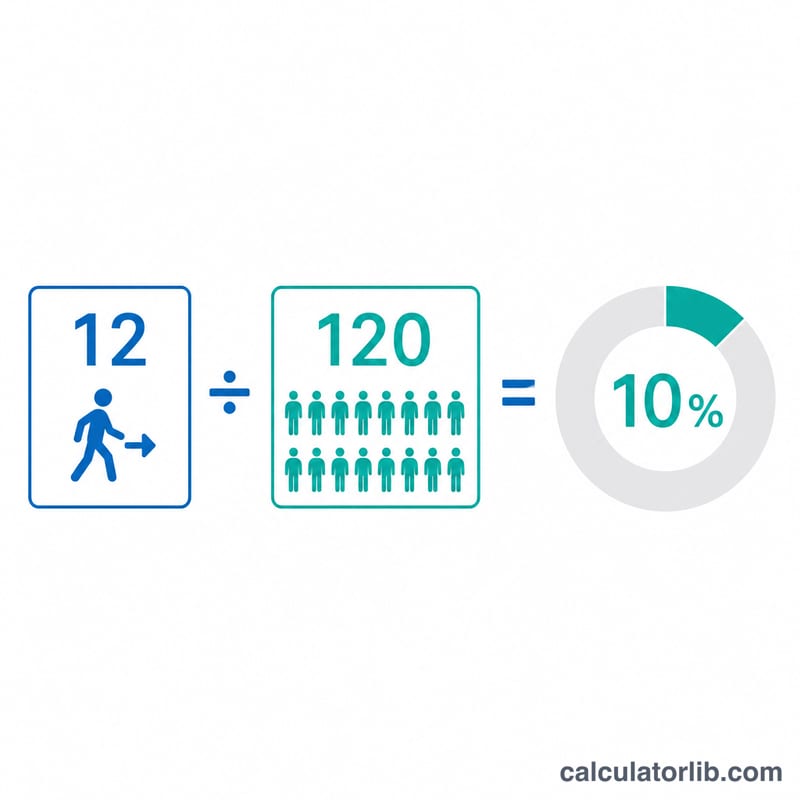
Suppose 15 employees left, you began the period with 100 staff and ended with 120. The average is \((100 + 120) / 2 = 110\) employees. Turnover rate $$= (15 / 110) \times 100 = 13.64\%$$ The retention rate is \(100 - 13.64 = 86.36\%\).
FAQ
Should I count voluntary and involuntary departures? For overall turnover, include all separations. Many teams also track voluntary turnover separately to gauge attrition driven by employee choice.
What is a good turnover rate? It varies widely by industry, but a lower rate generally indicates better retention. Compare against your sector's benchmarks rather than a single universal figure.
Why use average headcount instead of the starting number? Averaging the start and end counts accounts for hiring or downsizing during the period, giving a more accurate denominator.