
What Is the Employee Retention Rate?
The employee retention rate measures the percentage of staff who remain with your organization over a defined period. It is a core HR and workforce-planning metric: high retention signals a healthy, engaged workforce, while low retention points to costly turnover, recruiting expense, and lost institutional knowledge. This calculator works for any time frame — monthly, quarterly, or annual — as long as your numbers cover the same window.
How to Use the Calculator
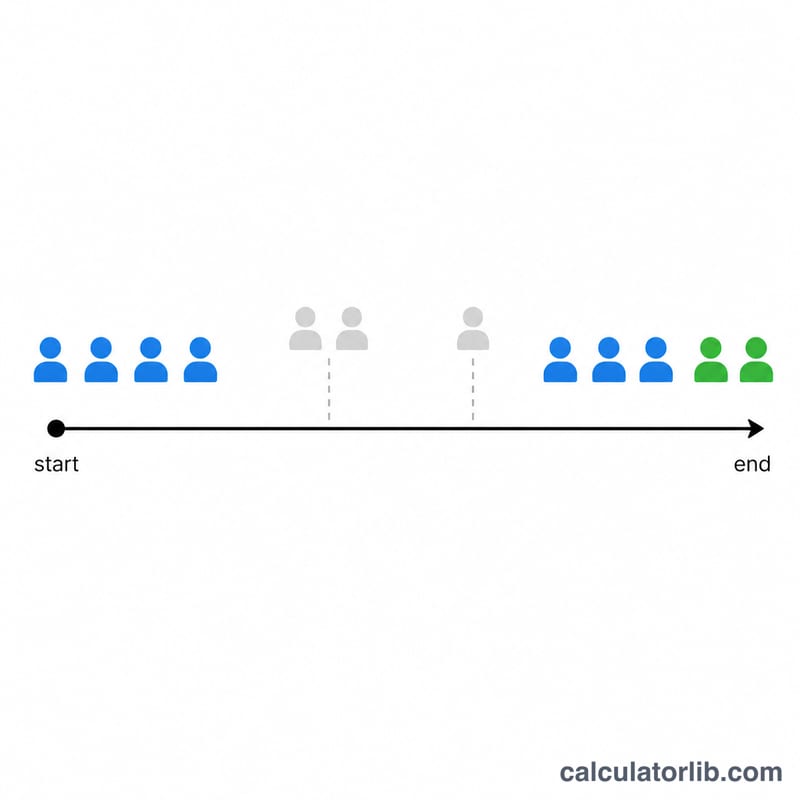
Enter three figures: the number of employees on staff at the start of the period, the number at the end, and the number of new hires brought in during the period. New hires are subtracted so you measure only how well you held on to your original people. Press calculate to see your retention rate, the count of retained employees, and the matching turnover rate.
The Formula Explained
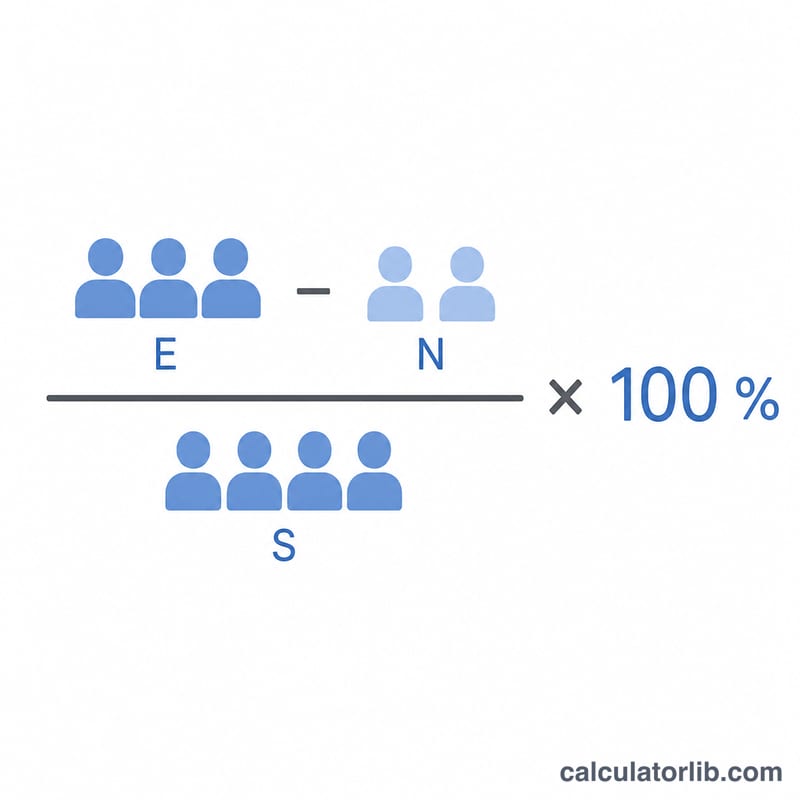
$$\text{Retention Rate} = \frac{\text{End Employees} - \text{New Hires}}{\text{Start Employees}} \times 100\%$$ By removing new hires from the end count, the numerator reflects only employees who were present at the start and are still present at the end. Dividing by the starting headcount and multiplying by 100 expresses that as a percentage.
Worked Example
Suppose you began the year with 100 employees, ended with 95, and hired 10 new people during the year. Retained = \(95 - 10 = 85\). $$\text{Retention rate} = \frac{85}{100} \times 100 = 85\%$$ meaning 15% of your original staff left, a 15% turnover rate.
FAQ
Why subtract new hires? Including new hires would inflate the figure with people who were not part of your original group, distorting how well you actually retained existing staff.
What is a good retention rate? It varies by industry, but annual retention above 90% is generally considered strong; below 80% may warrant review of compensation, culture, or management.
Can I use it for a month? Yes — just make sure all three inputs reference the same period.