

What Is the Employee Turnover Rate?
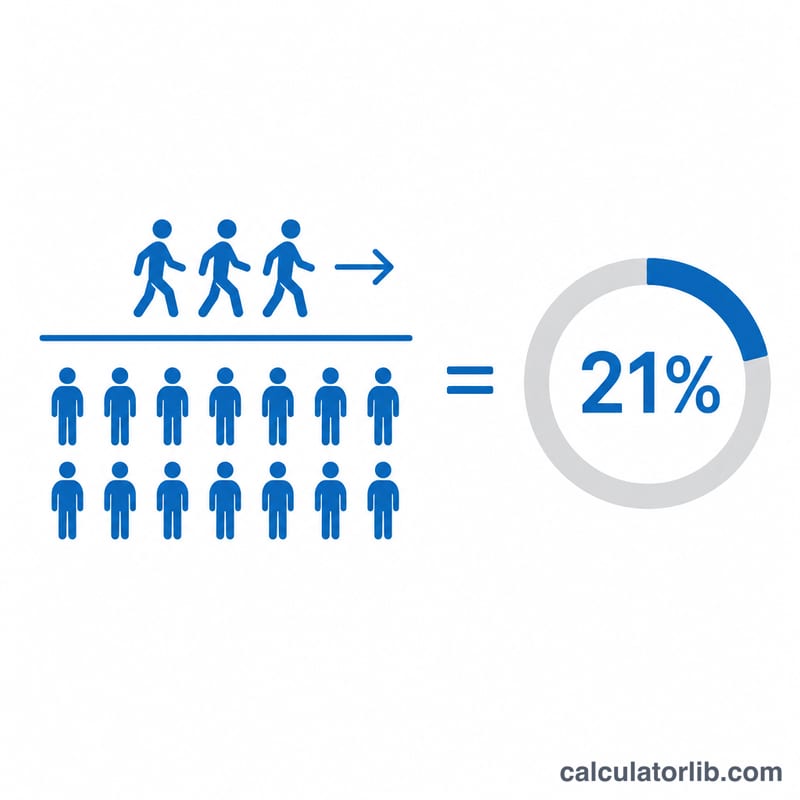
Employee turnover rate measures the percentage of workers who leave an organization during a given period (a month, quarter, or year). It is one of the most-watched human resources metrics because high turnover signals problems with engagement, compensation, management, or workplace culture — and because replacing staff is expensive. This calculator works for any country or industry; it is a pure ratio with no jurisdiction-specific rules.
How to Use This Calculator
Enter three numbers for the period you care about: the total number of separations (everyone who left — voluntary resignations, terminations, and retirements), the headcount at the start of the period, and the headcount at the end. The tool computes the average number of employees, then divides separations by that average and multiplies by 100. It also reports the matching retention rate.
The Formula Explained
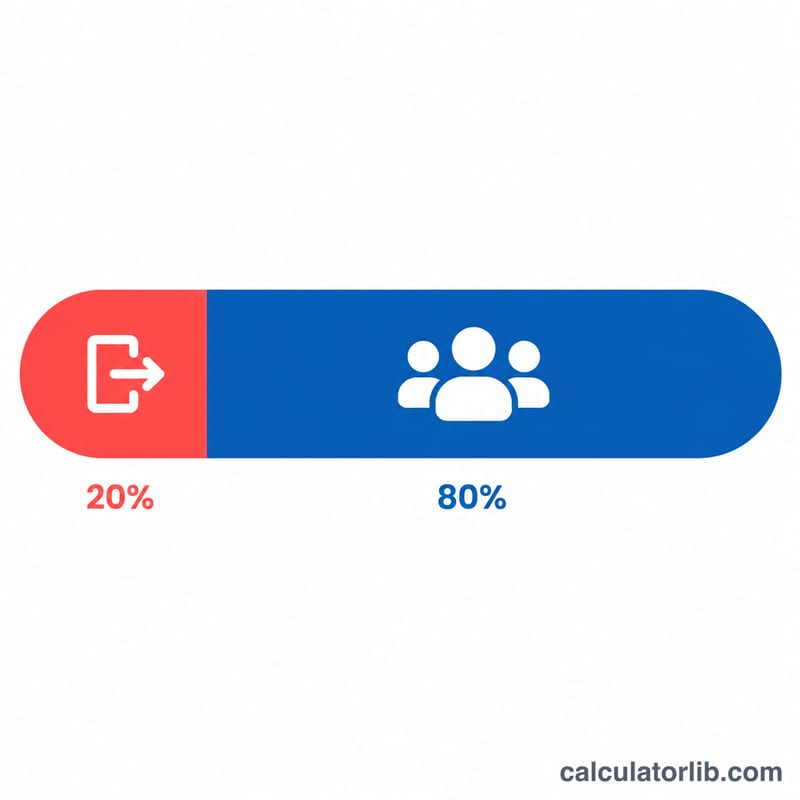
$$\text{Turnover \%} = \frac{\text{Separations}}{\dfrac{\text{Start} + \text{End}}{2}} \times 100$$ where Average Employees = (Beginning + Ending) ÷ 2. Using the average headcount instead of a single snapshot prevents distortion when your company is growing or shrinking quickly. Retention rate is simply 100% minus the turnover rate.
Worked Example
Suppose a company began the year with 200 employees and ended with 180, while 15 people left. The average headcount is \((200 + 180) \div 2 = 190\). $$\text{Turnover} = \frac{15}{190} \times 100 = 7.89\%$$ The retention rate is \(100 - 7.89 = 92.11\%\).
FAQ
Should I count new hires as separations? No. Only count people who left. New hires affect the ending headcount, which is why the average is used.
What is a good turnover rate? It varies widely by industry — retail and hospitality often run 30%+, while many office roles aim for under 10% annually. Compare against your sector benchmark.
How do I get an annual rate from monthly data? Sum each month's separations and use the average headcount across the year, or add up monthly turnover rates if you tracked them consistently.