
What Is Continuous Compound Interest?
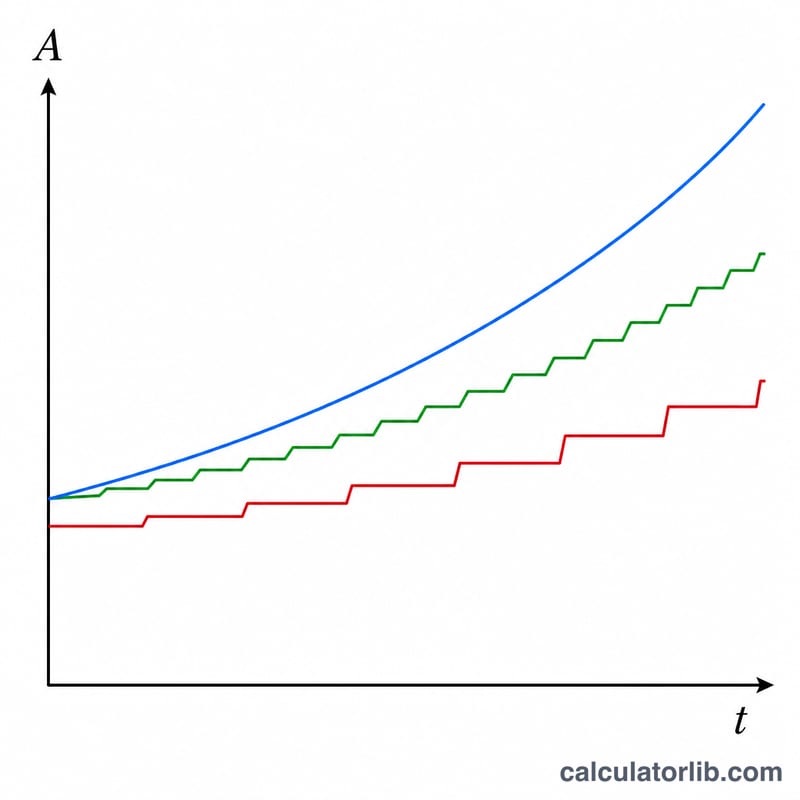
Continuous compound interest is the theoretical limit of compounding: instead of adding interest yearly, monthly, or daily, it is added at every instant. As the number of compounding periods approaches infinity, the growth formula simplifies to \(A = P \cdot e^{r \cdot t}\), where \(e\) ≈ 2.71828 is Euler's number. This represents the maximum possible growth for a given nominal rate and is widely used in finance, physics, and population modeling.
How to Use This Calculator
Enter three values: the principal (your starting amount), the annual rate as a percentage, and the time in years. The calculator converts the percentage rate to a decimal, applies the exponential formula, and returns the final amount along with the total interest earned.
The Formula Explained
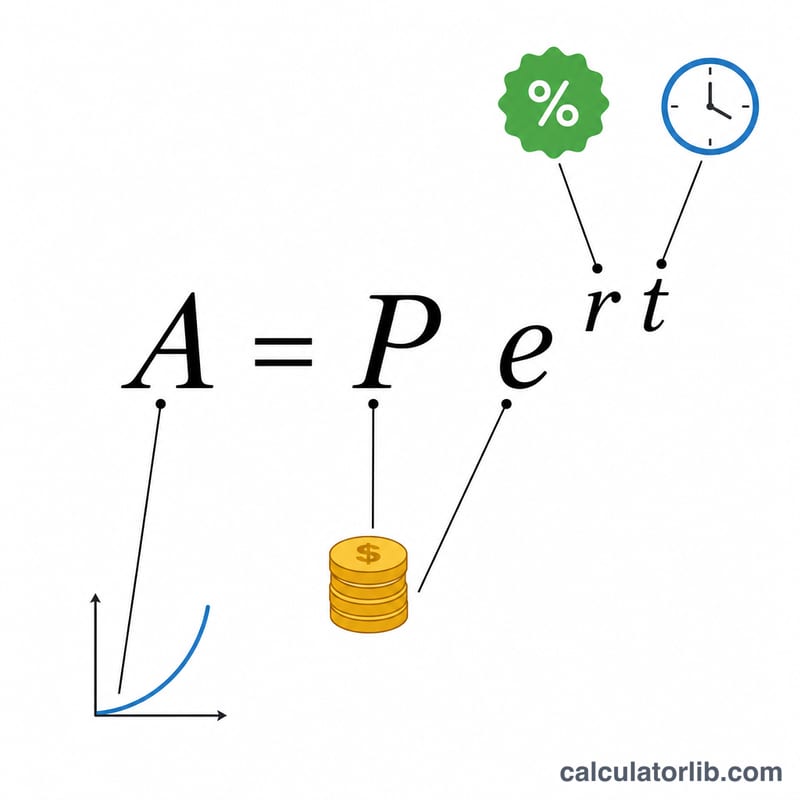
In $$A = P \cdot e^{r \cdot t}$$: \(A\) is the final amount, \(P\) is the principal, \(r\) is the annual interest rate as a decimal (5% → 0.05), and \(t\) is the time in years. Because compounding happens continuously, the result is always slightly higher than the same rate compounded monthly or daily.
Worked Example
Suppose you invest $1,000 at a 5% annual rate for 10 years. Then \(r = 0.05\) and \(r \cdot t = 0.5\). So $$A = 1000 \times e^{0.5} = 1000 \times 1.64872 = \$1{,}648.72$$ The total interest earned is $648.72.
FAQ
Is continuous compounding better than monthly compounding? Yes, slightly — for the same nominal rate it produces the highest possible final value, but the difference is small at typical rates.
What is \(e\)? Euler's number, approximately 2.71828, the base of the natural logarithm and the constant that arises naturally in continuous growth.
Can I use this for any currency? Yes. The calculation is purely mathematical and currency-independent — just enter your amount.