
What Is a Maturity Value Calculator?
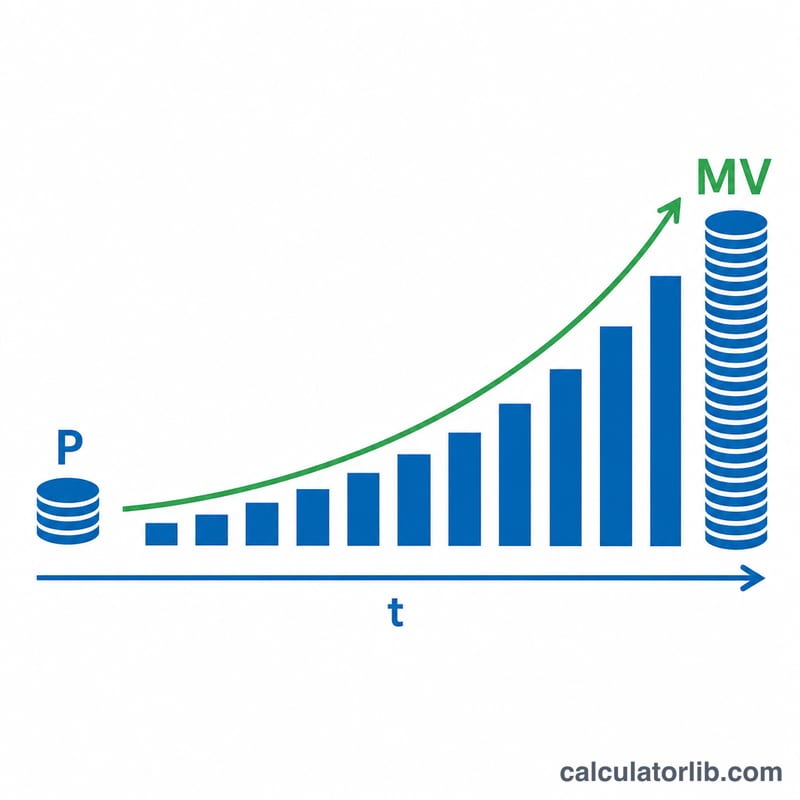
The maturity value is the total amount you receive when an investment or deposit reaches the end of its term. It is the sum of your original principal plus all the interest earned along the way. This calculator works for both fixed deposits, recurring savings, bonds and any lump-sum investment that grows at a known interest rate, supporting both simple and compound interest.
How to Use It
Enter the principal (the amount you invest today), the annual interest rate as a percentage, and the time in years. Choose whether interest is simple or compound. For compound interest, also pick how often interest is added — annually, semi-annually, quarterly, monthly or daily. The calculator instantly shows your maturity value, your original principal and the total interest earned.
The Formula Explained
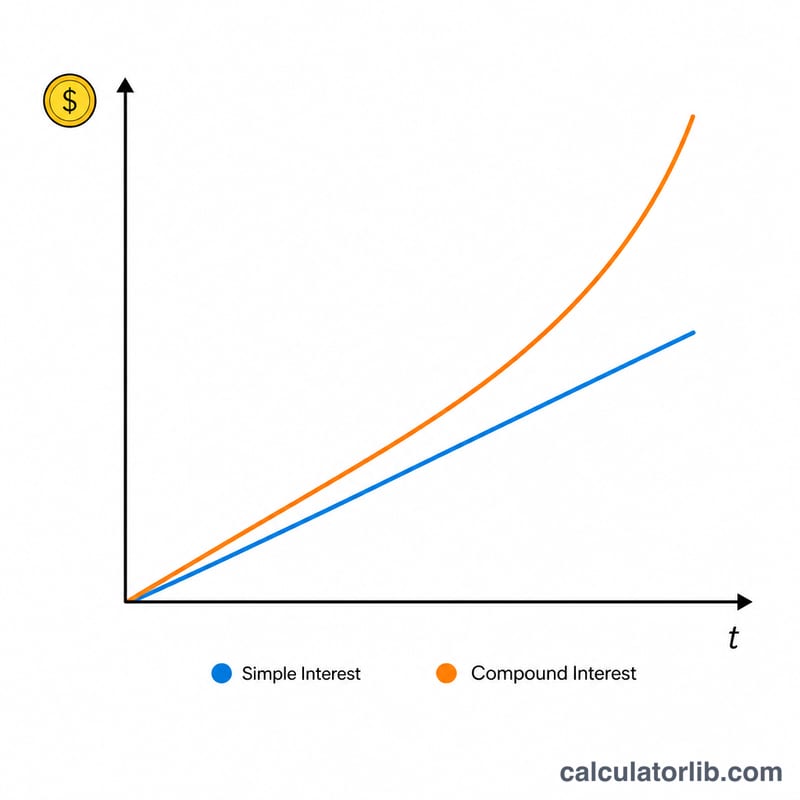
For simple interest, interest is calculated only on the principal: $$MV = P \times (1 + r \times t)$$ For compound interest, interest is added to the balance each period so you earn interest on interest: $$MV = P \times \left(1 + \frac{r}{n}\right)^{n \times t}$$ Here \(r\) is the rate as a decimal (5% = 0.05) and \(n\) is the number of compounding periods per year. The more frequently interest compounds, the higher the maturity value.
Worked Example
Invest $10,000 at 5% annual interest for 5 years, compounded monthly (n = 12). Then $$MV = 10{,}000 \times \left(1 + \frac{0.05}{12}\right)^{12 \times 5} = 10{,}000 \times (1.0041667)^{60} \approx \$12{,}833.59$$ The total interest earned is about $2,833.59. With simple interest instead, $$MV = 10{,}000 \times (1 + 0.05 \times 5) = \$12{,}500$$
FAQ
What is the difference between simple and compound interest? Simple interest is only calculated on the original principal, while compound interest is calculated on the principal plus previously accumulated interest, producing faster growth.
Does compounding frequency matter? Yes. More frequent compounding (e.g. daily vs annually) results in a slightly higher maturity value for the same rate.
Is the rate before or after tax? The calculator uses the nominal rate you enter. If your returns are taxed, enter your effective after-tax rate for a more accurate figure.