
What Is Enterprise Value?
Enterprise Value (EV) is a measure of a company's total value, often used as a more comprehensive alternative to market capitalization. While market cap only reflects the value of a company's equity, EV captures what it would actually cost to acquire the entire business: you take on its debt and other claims, but you also gain its cash. EV is the basis for popular valuation multiples such as EV/EBITDA and EV/Sales.
How to Use This Calculator
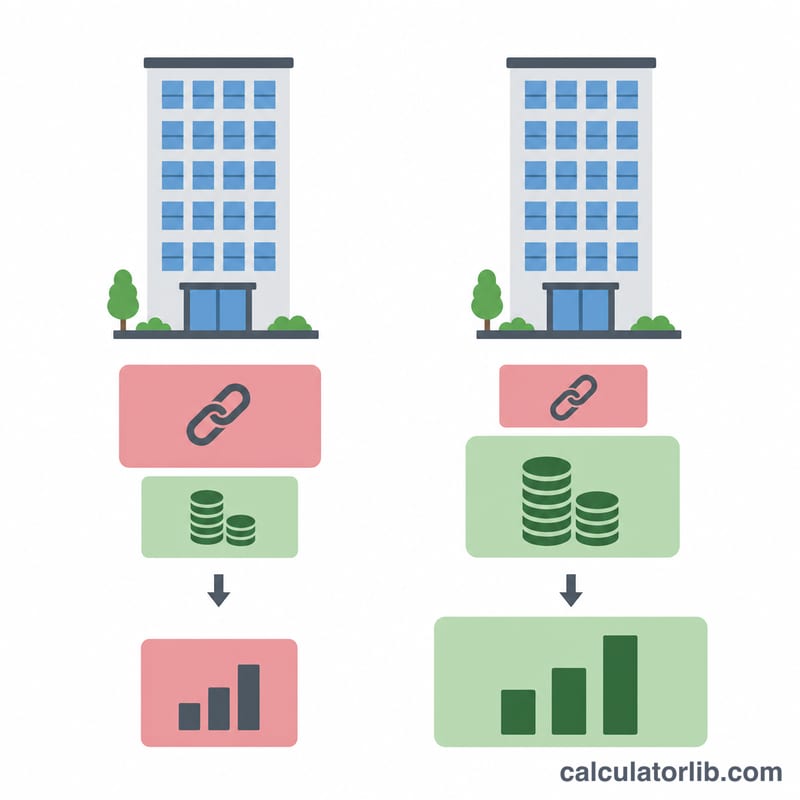
Enter the company's market capitalization (share price × shares outstanding), total debt (short- and long-term borrowings), any preferred equity and minority (non-controlling) interest, and the cash and cash equivalents on its balance sheet. The calculator instantly returns the Enterprise Value along with net debt for quick reference. Values can be entered in any currency unit as long as you are consistent.
The Formula Explained
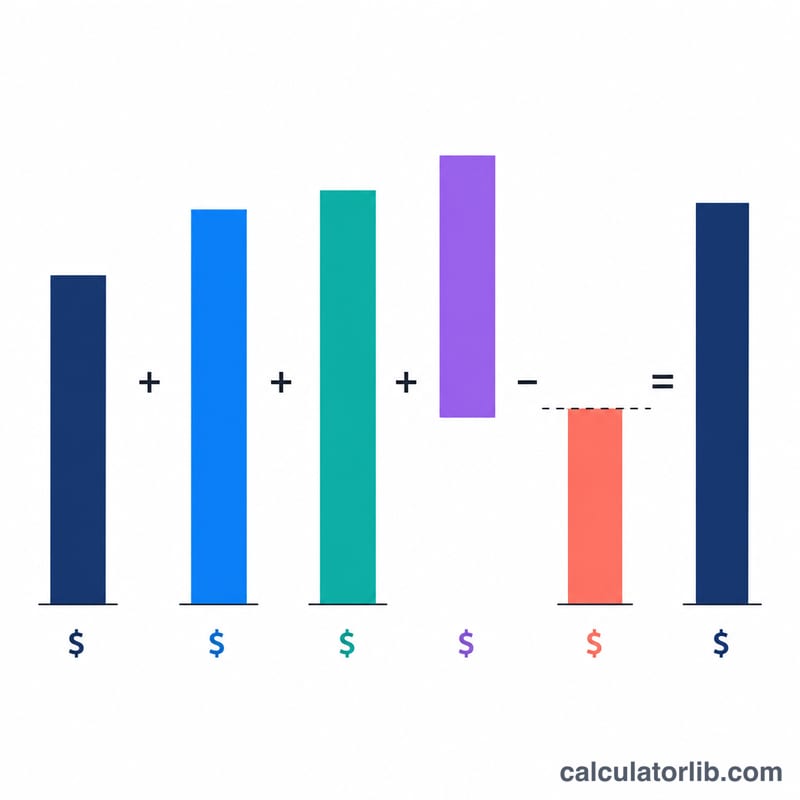
$$\text{EV} = \text{Market Cap} + \text{Total Debt} + \text{Preferred Equity} + \text{Minority Interest} - \text{Cash \& Equivalents}$$ Debt, preferred equity and minority interest are added because an acquirer assumes those obligations or third-party claims. Cash is subtracted because it could be used immediately to pay down debt, effectively reducing the net cost of the acquisition.
Worked Example
Suppose a company has a market cap of $1,000,000, total debt of $300,000, no preferred equity, no minority interest, and $100,000 in cash. $$\text{EV} = 1{,}000{,}000 + 300{,}000 + 0 + 0 - 100{,}000 = \$1{,}200{,}000$$ Net debt is \(300{,}000 - 100{,}000 = \$200{,}000\).
FAQ
Why subtract cash? A buyer can use the target's cash to immediately repay debt or recoup part of the purchase price, so cash lowers the effective acquisition cost.
Is EV always higher than market cap? No. If a company holds more cash than debt (and has no preferred/minority items), EV can be lower than market cap.
What is minority interest? It's the portion of a consolidated subsidiary owned by outside shareholders; it's added because the parent's financials include the full subsidiary but the parent doesn't own all of it.