
What is a Tenure Calculator?
A tenure calculator measures the length of service or duration between two dates — typically a start date (such as a hire date) and an end date (such as today or a leaving date). It expresses the result in a natural, calendar-aware breakdown of years, months and days, and also gives totals in days, months and years for quick comparisons.
How to use it
Enter the start date and the end date. The calculator returns the exact number of complete years, months and days between them, accounting for varying month lengths and leap years. It also reports the total number of days, the approximate total months, and the approximate total years.
The formula explained
The core idea is simple: \(\text{Tenure} = \text{End Date} - \text{Start Date}\). To present a calendar breakdown, the calculator subtracts the day, month and year components separately. If the day difference is negative, it borrows the number of days from the previous month; if the month difference is then negative, it borrows 12 months from the years. Total days are computed from the actual time elapsed, and approximate totals use 365.25 days per year and 30.4375 days per month to smooth out leap years.
$$\text{Tenure} = \text{End Date} - \text{Start Date}\;\Rightarrow\;\text{Years, Months, Days}$$$$\begin{gathered} \text{Total Days} = \text{End Date} - \text{Start Date} \\[1.5em] \text{where}\quad \left\{ \begin{aligned} \text{Total Years} &= \frac{\text{Total Days}}{365.25} \\ \text{Total Months} &= \frac{\text{Total Days}}{30.4375} \\ \text{Breakdown} &= \text{Years},\ \text{Months},\ \text{Days} \end{aligned} \right. \end{gathered}$$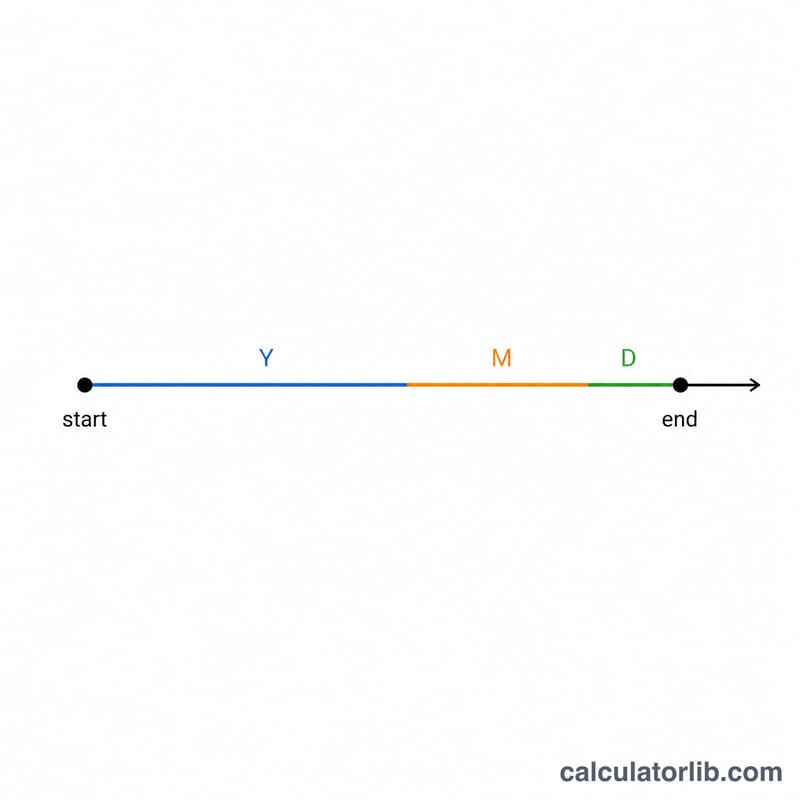
Worked example
From 1 January 2015 to 15 June 2024: the day part is \(15 - 1 = 14\), the month part is \(6 - 1 = 5\), and the year part is \(2024 - 2015 = 9\). So the tenure is 9 years, 5 months and 14 days, which is about 3,453 total days.
Tenure Across Common Start and End Dates
The rows below show how the same span of time is reported three ways: an exact anniversary-based breakdown (years, months, days), the true count of elapsed days, and that day count converted using average month and average year lengths (\(30.4375\) and \(365.25\) days). The breakdown follows the standard borrowing rule — when the end day-of-month is smaller than the start day-of-month, one month is borrowed and valued at the length of the month immediately before the end date; when the end month is earlier in the year than the start month, one year is borrowed as 12 months.
| Start date | End date | Exact breakdown | Total days | Total months (÷ 30.4375) | Total years (÷ 365.25) | What it shows |
|---|---|---|---|---|---|---|
| 31 Jan 2025 | 28 Feb 2025 | 0 y 0 m 28 d | 28 | 0.92 | 0.077 | Short-month borrowing: 28 < 31, so the month is borrowed at January's 31 days \((28-31+31=28)\) — no whole month is credited |
| 5 Mar 2026 | 20 Mar 2026 | 0 y 0 m 15 d | 15 | 0.49 | 0.041 | Same-month span: a plain day subtraction, no borrowing |
| 1 Sep 2024 | 1 Mar 2025 | 0 y 6 m 0 d | 181 | 5.95 | 0.496 | Exactly six calendar months is only 5.95 average months, because Sep–Feb are short months |
| 29 Feb 2020 | 28 Feb 2023 | 2 y 11 m 30 d | 1,095 | 35.98 | 2.998 | Leap-day start: 2023 has no 29 February, so the third anniversary is not yet reached — one day short of 3 years |
| 1 Jan 2015 | 31 Dec 2024 | 9 y 11 m 30 d | 3,652 | 119.98 | 9.999 | Near-decade: a "ten calendar years" span is one day short of 10 completed years (3 leap days: 2016, 2020, 2024) |
| 15 Jun 2016 | 11 Sep 2026 | 10 y 2 m 27 d | 3,740 | 122.87 | 10.240 | Crosses the 2020 and 2024 leap days; borrowing uses August's 31 days \((11-15+31=27)\) |
Check of the last row: 15 Jun 2016 + 10 years = 15 Jun 2026; + 2 months = 15 Aug 2026; + 27 days = 11 Sep 2026. Total months and total years are derived from the day count, not from the breakdown, which is why 0 y 6 m 0 d appears as 5.95 average months.
Key Terms and Definitions
- Start date (hire date)
- The first day of the period being measured — typically the first day of employment recorded by the employer. The calculator counts from this date forward.
- End date (leaving date or as-of date)
- The date the period is measured to: a last working day, a resignation or termination date, or simply today's date for current service.
- Tenure / length of service
- The amount of time elapsed between the start date and the end date, expressed as completed years, months and days, or as a single total (days, months, years).
- Continuous service vs. total service
- Continuous service is an unbroken span with one employer; total service may add several separate spells together and can ignore or bridge gaps. This calculator measures one span at a time — for a career with breaks, run each spell separately and add the results, and check whose definition of "continuous" applies.
- Elapsed days vs. inclusive day count
- An elapsed count is end minus start: 1 Jan to 2 Jan is 1 day. An inclusive count counts both endpoints: the same pair is 2 days. This tool reports elapsed days; add 1 if you need the inclusive "days worked" figure.
- Complete year / complete month (anniversary-based)
- A year or month is only credited when the corresponding anniversary date has been reached or passed. On 28 Feb 2025, someone who started 1 Mar 2024 has 11 complete months, not 1 year.
- Calendar year vs. average year (365.25 days)
- A calendar year is 365 or 366 days depending on leap years. The average year of 365.25 days is the mean over a four-year leap cycle and is used only to convert a day count into decimal years.
- Average month (30.4375 days)
- \(365.25 \div 12 = 30.4375\) days — the mean calendar month, used to express a day count as decimal months. No real month has this length.
- Leap year
- A year containing 29 February. In the Gregorian calendar a year is a leap year if it is divisible by 4, except centuries, which must be divisible by 400 (2000 was a leap year; 1900 was not).
- Anniversary date
- The same day-of-month and month as the start date in a later year — the point at which a further complete year of service is credited.
- Month-end borrowing
- The adjustment applied when the end day-of-month is smaller than the start day-of-month: one month is removed from the month count and converted to days using the length of the month immediately preceding the end date. This is what makes 31 Jan → 28 Feb come out as 28 days rather than 1 month.
Note on scope: this calculator measures elapsed calendar time only. It does not apply employer-specific or statutory service-crediting rules — for example rounding to whole months, part-time or hours-based credit, counting unpaid leave or layoff periods, bridging of prior service, or probation and notice rules. Those rules differ by employer, plan document and country, and can produce a service figure different from the elapsed time shown here.
Interpreting Your Tenure Result
Two different measurements, both correct. The years/months/days breakdown is anniversary-based and exact: it tells you how many complete years, then complete months, then leftover days have passed. The total-months and total-years figures are averages: they divide the exact day count by 30.4375 and 365.25, so they will rarely line up neatly with the breakdown.
Worked example — start 15 Oct 2015, end 29 Mar 2025. The breakdown is 9 years, 5 months, 14 days. The elapsed day count is 3,453 days, which converts to:
$$\text{Average months} = \frac{3453}{30.4375} \approx 113.45 \qquad \text{Average years} = \frac{3453}{365.25} \approx 9.45$$So 9 y 5 m 14 d, 113.45 months and 9.45 years all describe the same span. Use the breakdown when you need to state service formally ("9 years and 5 months"); use the decimal figures for averages, charts, pro-rating or spreadsheet work.
- The end date is a boundary, not a counted day. 1 Jan → 2 Jan is 1 day of elapsed time, not 2. If you need the number of days on the payroll inclusive of both the first and last day, add 1 to the total days.
- A 29 February start has no anniversary in common years. Someone who started 29 Feb 2020 reaches 2 y 11 m 30 d on 28 Feb 2023 and a full 3 years on 1 Mar 2023. Some employers and plans treat 28 February as the anniversary instead — that is a policy choice, not arithmetic.
- Month-end starts behave the same way. A 31 January start reaches its next monthly milestone on 28 February (or 29 February in a leap year) only if the rule used is "last day of month"; by strict date arithmetic, 31 Jan → 28 Feb is 28 days and no complete month.
- Small input errors matter at thresholds. One day either way can move a result across a whole-year boundary, as the 1 Jan 2015 → 31 Dec 2024 case shows (9 y 11 m 30 d, not 10 years). Re-check the exact start and end dates before relying on a milestone.
Milestones are defined elsewhere. Probation end dates, pension or equity vesting dates, notice-period and severance tiers, seniority ranking, holiday accrual bands and statutory service thresholds are all set by your employment contract, the plan document, a collective agreement or the employment law of the country you work in — and those rules vary widely from one jurisdiction to another. This calculator reports elapsed calendar time; it is general information, not legal, HR, tax or benefits advice, and it is not a determination of your entitlements. For anything with money or rights attached, confirm the figure against the governing document or with a qualified professional in your jurisdiction.
FAQ
Does it count the end date? The result is the elapsed span between the two dates; the end date itself is the boundary, not an extra full day.
Why are total years approximate? Because months and years vary in length, total years and months use average lengths (365.25 and 30.4375 days) so they stay consistent across leap years.
Can I use it for employment tenure? Yes — use your hire date as the start date and today's date (or your last working day) as the end date.