
What This Calculator Does
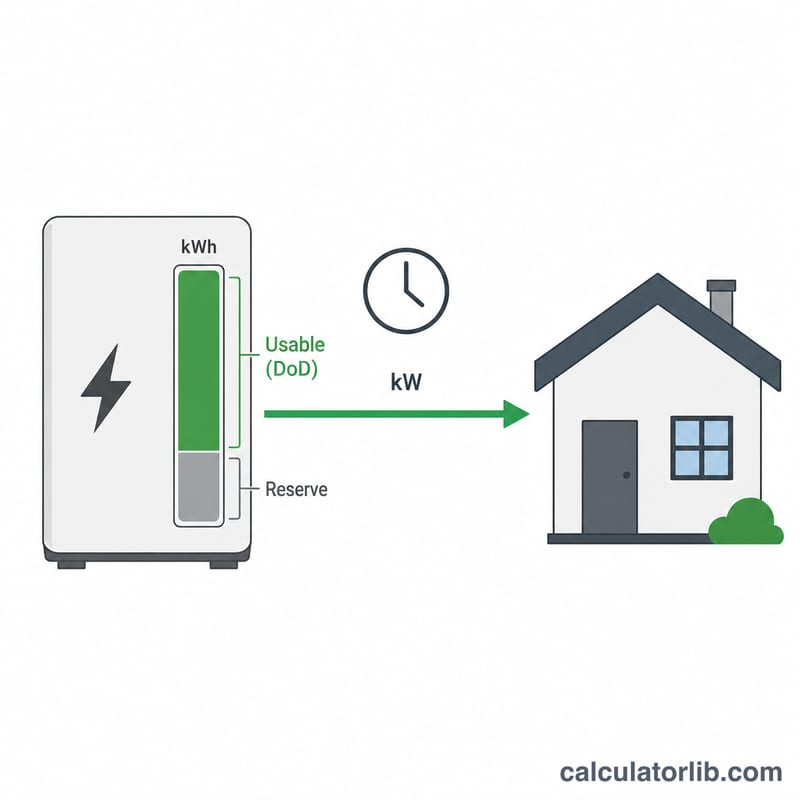
The Home Battery Backup Duration Calculator estimates how long a home energy storage system — such as a Tesla Powerwall, Enphase IQ Battery, or LG Chem unit — can keep your essential appliances running during a power outage. It works by dividing the usable energy stored in your battery by the average power your home draws.
How to Use It
Enter three values: your battery's rated capacity in kilowatt-hours (kWh), the usable depth of discharge as a percentage (most lithium home batteries allow 90–100%), and the average load your home draws in kilowatts (kW). The calculator returns the estimated number of hours the battery can sustain that load, broken down into hours and minutes.
The Formula Explained
The core equation is $$\text{Backup Hours} = \frac{\text{Battery (kWh)} \times \dfrac{\text{DoD (\%)}}{100}}{\text{Load (kW)}}$$ Depth of discharge (DoD) converts the rated capacity into the energy you can actually use without damaging the cells. Dividing that usable energy (in kWh) by your power demand (in kW) yields a result in hours, since \(\text{kWh} \div \text{kW} = \text{h}\).
Worked Example
Suppose you own a 13.5 kWh battery with a 100% usable depth of discharge, and during an outage your fridge, lights, router, and a few outlets pull about 1 kW on average. Usable energy = \(13.5 \times 1.00 = 13.5\) kWh. Backup time = \(13.5 \div 1 = 13.5\) hours, or 13 hours and 30 minutes.
FAQ
Why use depth of discharge? Discharging a lithium battery to 0% shortens its lifespan, so manufacturers specify a usable percentage. A 100% DoD means the full rated capacity is available.
What load should I enter? Use your average continuous draw during the outage, not the peak. Add up the wattage of devices you'll run and divide by 1000 to get kW.
Is the estimate exact? No. Real runtime varies with temperature, inverter efficiency (typically 90–95%), and fluctuating loads. Treat this as a planning estimate and keep a safety margin.