
What This Calculator Does
The Smart Home UPS/Battery Backup Runtime Calculator estimates how many hours a battery system or uninterruptible power supply (UPS) can keep your devices running during an outage. It works for any battery rated in watt-hours (Wh) — from small desktop UPS units to large home energy storage systems — and is independent of country or grid voltage.
How to Use It
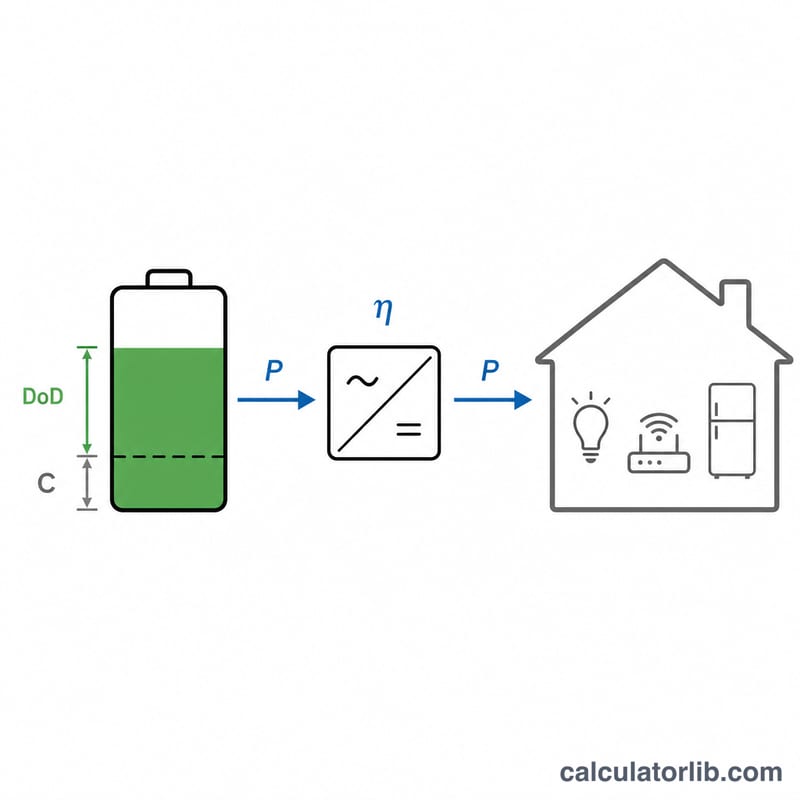
Enter four values: the battery capacity in watt-hours, the total continuous load in watts that you want to power, the inverter efficiency as a percentage, and the usable depth of discharge (DoD). DoD reflects how much of the battery you can safely use — lithium batteries often allow 80–100%, while lead-acid is typically limited to about 50% to protect battery life.
The Formula Explained
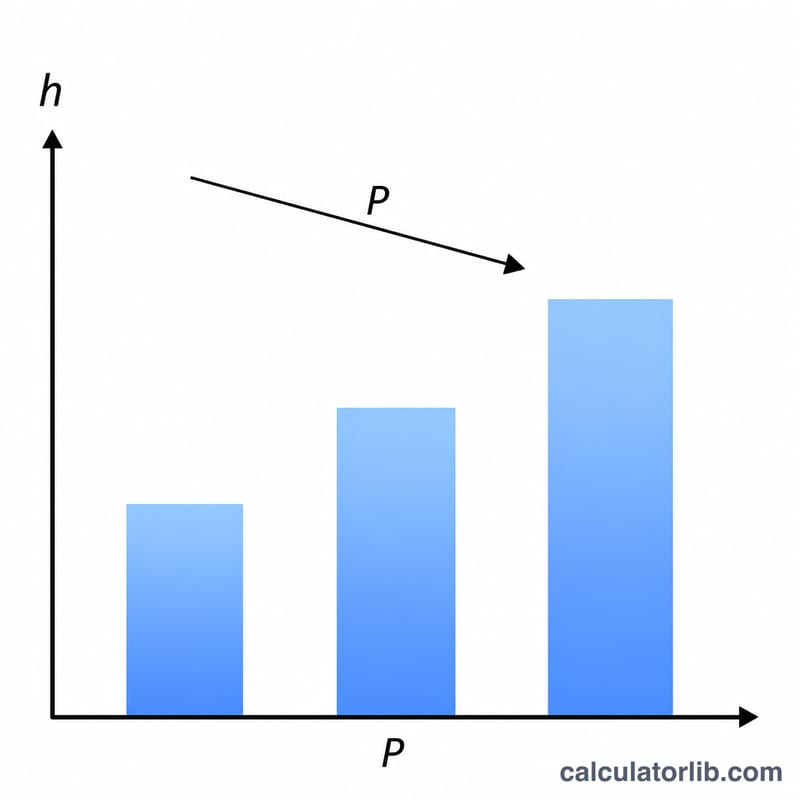
Runtime is the usable energy divided by the power draw, adjusted for conversion losses:
$$\text{Runtime (h)} = \frac{\text{Capacity (Wh)} \times \dfrac{\text{DoD (\%)}}{100} \times \dfrac{\text{Efficiency (\%)}}{100}}{\text{Load (W)}}$$
Capacity × DoD gives the energy you can actually pull from the battery. Multiplying by inverter efficiency accounts for losses when converting DC battery power to AC. Dividing by the load (in watts) yields the runtime in hours.
Worked Example
Suppose you have a 1000 Wh battery, a 150 W total load, 90% inverter efficiency, and 100% usable DoD. Usable energy = \(1000 \times 1.0 = 1000\) Wh. Runtime = $$\frac{1000 \times 0.9}{150} = \frac{900}{150} = \textbf{6 hours}$$ (360 minutes).
FAQ
Why is my real runtime shorter? Real-world factors like battery age, temperature, surge loads, and self-consumption of the inverter reduce runtime. Treat the result as an optimistic estimate.
How do I find total load in watts? Add the wattage of every device you plan to run. A router (10 W), modem (8 W), and laptop (60 W) together draw about 78 W.
What is depth of discharge? DoD is the percentage of the battery's capacity you can use without damaging it. Using 100% DoD on lithium is common; lead-acid batteries should usually stay around 50%.