
What Is the Smart Home Device Power Consumption Calculator?
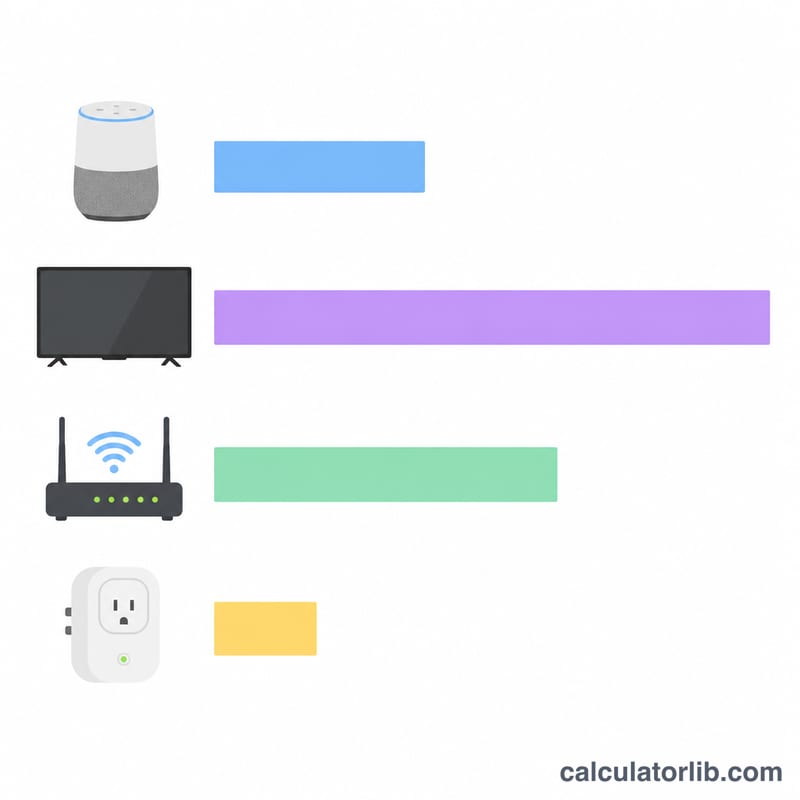
Many smart home gadgets — speakers, plugs, hubs, doorbells, TVs and chargers — never fully turn off. They sit in standby mode drawing a few watts around the clock. This calculator estimates the yearly electricity cost and energy use of that always-on "vampire" power, so you can see what those tiny watts add up to over a full year.
How to Use It
Enter the device's standby power draw in watts (check the spec sheet, a power meter, or estimate 1-10 W for typical smart devices), then enter your electricity price per kilowatt-hour (kWh). The calculator multiplies the standby draw by every hour of the year and converts it to a cost. You can run it once per device or use a combined total wattage for your whole home.
The Formula Explained
The core equation is:
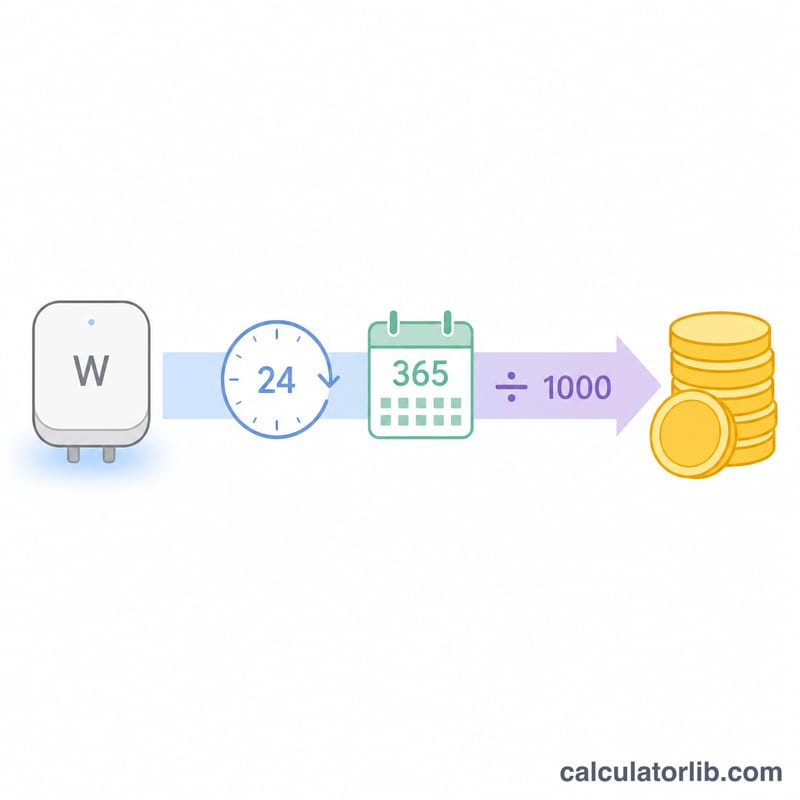
$$\text{Annual Cost} = \frac{\text{Standby (W)} \times 24 \times 365}{1000} \times \text{Cost per kWh}$$
There are 24 hours in a day and 365 days in a year, giving 8,760 hours. Multiplying watts by 8,760 gives watt-hours; dividing by 1,000 converts to kilowatt-hours (kWh). Multiplying by your electricity price gives the annual cost. We also estimate CO₂ emissions using a grid average of 0.4 kg per kWh.
Worked Example
Suppose a smart speaker draws 5 W in standby and electricity costs $0.15/kWh. Annual energy = $$5 \times 24 \times 365 \div 1000 = 43.8 \text{ kWh}.$$ Annual cost = $$43.8 \times 0.15 = \$6.57.$$ Across ten such devices that is over $65 a year just for standby.
FAQ
What counts as standby power? It is the electricity a device uses while plugged in but not actively performing its main task — keeping Wi-Fi alive, listening for commands, or showing a status light.
How do I find my standby wattage? Use an inexpensive plug-in power meter, or check the manufacturer's specifications. Typical smart devices draw 1-10 W.
Is the CO₂ figure exact? No — it uses a 0.4 kg/kWh average. Your actual grid emissions vary by region and energy mix.