
What Is the Ceiling Fan Size Calculator?
Choosing the right ceiling fan size is essential for efficient air circulation and a balanced look in any room. A fan that's too small won't move enough air, while one that's too large can overpower a small space. This calculator recommends a ceiling fan blade span (in inches) based on the floor area of your room, using widely accepted industry sizing guidelines.
How to Use It
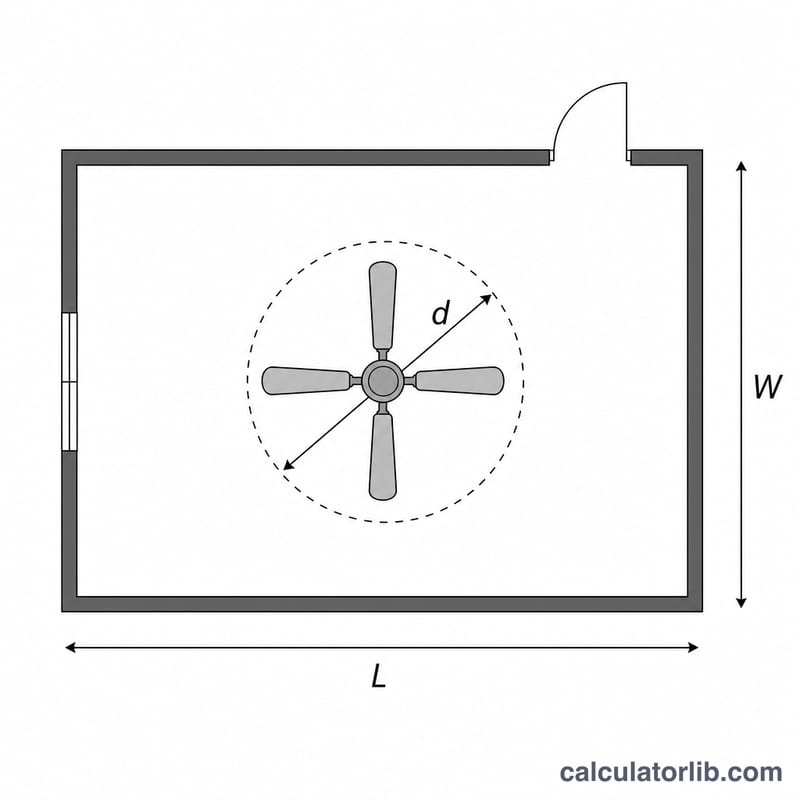
Measure your room's length and width in feet and enter both values. The calculator multiplies them to find the floor area, then matches that area to a recommended blade span. Blade span is the diameter of the circle the blades trace — typically the most important sizing dimension for a ceiling fan.
The Formula Explained
First the area is calculated as \(A = \text{Length} \times \text{Width}\). Then the recommended span is selected by thresholds:
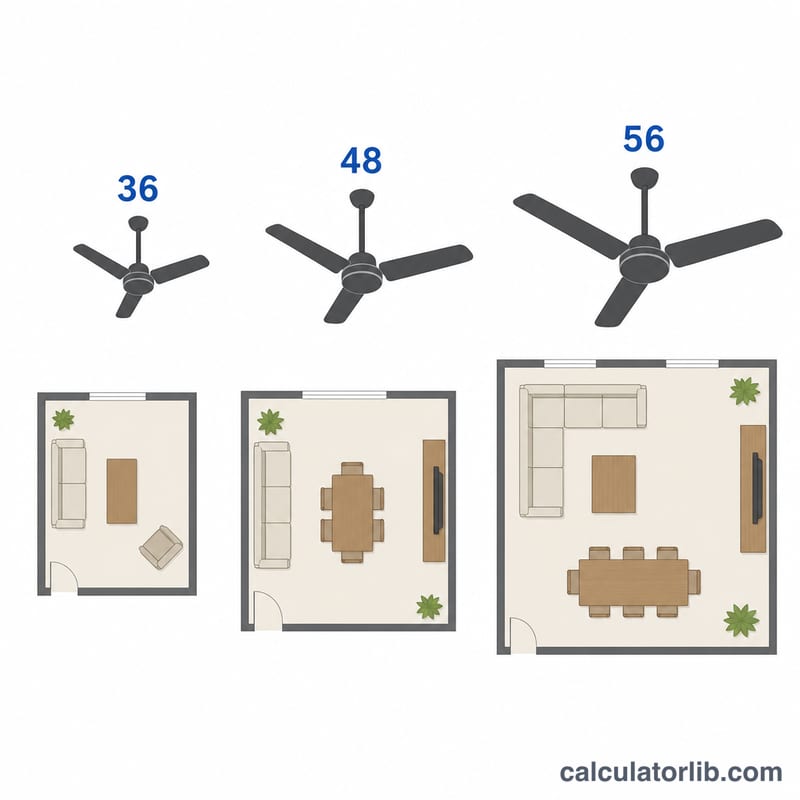
$$\text{Span} = \begin{cases} 36" & \text{Area} \le 75 \\ 48" & 75 < \text{Area} \le 144 \\ 56" & \text{Area} > 144 \end{cases}$$rooms up to 75 sq ft suit a 36-inch fan, rooms between 75 and 144 sq ft suit a 48-inch fan, and larger rooms call for a 56-inch fan. These breakpoints reflect common manufacturer recommendations for bedrooms, living rooms, and great rooms.
Worked Example
Suppose your living room is 12 ft by 12 ft. The area is $$12 \times 12 = 144 \text{ sq ft}.$$ Since 144 falls within the 75–144 range, the recommended blade span is 48 inches — a versatile size ideal for medium-sized rooms.
FAQ
Should I measure ceiling height too? Ceiling height affects mounting (downrod length), not blade span. For ceilings over 9 ft, use a longer downrod so the fan hangs 8–9 ft above the floor.
What if my room is very large? For rooms above ~225 sq ft, consider two fans or a 60-inch-plus model. This calculator caps at the 56-inch recommendation.
Is bigger always better? No — an oversized fan in a small room looks awkward and may circulate air too aggressively. Match the span to the room area for the best balance.