
What This Calculator Does
The Solar Battery Home Backup Sizing Calculator estimates how much battery storage capacity (in kilowatt-hours) you need to keep your home powered during a grid outage or off-grid period. It takes your daily energy consumption, the number of days you want to ride through, and your battery's safe depth of discharge to produce a recommended rated capacity. This tool is universal and works with any battery chemistry or brand.
How To Use It
Enter your average daily energy use in kWh (check your utility bill — a typical home uses 20–40 kWh/day). Set how many days of autonomy you want. Enter the battery's depth of discharge (DoD): lithium batteries often allow 90–100%, while lead-acid is commonly limited to 50%. Optionally adjust round-trip efficiency to account for charge/discharge losses (typically 90–95%).
The Formula Explained
The core equation is:
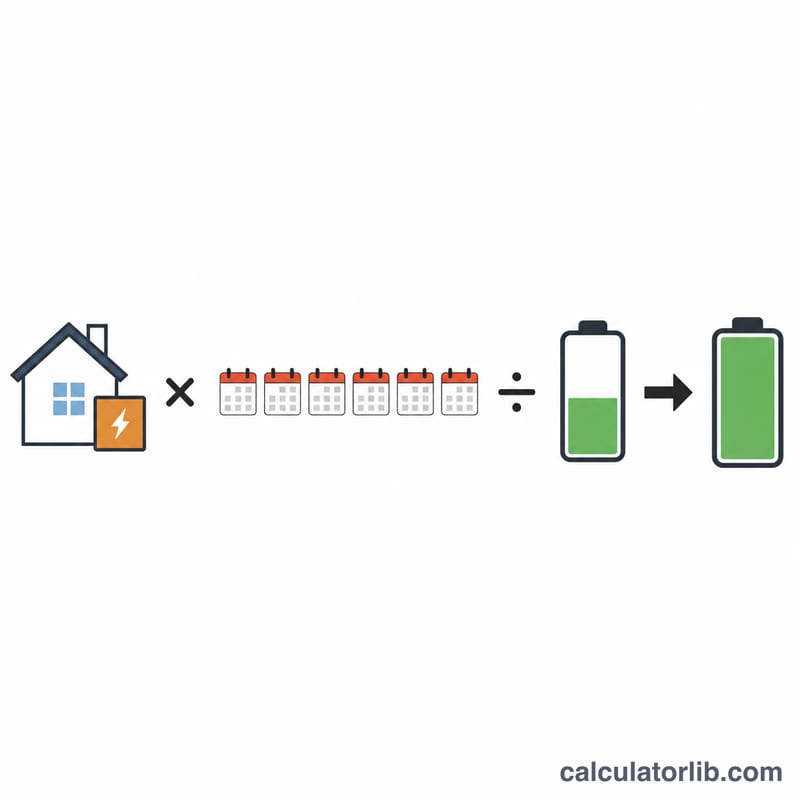
$$\text{Battery (kWh)} = \frac{\text{daily kWh} \times \text{backup days}}{\text{depth of discharge}}$$
The numerator is the total energy you must deliver over the backup period. Dividing by depth of discharge converts that usable energy into the larger rated capacity you must buy, because you should not fully drain a battery. A second figure further divides by efficiency to cover energy lost in conversion.
Worked Example
Suppose your home uses 30 kWh per day and you want 2 days of backup with a battery rated to 90% depth of discharge. Energy needed = \(30 \times 2 = 60\) kWh. Rated capacity = \(60 \div 0.90 = 66.67\) kWh. Allowing for 95% efficiency, you'd want about \(66.67 \div 0.95 = 70.18\) kWh of storage.
FAQ
What depth of discharge should I use? Use the manufacturer's recommended figure — around 90–100% for lithium (LFP/NMC) and about 50% for lead-acid.
Should I include efficiency? Yes, for accuracy. Real batteries and inverters lose 5–15% of energy, so the efficiency-adjusted figure is the safer number to size to.
How do I find my daily kWh use? Divide your monthly utility usage by 30, or check a smart meter. For backup, you may only need to power essential loads, which lowers the requirement.