

What Is the PTO Accrual Calculator?
This calculator estimates how much paid time off (PTO) you have earned based on the number of hours you have worked. Many employers grant PTO on an accrual basis — you earn a set amount of paid leave for every period (or every hour) worked, rather than receiving a lump sum at the start of the year. By entering your hours worked, the length of a full accrual period, and the PTO granted per full period, you instantly see your accrued balance in hours and in 8-hour days.
How to Use It
Enter three values: Hours Worked so far, Hours per Full Period (the hours that correspond to a full PTO grant — e.g. 2080 for a full year of full-time work, or 80 for a two-week pay period), and PTO Earned per Full Period in hours. The result shows accrued PTO hours, the equivalent in standard 8-hour days, and your effective accrual rate per hour worked.
The Formula Explained
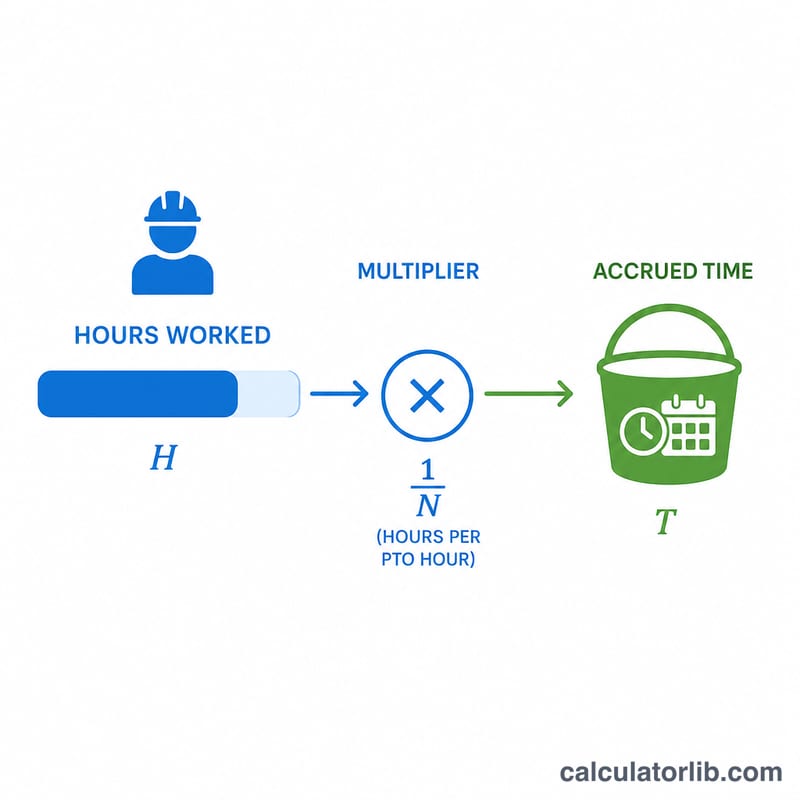
The accrual is simply proportional:
$$\text{PTO Accrued (hrs)} = \frac{\text{Hours Worked}}{\text{Hours per Period}} \times \text{PTO per Period}$$
The fraction \(\frac{\text{Hours Worked}}{\text{Hours per Period}}\) is the share of a full period you have completed. Multiplying by the PTO granted per full period scales that share into earned PTO hours.
Worked Example
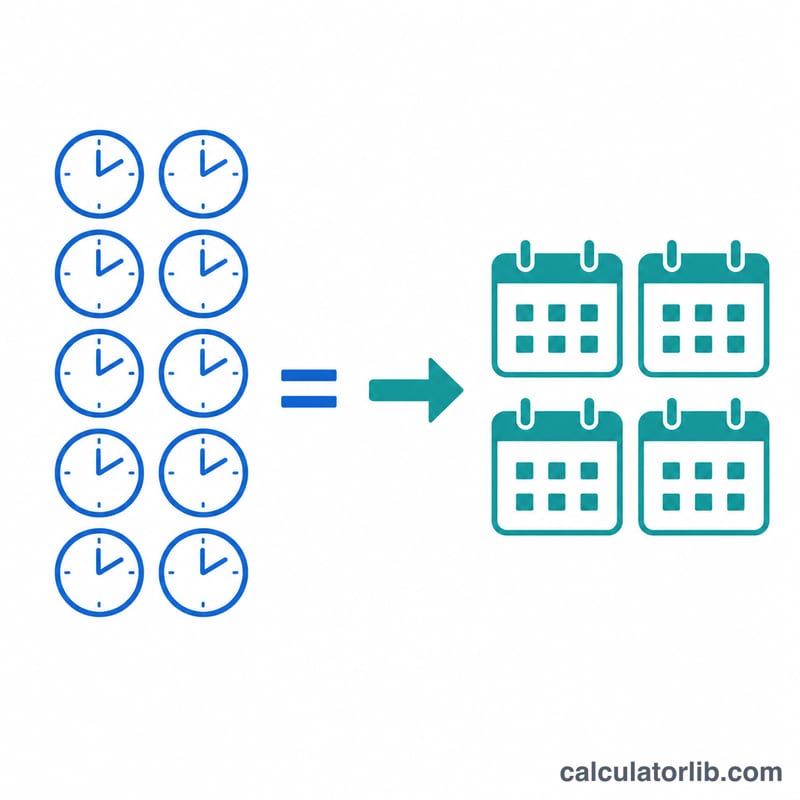
Suppose a full-time employee earns 80 hours of PTO per year, a full year is 2080 working hours, and they have worked 1040 hours so far. Their accrued PTO is $$\frac{1040}{2080} \times 80 = 0.5 \times 80 = 40 \text{ hours},$$ which equals 5 eight-hour days. Their accrual rate is \(\frac{80}{2080} \approx 0.0385\) PTO hours per hour worked.
FAQ
Does this work for any pay frequency? Yes. Set "Hours per Full Period" to match your accrual basis — annual (2080), monthly (~173.33), biweekly (80), or weekly (40).
Why convert to days? Many people think in vacation days. We assume an 8-hour workday; divide your hours by your own day length if it differs.
Is this official advice? No. PTO rules vary by employer, contract, and local law (including caps, rollovers, and waiting periods). Use this as an estimate and confirm with your HR policy.