

What this calculator does
The Freelance Hourly Rate Calculator tells you the minimum hourly rate you should charge clients to reach your income goal while still covering your business costs. Many freelancers undercharge because they forget that not every working hour is billable, and that expenses such as software, insurance, taxes set-aside, and equipment eat into earnings. This tool turns your real targets into a concrete number.
How to use it
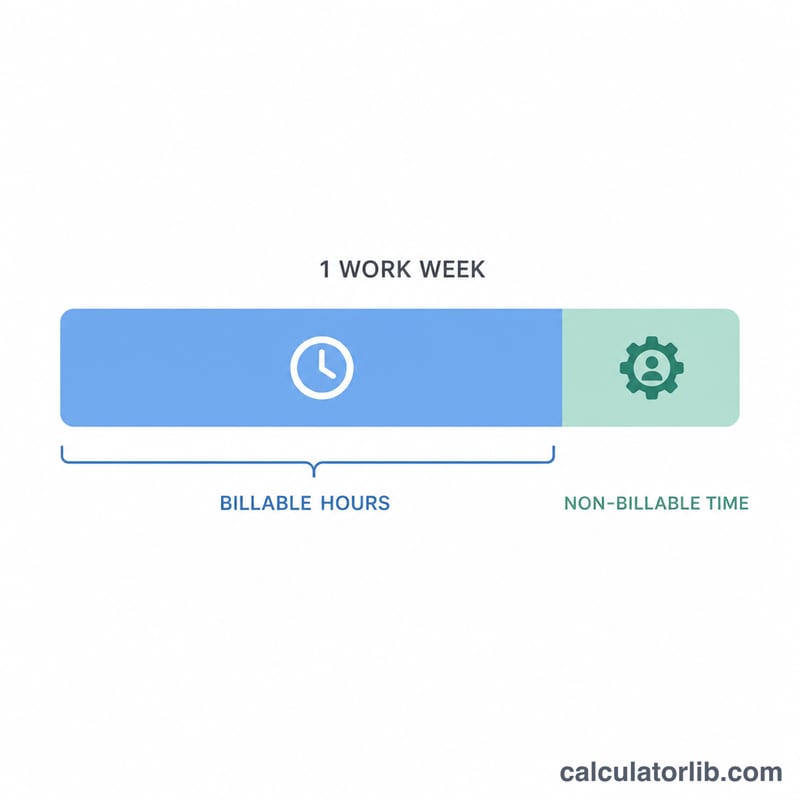
Enter four things: your target annual income (the money you want to keep before personal taxes), your annual business expenses, the number of working weeks you plan each year (subtract holidays and time off from 52), and the realistic billable hours per week you can actually invoice — usually far fewer than the hours you work, because admin, marketing, and emails are not billable.
The formula explained
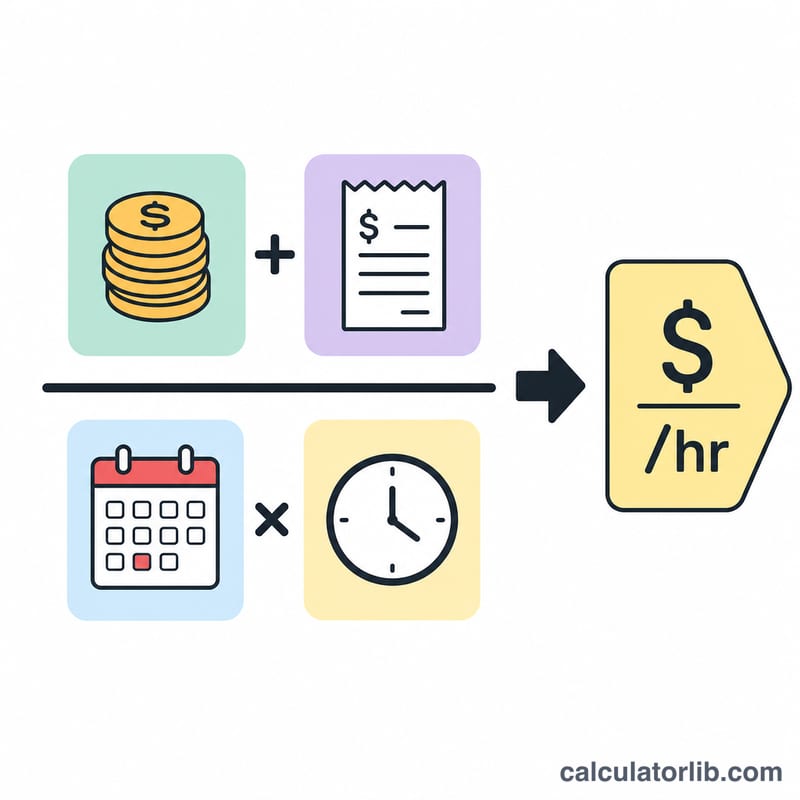
The math is simple: add your income goal and your expenses to get the total you must generate, then divide by the total billable hours you have available in a year.
$$\text{Hourly Rate} = \frac{\text{Target Income} + \text{Expenses}}{\text{Weeks} \times \text{Hours/Week}}$$
Worked example
Suppose you want to take home $60,000, expect $8,000 in business expenses, plan to work 46 weeks, and can bill 25 hours per week. Billable hours per year = \(46 \times 25 = 1{,}150\). Total needed = \(60{,}000 + 8{,}000 = 68{,}000\). Hourly rate = $$68{,}000 \div 1{,}150 \approx \$59.13/\text{hour}.$$
FAQ
Why are billable hours lower than working hours? Running a freelance business means unpaid time for finding clients, invoicing, and learning — often 30–50% of your week, so be honest about hours you can actually charge for.
Should I include taxes? This figure is your pre-personal-tax revenue. Add a buffer to your target income or expenses to cover self-employment taxes in your country.
Can I use this for project pricing? Yes — multiply the resulting hourly rate by your estimated project hours to set a fair fixed price.