
What Is the Salary to Hourly Rate Calculator?
This calculator turns a fixed annual salary into the equivalent hourly rate so you can compare salaried roles with hourly jobs, freelance gigs, or contract offers on equal footing. Many salaried employees never know what they actually earn per hour — especially once long weeks are factored in. By entering your salary and the hours you really work, you get your true hourly worth.
How to Use It
Enter three values: your gross annual salary, the number of hours you work in a typical week, and the number of weeks you work each year (use 52 if you work all year, or fewer if you take unpaid time off). The calculator instantly returns your hourly rate, plus equivalent daily, weekly and monthly figures and your total hours worked per year.
The Formula Explained
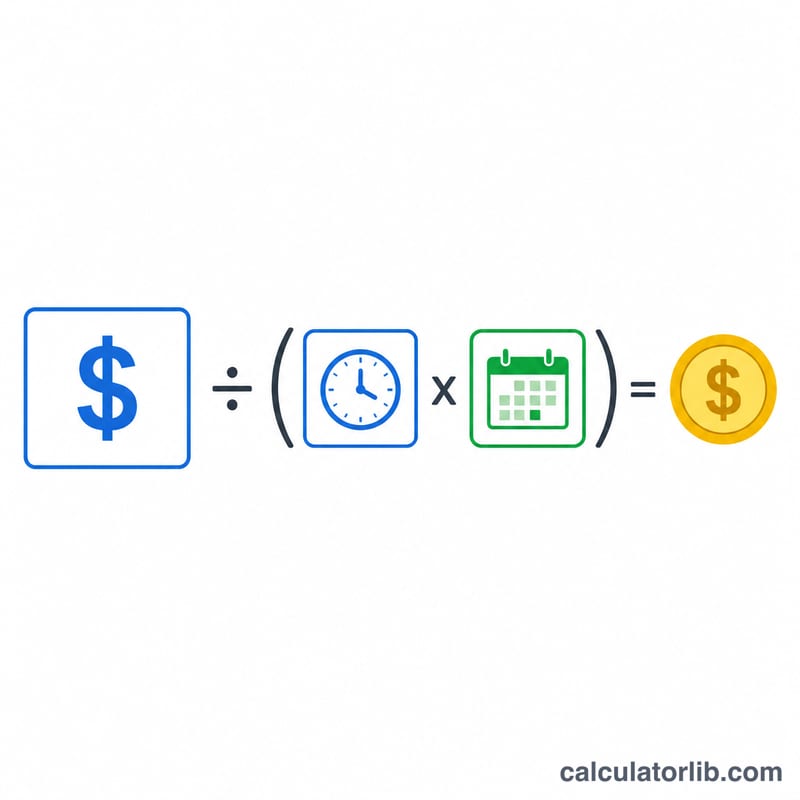
The core equation is simple:
$$\text{Hourly Rate} = \frac{\text{Annual Salary}}{\text{Hours per Week} \times \text{Weeks per Year}}$$
First we calculate total annual hours by multiplying weekly hours by weeks worked. Dividing the salary by that figure gives the hourly rate. Daily pay assumes a 5-day week (hourly × hours ÷ 5), weekly pay is hourly × weekly hours, and monthly pay is simply the salary divided by 12.
Worked Example
Suppose you earn a $52,000 salary, work 40 hours a week, and work all 52 weeks of the year. Total annual hours = \(40 \times 52 = 2{,}080\). Hourly rate = \(52{,}000 \div 2{,}080 = \mathbf{\$25.00}\) per hour. If instead you grind 50 hours a week, your true rate drops to \(52{,}000 \div (50 \times 52) = \$20.00\) — revealing how overtime erodes effective pay.
FAQ
Should I use 52 weeks? Use 52 if you are paid for all weeks including vacation. If you take unpaid leave, subtract those weeks for a more accurate rate.
Is this before or after tax? It is based on gross salary, so the result is your pre-tax hourly rate.
Why include hours actually worked? A salary covering 60-hour weeks is worth far less per hour than the same salary for 35-hour weeks. Using real hours shows your genuine value.