

What this calculator does
The Salary vs Hourly Equivalent Comparison Calculator turns a fixed annual salary into the hourly rate it actually represents, based on how many hours you really work. This makes it easy to compare a salaried job offer with an hourly position, or to understand the true value of your own time. It is currency-neutral, so the figures work in any country — just enter the amounts in your local currency.
How to use it
Enter your gross annual salary, the number of hours you work in a typical week, and the number of weeks you work per year (use 52 for a full year, or fewer to account for unpaid leave). The calculator instantly shows your equivalent hourly rate along with weekly, monthly and annual breakdowns and the total hours you put in over the year.
The formula explained
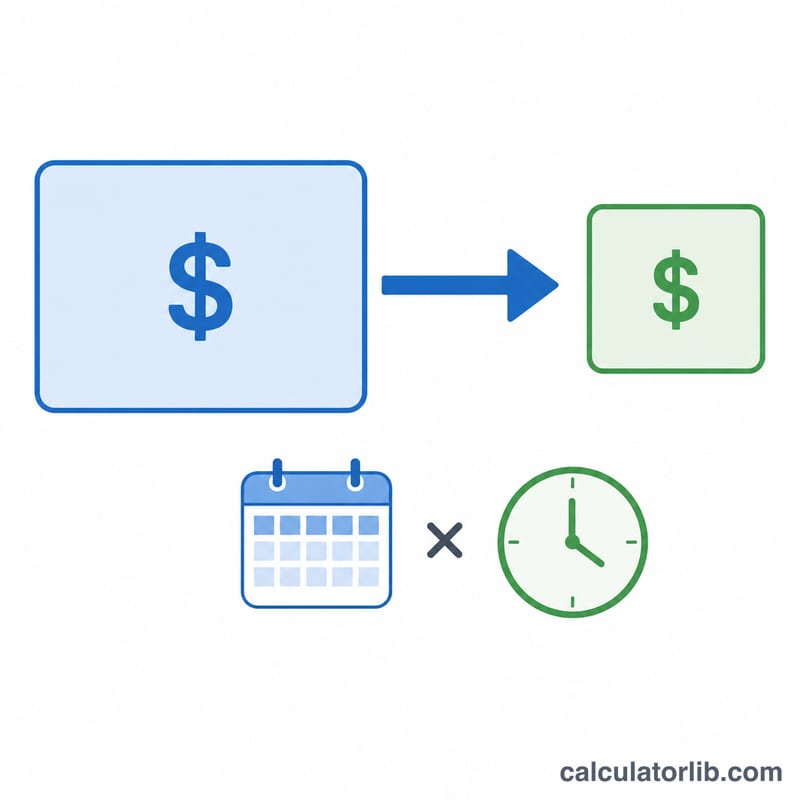
The core calculation is simple: $$\text{Hourly} = \frac{\text{Annual Salary}}{\text{Hours/Week} \times \text{Weeks/Year}}$$ The denominator is the total number of hours you actually work in a year. Dividing your salary by those hours reveals what each hour of work is really worth. Note that a salaried role with long hours can have a surprisingly low effective hourly rate.
Worked example
Suppose you earn a $52,000 salary, work 40 hours per week and 52 weeks per year. Total hours = \(40 \times 52 = 2{,}080\). Hourly equivalent = \(52{,}000 \div 2{,}080 = \) $25.00 per hour. Your monthly pay is \(52{,}000 \div 12 \approx \$4{,}333.33\), and weekly pay is \(52{,}000 \div 52 = \$1{,}000\).

FAQ
Should I use 52 weeks? Use 52 if you are paid during vacation. If you take unpaid weeks off, subtract them to get a more accurate hourly figure.
Does this include overtime or bonuses? No — it uses base salary and base hours. Add bonuses to the salary field if you want them reflected.
Is this before or after tax? The result uses whatever number you enter. Enter gross salary for a pre-tax rate or net salary for a take-home rate.