
What This Calculator Does
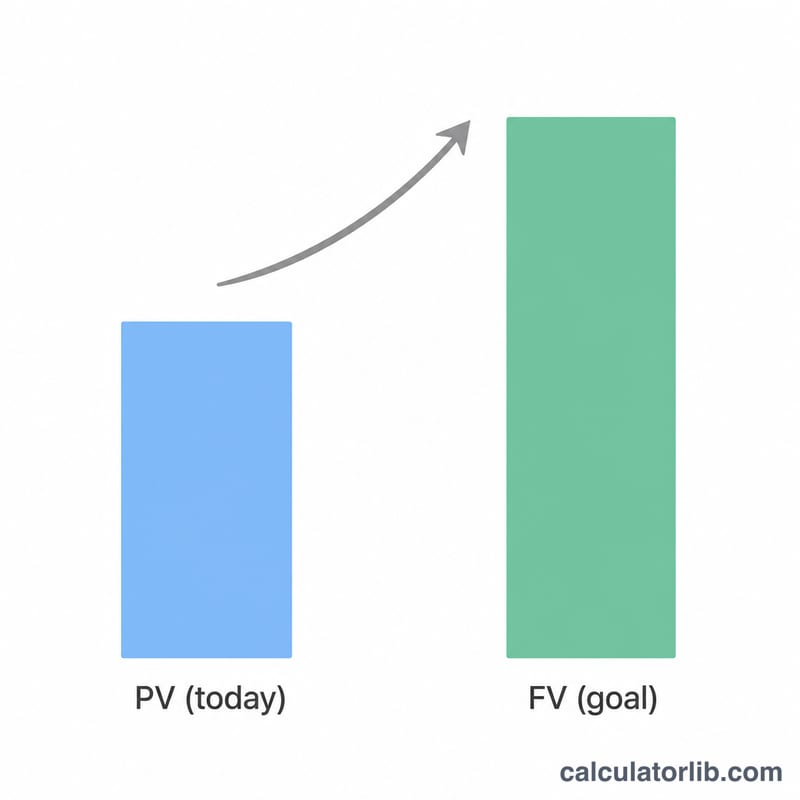
This calculator answers a common savings question: how much do I need to invest right now, as a single lump sum, so that it grows into a specific amount by a future date? It computes the present value of your goal — the deposit that, left to compound at a fixed annual rate, will reach your target. This is universal math and applies in any country or currency.
How to Use It
Enter three values: your future goal amount (the sum you want to have), the annual interest or growth rate you expect, and the number of years until you need the money. The calculator returns the single deposit required today, plus the total interest that deposit will earn along the way.
The Formula Explained
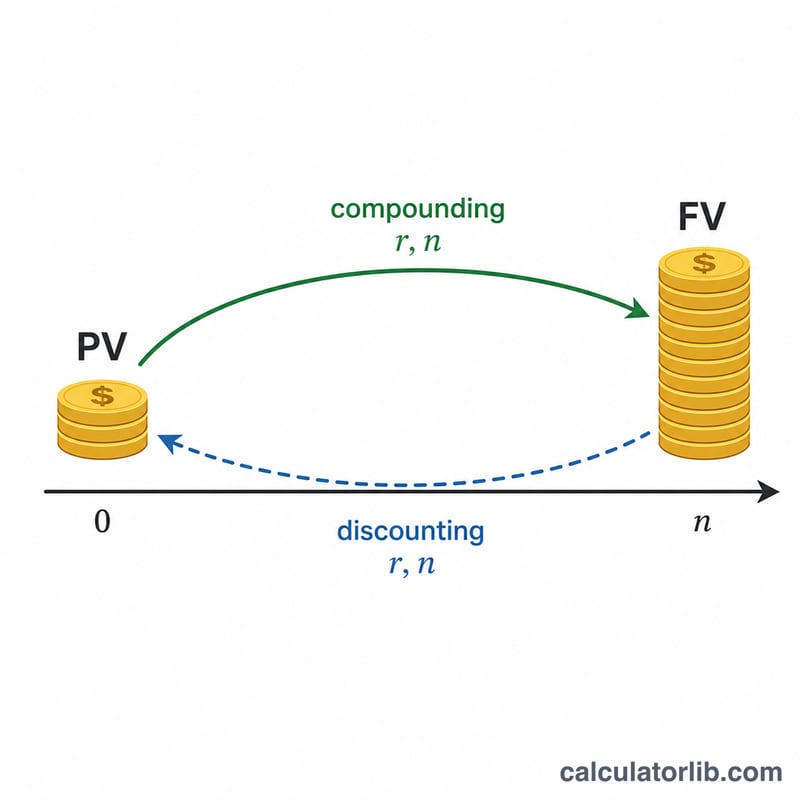
The present value formula is $$PV = \frac{FV}{(1 + r)^n}$$ where FV is the future goal, r is the decimal annual rate (5% = 0.05), and n is the number of years. The denominator \((1 + r)^n\) is the compounding growth factor; dividing the goal by it "discounts" the amount back to today's dollars. A higher rate or longer horizon means a smaller deposit is needed now.
Worked Example
Suppose you want $10,000 in 10 years and expect 5% annual growth. The growth factor is \((1.05)^{10} \approx 1.62889\). Dividing: $$\$10{,}000 / 1.62889 \approx \$6{,}139.13$$ So a one-time deposit of about $6,139 today grows to your $10,000 goal, earning roughly $3,861 in interest.
FAQ
Does this assume monthly compounding? No — it uses annual compounding. For other frequencies, convert your rate and periods accordingly.
What if I plan regular contributions too? This tool covers a single lump sum only. Recurring deposits require an annuity (PMT) calculation.
Can the rate be 0%? Yes. With a 0% rate the deposit needed equals the goal exactly, since no growth occurs.