
What This Calculator Does
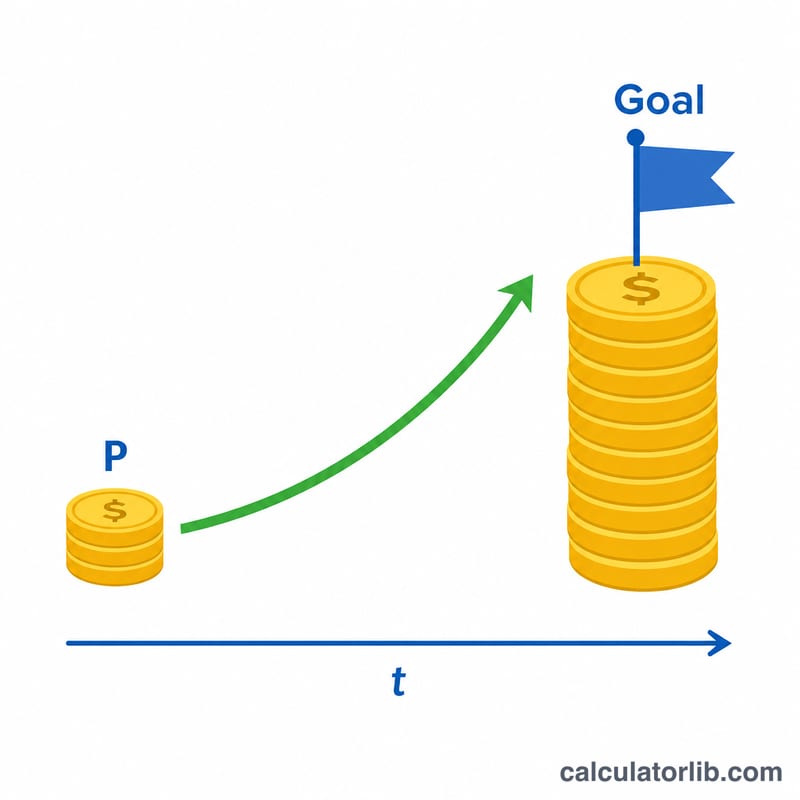
The Initial Deposit Needed for a Goal Calculator tells you the single lump sum you must invest or deposit today so that, with compound interest, it grows to a specific target amount by a future date. This is the present value of a future goal — useful for planning a down payment, a child's tuition fund, a wedding, or any one-time financial milestone.
How to Use It
Enter your savings goal (the future amount you want), the annual interest rate you expect to earn, the number of years until you need the money, and how often interest compounds. The calculator returns the deposit required now, the goal, and how much of that goal comes from interest rather than your own money.
The Formula Explained
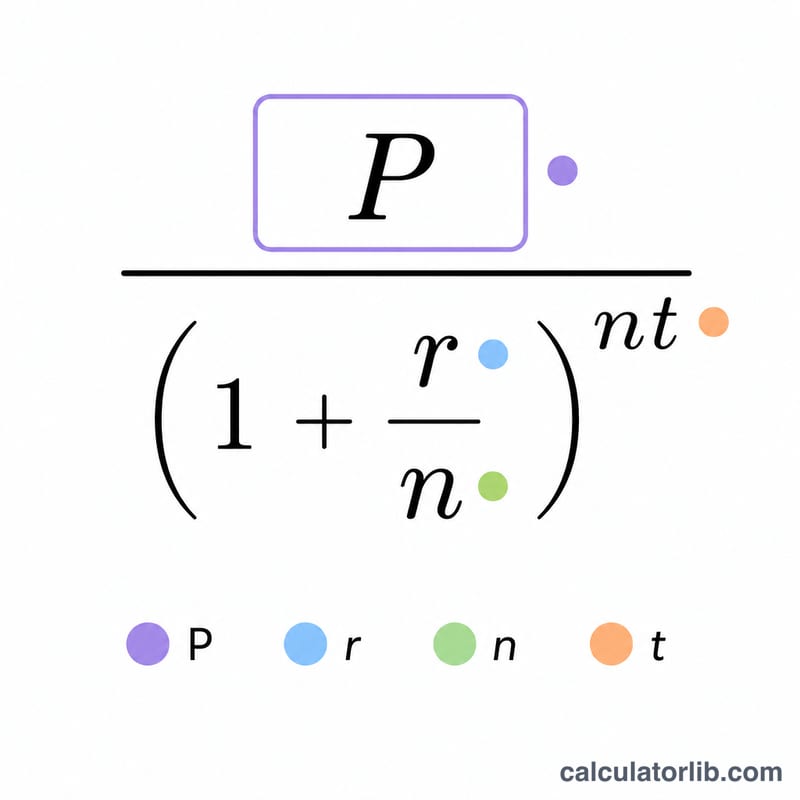
The core equation is $$P = \dfrac{\text{Goal}}{\left(1 + \dfrac{r}{n}\right)^{n \times t}}$$ Here r is the annual interest rate as a decimal, n is the number of compounding periods per year, and t is the number of years. Dividing the goal by the compound growth factor "discounts" the future value back to today's dollars.
Worked Example
Suppose you want $10,000 in 10 years at a 5% annual rate compounded monthly (\(n = 12\)). The growth factor is $$\left(1 + \frac{0.05}{12}\right)^{12 \times 10} \approx 1.6470$$ So $$P = \frac{10{,}000}{1.6470} \approx \$6{,}071.34$$ Deposit that amount today and compound interest does the rest, earning about $3,928.66.
FAQ
Does this assume any additional contributions? No — this is for a single lump-sum deposit with no further additions. For regular monthly savings, use a recurring-deposit goal calculator instead.
What if my rate is 0%? With no interest the growth factor is 1, so the required deposit simply equals your goal.
Which compounding frequency should I pick? Match it to your account: most savings accounts and many investments compound monthly or daily, while some bonds and CDs compound semi-annually or annually.