
What Is a Certificate of Deposit (CD)?
A certificate of deposit is a fixed-term savings product offered by banks and credit unions. You deposit a lump sum for a set period — the term — and the institution pays a guaranteed interest rate. Because the rate is locked in and the deposit is typically insured, CDs are a low-risk way to grow savings. This calculator shows how much your CD will be worth at maturity, how much interest you will earn, and the effective annual yield (APY).
How to Use This Calculator
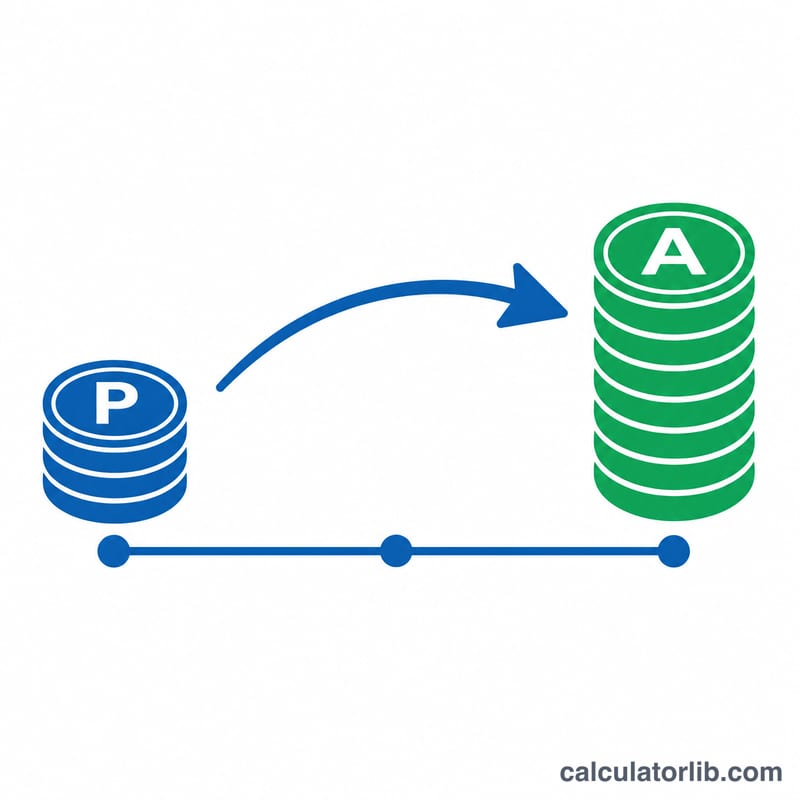
Enter your initial deposit, the advertised annual interest rate (APR), the length of the term in years, and how often interest compounds (monthly, quarterly, annually, etc.). The calculator instantly returns the maturity value, total interest earned, and APY. Try different terms and compounding frequencies to compare CD offers from different banks.
The Formula Explained
The growth of a CD follows compound interest: $$A = P\left(1 + \frac{r}{n}\right)^{n\,t}$$ Here \(P\) is your principal, \(r\) is the annual rate as a decimal, \(n\) is the number of compounding periods per year, and \(t\) is the term in years. The more frequently interest compounds, the slightly higher your return. The APY restates the rate as a single effective yearly figure: $$\text{APY} = \left(1 + \frac{r}{n}\right)^{n} - 1$$
Worked Example
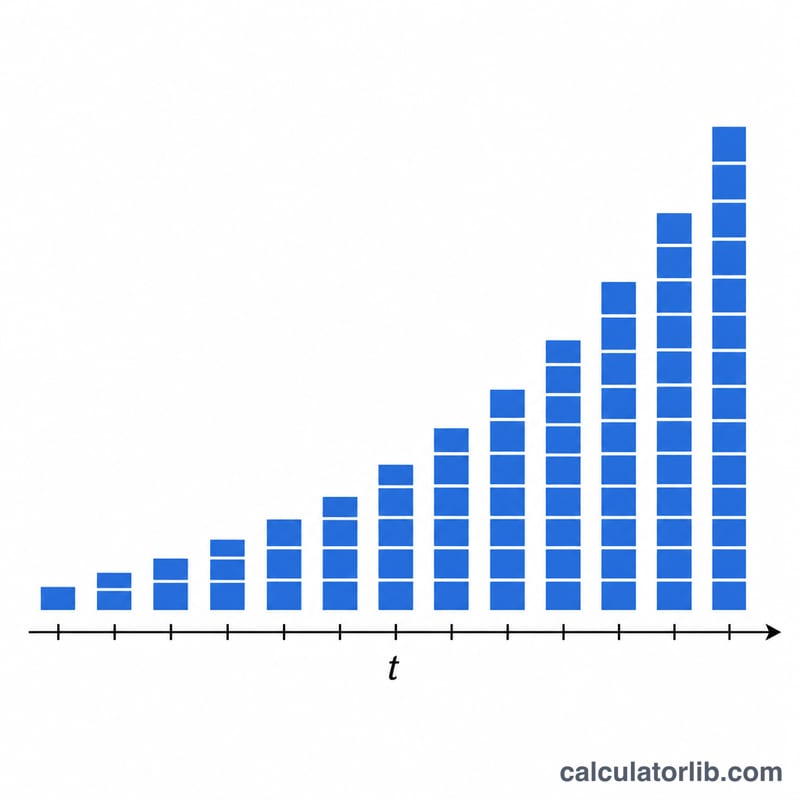
Suppose you deposit $10,000 in a 5-year CD paying 4.5% APR compounded monthly. Then \(P = 10{,}000\), \(r = 0.045\), \(n = 12\), \(t = 5\). The maturity value is $$A = 10{,}000 \times \left(1 + \frac{0.045}{12}\right)^{60} \approx \$12{,}517.96,$$ meaning you earn about $2,517.96 in interest. The APY is $$\left(1 + \frac{0.045}{12}\right)^{12} - 1 \approx 4.59\%.$$
FAQ
What's the difference between APR and APY? APR is the stated nominal rate; APY accounts for compounding and reflects what you actually earn over a year.
Does more frequent compounding help? Yes, but only modestly. Daily compounding yields slightly more than annual compounding at the same nominal rate.
What happens if I withdraw early? Most CDs charge an early-withdrawal penalty, often several months of interest. This calculator assumes you hold the CD to maturity.