
What is the Months Until Date Calculator?
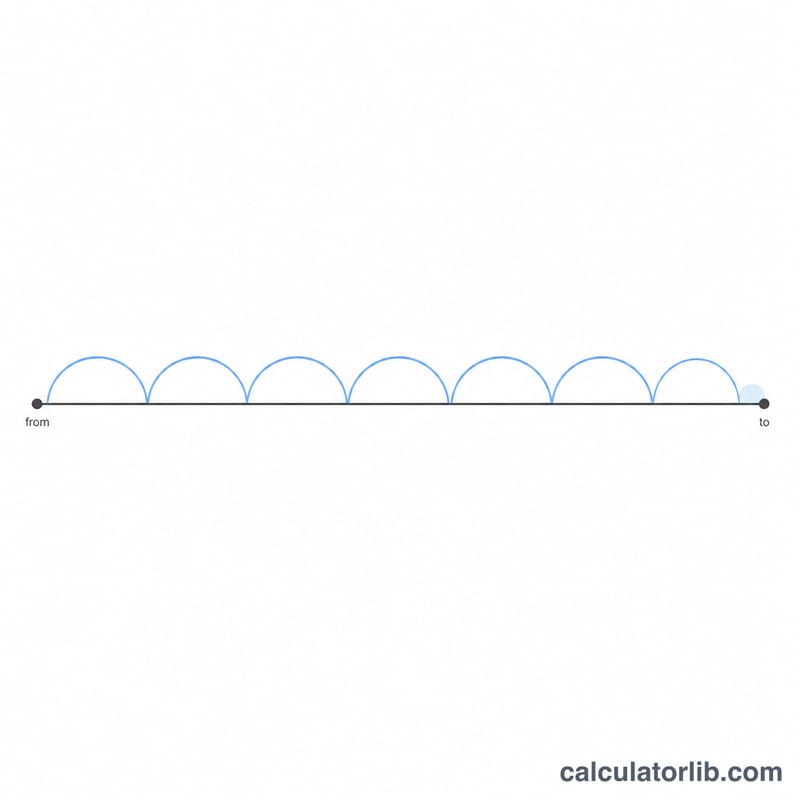
This tool tells you how many months remain between today (or any starting date) and a future target date. It is handy for planning deadlines, due dates, subscriptions, lease ends, exams, weddings, or any milestone you want to count down to. The calculator reports three figures: complete calendar months, exact decimal months, and the total number of days.
How to use it
Enter your starting date in the "From date" field (default is today) and your milestone in the "Target date" field. Press calculate. The big number shows how many full calendar months have elapsed between the two dates, while the table below adds a precise decimal-month value and the raw day count for fine-grained planning.
The formula explained
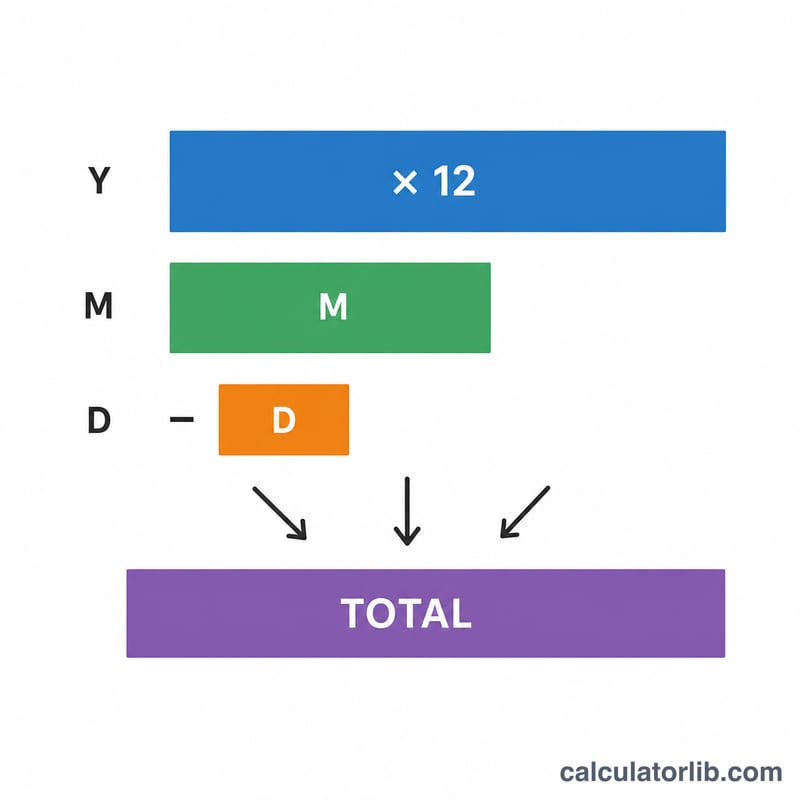
Complete months are found by comparing year and month components: \((Y_t - Y_f) \times 12 + (M_t - M_f)\). If the target's day-of-month is earlier than the start day, the final month is not yet complete, so we subtract one. For a continuous value, we divide the total days between the dates by the average month length of \(30.4375\) days (\(365.25 \div 12\)).
$$\text{Months} = \left( Y_t - Y_f \right) \times 12 + \left( M_t - M_f \right) - \begin{cases} 1 & D_t < D_f \\ 0 & \text{otherwise} \end{cases}$$
$$\text{Months}_{\text{decimal}} = \frac{\text{Target date} - \text{From date}}{30.4375 \ \text{days}}$$
Worked example
From 2024-01-15 to 2025-04-10: years differ by 1 (\(\times 12 = 12\)), months differ by 3 (April − January), giving 15. Because the target day (10) is before the start day (15), we subtract 1, leaving 14 complete months. The total of about 451 days divided by \(30.4375\) gives roughly \(14.8\) exact months.
FAQ
Why do complete months and decimal months differ? Complete months only count fully elapsed calendar months, while decimal months spread the leftover days proportionally.
What if the target date is in the past? The result will be negative, showing how many months ago the date occurred.
Does it handle leap years? Yes — the day count uses actual calendar dates, and the average month length accounts for leap years over time.