
What this calculator does
Jurisdiction: Japan. This tool models a fixed-amount monthly installment savings plan (a "recurring deposit", known in Japan as teigaku tsumitate). You contribute a fixed amount every month, optionally start with a lump-sum principal, earn compound interest at a chosen frequency, and pay tax on the interest once at maturity. The default tax rate of 20.315% is Japan's deposit-interest withholding (income tax 15% + special reconstruction income tax 0.315% + local resident tax 5%) for deposits maturing on or after January 2013. The compounding mathematics is universal; only the default tax rate and the "tax once at maturity" rule are Japan-specific. The original source page enters money in units of 10,000 yen (man-yen); here you may use any consistent currency amount.
How to use it
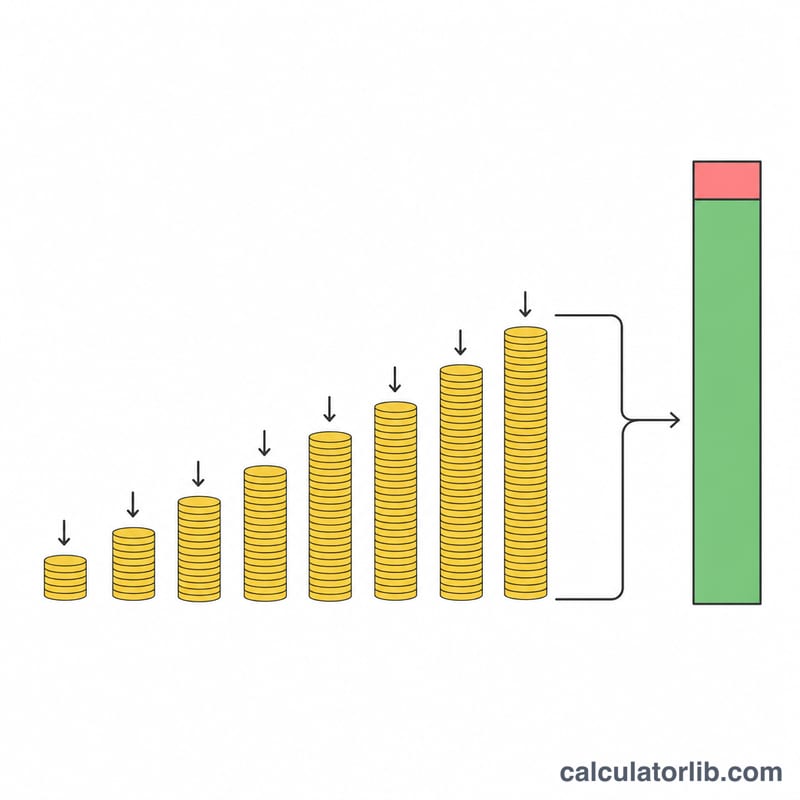
Enter the annual interest rate, the savings period in years, your monthly deposit, any initial principal, the compounding method (monthly, semi-annual, or annual), the rounding rule applied to each credited interest amount, and the tax method/rate. The calculator returns the total deposited, interest earned, gross principal + interest, the tax on interest, and the after-tax total.
The formula
With balance starting at the initial principal, each month a deposit is added. At each k-month credit date (and at maturity), interest is credited as \( \text{balance} \times r \times \frac{\text{months since credit}}{12} \), then rounded. After all months:
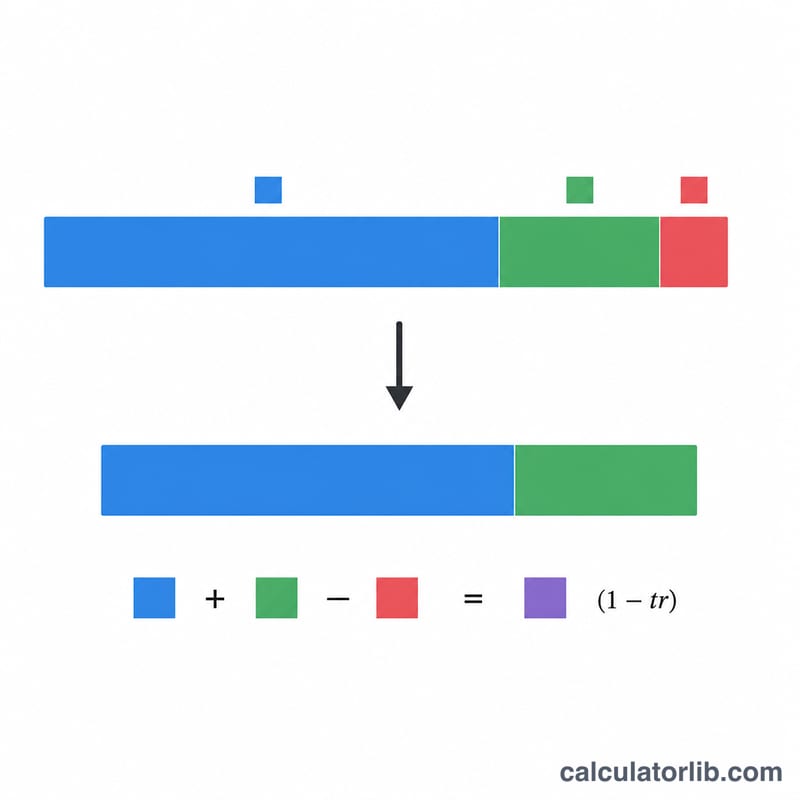
$$\text{totalDeposited} = \text{initialPrincipal} + \text{monthlyDeposit} \times 12 \times \text{years}$$ $$\text{grossInterest} = \text{grossTotal} - \text{totalDeposited}$$ $$\text{taxAmount} = \lfloor \text{grossInterest} \times \text{taxRate} \rfloor$$ $$\text{afterTaxTotal} = \text{grossTotal} - \text{taxAmount}$$
Worked example
Rate 3%, 2 years (24 months), monthly deposit 100,000, semi-annual compounding, floor rounding, 20.315% tax. Interest credits at months 6/12/18/24 each use \( r \times 0.5 = 0.015 \). The balance reaches 2,491,360. Total deposited = 2,400,000, so interest = 91,360. Tax = \( \lfloor 91{,}360 \times 0.20315 \rfloor = 18{,}559 \). After-tax total = 2,472,801.
FAQ
Why does rounding matter? Banks commonly truncate interest to whole yen each period, which over many periods slightly reduces the total — floor is the default.
How is this different from per-period tax? A sibling tool taxes interest at every compounding event; this one applies a single tax on total interest at maturity.
Is this exact? No — real institutions vary in accrual and fraction-handling conventions, so treat the figure as a close approximation.