

What this calculator does
This tool models a fixed-amount recurring (installment) savings plan and is based on a Japanese banking convention: tax on interest is withheld at every compounding event, not only once at maturity. The default tax rate is the Japanese 20.315% (income tax 15.315% including the post-2013 special reconstruction surcharge, plus 5% residents tax). The tax field is editable, so users outside Japan can set their own rate or 0. Money is entered in "ten-thousand units" reflecting the Japanese man-yen convention (1 unit = 10,000 of your currency).
How to use it
Enter the annual interest rate, savings period in years, the monthly deposit, and any initial lump-sum principal. Choose the compounding method (monthly, semi-annual, or annual), whether each period's new deposits earn interest from the start ("beginning") or not ("end"), the tax mode, and the rounding rule applied to yen amounts. The result shows the maturity total and a period-by-period schedule of deposits, gross interest, tax, net interest, and accumulated balance.
The formula explained
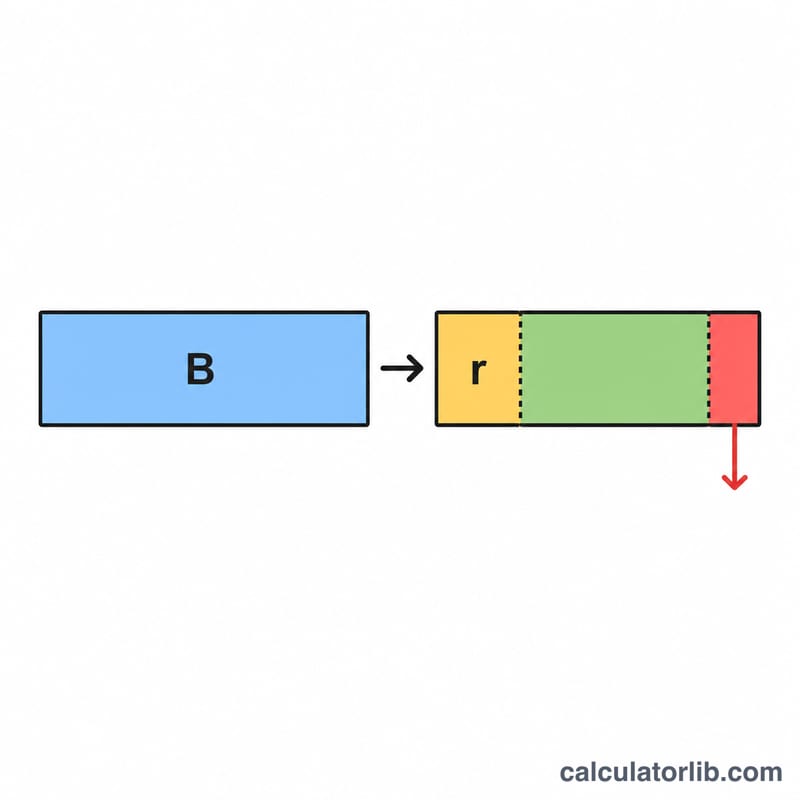
The number of months between compounding events is \(m\) (1, 6 or 12). The periodic rate is $$r_p = \text{annualRate} \times \frac{m}{12}$$ Each period the interest-earning base is the starting balance plus that period's deposits (beginning timing) or just the starting balance (end timing). Gross interest \(= \text{base} \times r_p\) is rounded; tax \(= \text{round}(\text{gross} \times \text{taxRate})\); net interest \(= \text{gross} - \text{tax}\). Because rounding is applied per period, the totals are sums of rounded amounts. $$\text{Net}_p = \text{round}(B_p \times r_p) - \text{round}(\text{round}(B_p \times r_p)\times t)$$
Worked example
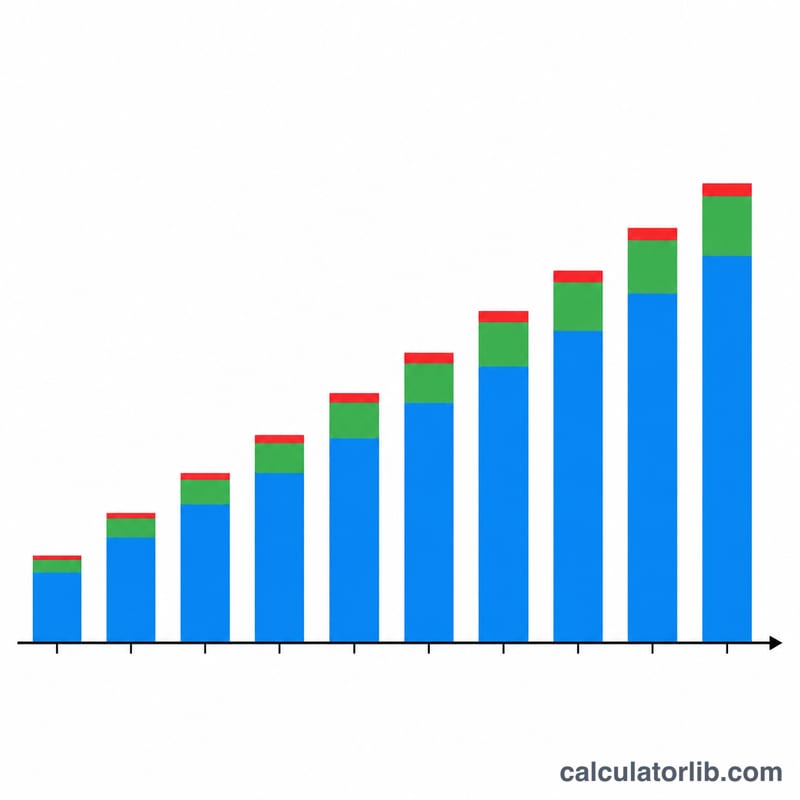
Rate 3%, 2 years, 10 units/month (100,000), initial 40 units (400,000), semi-annual compounding, beginning timing, tax 20.315%, round down. Over 4 periods the maturity total is about 2,892,049, total principal 2,800,000, gross interest 115,515, tax 23,466, and net interest 92,049.
FAQ
Why is tax taken every period? Some recurring deposit products withhold tax at each interest posting; this reduces the compounding base versus taxing only at maturity.
Why might my bank's figure differ? Rounding rules vary by institution. Choose round down, nearest, or up to match your provider; results are estimates only.
Can I make it tax-free? Yes — select tax-exempt mode or set the tax rate to 0.