
What Is Headcount Growth Rate?
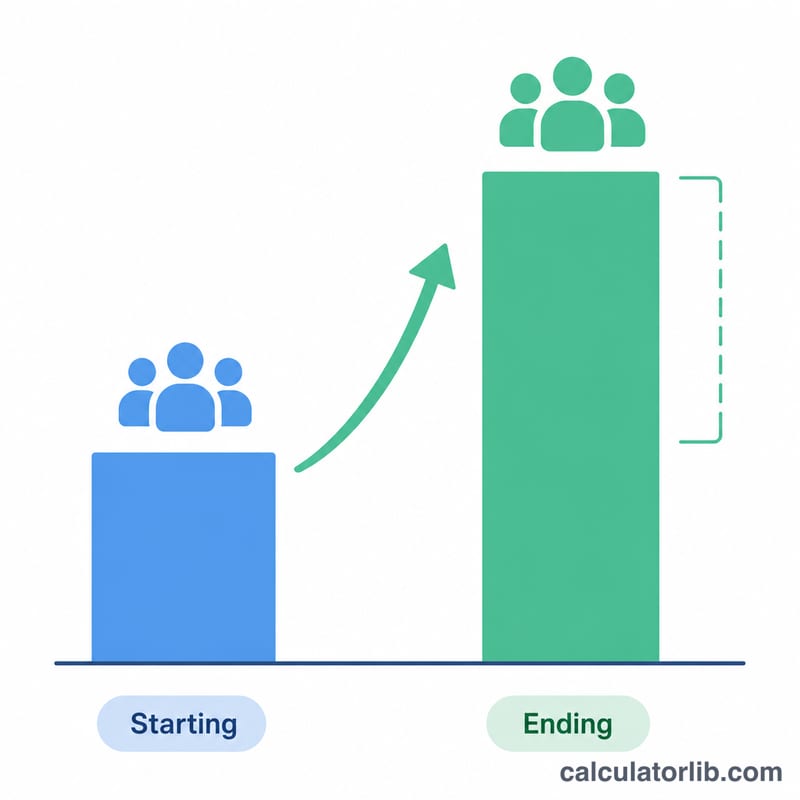
Headcount growth rate measures how much your workforce has expanded (or contracted) over a defined period, expressed as a percentage. It is one of the most-watched HR and workforce-planning metrics because it links hiring activity to business growth, budgeting, and organizational scaling. A positive rate signals expansion; a negative rate indicates a reduction in staff.
How to Use This Calculator
Enter your starting headcount (the number of employees at the beginning of the period) and your ending headcount (the number at the end of the period). The calculator returns the growth rate as a percentage along with the net change in employees. Choose any consistent period — monthly, quarterly, or annual — as long as both counts cover the same window.
The Formula Explained
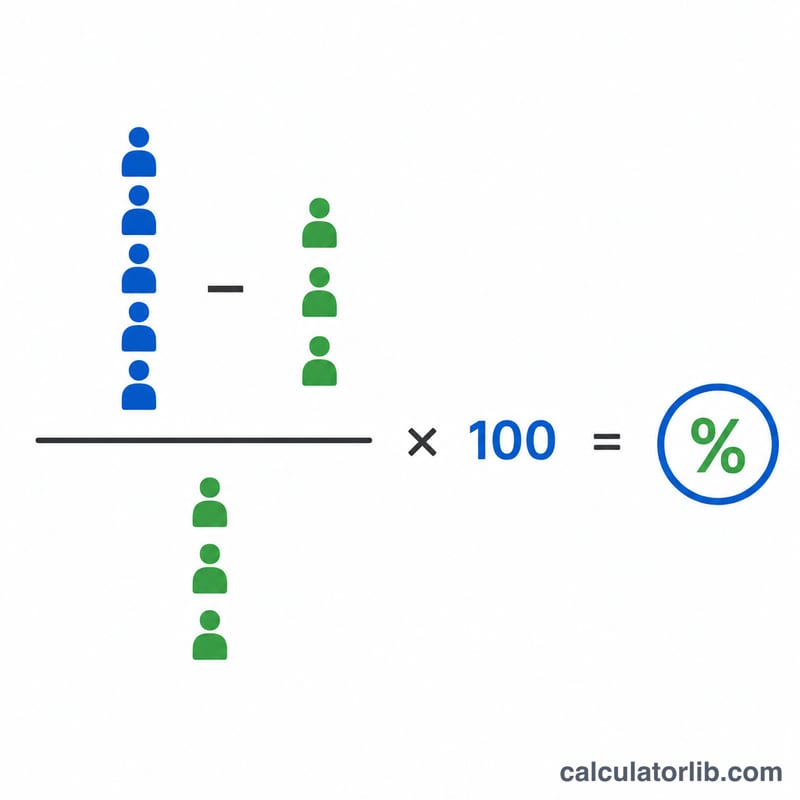
The growth rate is the net change in headcount divided by the starting headcount, multiplied by 100:
$$\text{Growth Rate} = \frac{\text{Ending Headcount} - \text{Starting Headcount}}{\text{Starting Headcount}} \times 100\%$$
Subtracting starting from ending gives the net hires (or losses). Dividing by the starting figure normalizes that change relative to your original team size, and multiplying by 100 converts it to a percentage.
Worked Example
Suppose your company started the year with 100 employees and ended with 120. The net change is \(120 - 100 = 20\). Dividing by the starting headcount: \(20 \div 100 = 0.20\). Multiplied by 100, that's a 20% headcount growth rate for the year.
FAQ
Can the growth rate be negative? Yes. If your ending headcount is lower than the starting count, the result is negative, reflecting a net reduction in staff.
What period should I use? Any period works, but be consistent. Annual growth rates are most common for benchmarking, while monthly rates suit fast-scaling startups.
Is this the same as turnover rate? No. Growth rate measures net change in total headcount, while turnover rate measures how many employees left relative to the average headcount.