

What Is the Absenteeism Rate?
The absenteeism rate measures the proportion of scheduled work time that employees miss due to absence. It is one of the most widely tracked HR metrics because high absenteeism signals problems with morale, workload, health, or engagement — and it directly affects productivity and labor costs. This calculator expresses absenteeism as a clean percentage so you can benchmark teams, departments, or time periods on the same scale.
How to Use the Calculator
Enter three numbers: the total absent days recorded over your period (sum across all employees), the number of employees in the group, and the available workdays per employee for the period (for example, ~21 working days in a typical month or ~261 in a year). The tool returns your absenteeism rate, the matching attendance rate, and the total pool of available workdays it used as the denominator.
The Formula Explained
The calculation is straightforward:
$$\text{Absenteeism Rate} = \frac{\text{Absent Days}}{\text{Employees} \times \text{Available Workdays}} \times 100$$
The denominator, employees × available workdays, is the maximum number of workdays your team could have worked. Dividing the days actually missed by that pool and multiplying by 100 converts the loss into a percentage. The attendance rate is simply $$\text{Attendance} = 100 - \text{Absenteeism Rate}$$

Worked Example
Suppose a department of 50 employees each had 21 available workdays in a month, and the team logged 120 absent days in total. The available pool is \(50 \times 21 = 1{,}050\) workdays. The absenteeism rate is $$\frac{120}{1{,}050} \times 100 \approx 11.43\%$$ giving an attendance rate of about 88.57%. A rate above roughly 3–5% is often flagged for review, so this team would warrant attention.
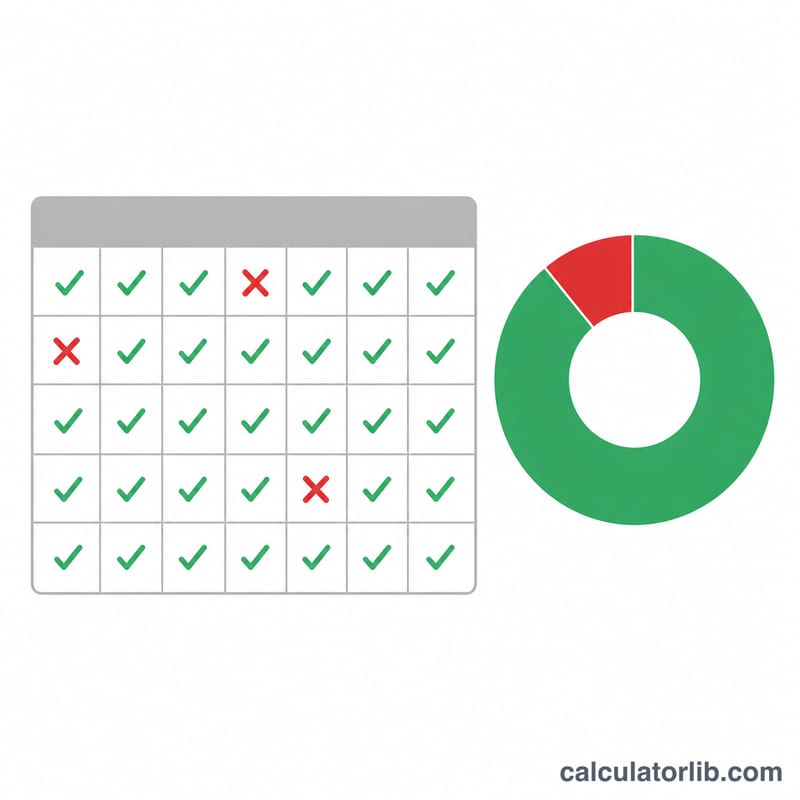
Interpreting Your Absenteeism Rate
The absenteeism rate expresses unplanned (and sometimes total) absence as a percentage of scheduled working time. It is calculated as:
$$\text{Absenteeism Rate} = \frac{\text{Absent Days}}{\text{Employees} \times \text{Workdays/Employee}} \times 100\%$$For example, a 20-person team with 5 scheduled workdays each (100 available person-days) that logs 4 absent days has an absenteeism rate of 4%.
What the percentage indicates
While no single threshold is universal, HR reporting commonly uses rough bands to flag where a result sits relative to typical office benchmarks:
| Absenteeism rate | General interpretation |
|---|---|
| Below 3% | Low — within or below the range many organizations consider routine |
| 3% – 5% | Moderate — a watch zone worth monitoring for trends by team or season |
| Above 5% | High — elevated relative to common office benchmarks |
These bands are descriptive starting points, not regulatory standards. The "normal" rate varies widely by industry, role type, region, and how the absence is defined (sick leave only versus all unplanned absence).
Comparing to a baseline or department
A single rate is most meaningful in context. Compare your result against (1) your own historical average for the same period last month, quarter, or year; (2) other departments measured the same way; and (3) any published industry figure that uses a comparable definition of "absent." A rate that looks high in isolation may simply reflect a flu season, a known long-term medical leave, or a counting method that includes vacation. Consistency in what counts as an "absent day" is what makes period-to-period and team-to-team comparisons valid.
Cost and productivity implications
Each percentage point of absenteeism corresponds to lost scheduled labor. In the example above, 4 absent days out of 100 available person-days means 4% of the team's planned capacity was unavailable for that period. Higher rates translate to reduced output, potential overtime or temporary-cover costs to backfill the work, and added scheduling burden on present staff. Because the denominator is total available person-days, the same number of absent days produces a smaller percentage on a larger team and a larger percentage on a smaller one.
The paired attendance rate
The attendance rate is the complement of the absenteeism rate:
$$\text{Attendance Rate} = 100\% - \text{Absenteeism Rate}$$A 4% absenteeism rate therefore corresponds to a 96% attendance rate — the share of scheduled person-days actually worked. The two figures describe the same data from opposite directions: absenteeism highlights lost time for cost and risk analysis, while attendance is often the figure presented in performance or engagement summaries. They always sum to 100% when measured over the same population and period.
FAQ
What counts as a "good" absenteeism rate? Many organizations aim for under 3–4%, though acceptable ranges vary by industry. Compare against your own historical baseline rather than a single universal target.
Should I include planned leave like vacation? Typically no — absenteeism focuses on unplanned absence (sick days, no-shows). Decide your definition and apply it consistently.
Can I use this for a single employee? Yes. Set employees to 1 and enter that person's absent and available days to get their individual absence percentage.