
What is the IV Drip Rate Calculator?
This calculator determines how many drops per minute (gtt/min) should fall in an IV chamber to deliver a prescribed volume of fluid over a set time using gravity (manual) infusion. It is a standard tool used by nurses, paramedics, and clinical students. It is general-purpose and unit-based, so it applies anywhere — but always follow your local protocols and verify against the prescriber's order.
How to use it
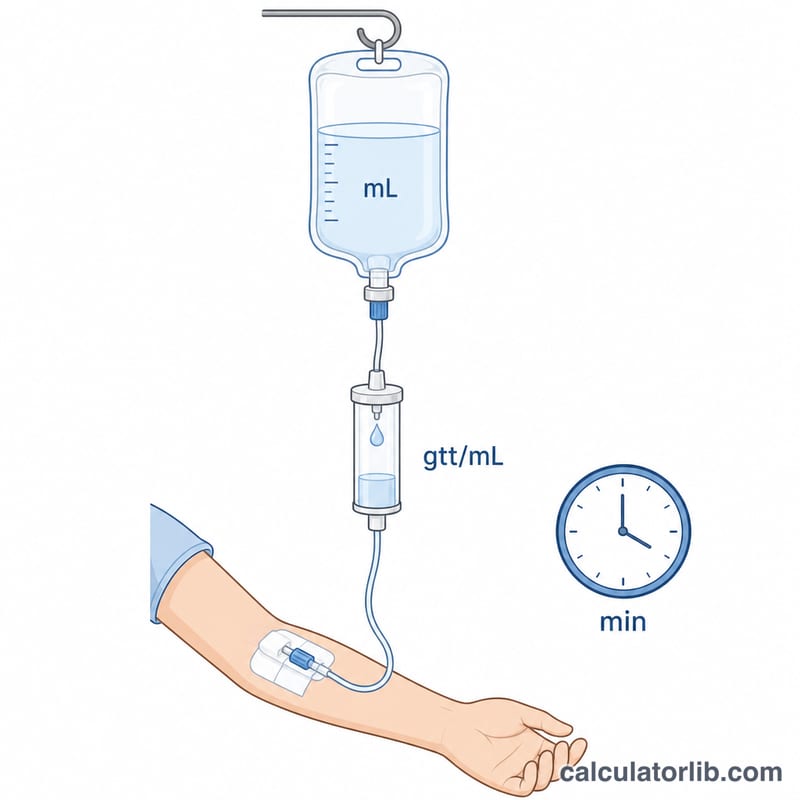
Enter the total volume to infuse in milliliters, the time over which it should run in minutes, and select the drop factor of your IV tubing (printed on the package — commonly 10, 15, or 20 gtt/mL for macrodrip sets and 60 gtt/mL for microdrip sets). The calculator returns the manual drip rate in drops per minute and the equivalent flow rate in mL per hour.
The formula explained
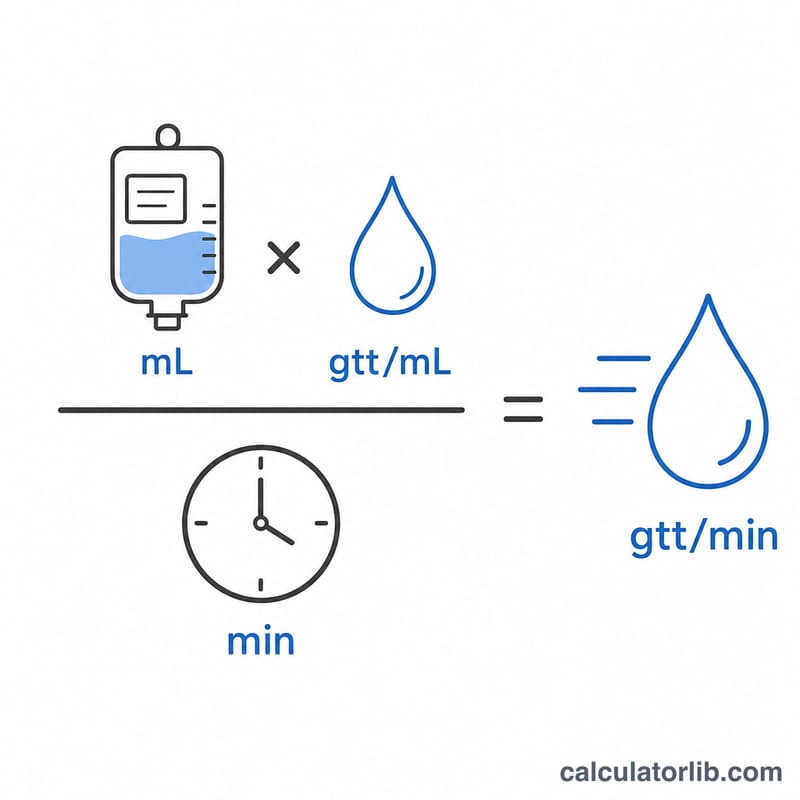
The drip rate is found by multiplying the volume (mL) by the drop factor (gtt/mL) and dividing by the time in minutes:
$$\text{drops/min} = \frac{\text{volume} \times \text{drop factor}}{\text{time}}$$
Because the drop factor already expresses how many drops make up one milliliter, this gives the number of drops that must pass each minute to complete the infusion on schedule. You count and adjust the drip chamber to match this value.
Worked example
Infuse 1000 mL over 480 minutes (8 hours) with 20 gtt/mL tubing: $$\frac{1000 \times 20}{480} = \frac{20000}{480} \approx 41.7$$ so set roughly 42 drops per minute. The flow rate is \(\frac{1000}{480} \times 60 = 125\) mL/hour.
FAQ
What is a drop factor? It is the number of drops that equal 1 mL for a given IV set, set by the tubing's design and printed on its packaging.
Macrodrip vs microdrip? Macrodrip sets (10–20 gtt/mL) deliver larger drops for higher flow rates; microdrip sets (60 gtt/mL) deliver tiny drops for precise, low-volume infusions.
Do I round the drip rate? Yes — drops are counted as whole numbers, so round to the nearest whole drop per minute when setting the rate manually.