
What is the IV Drip Rate Calculator?
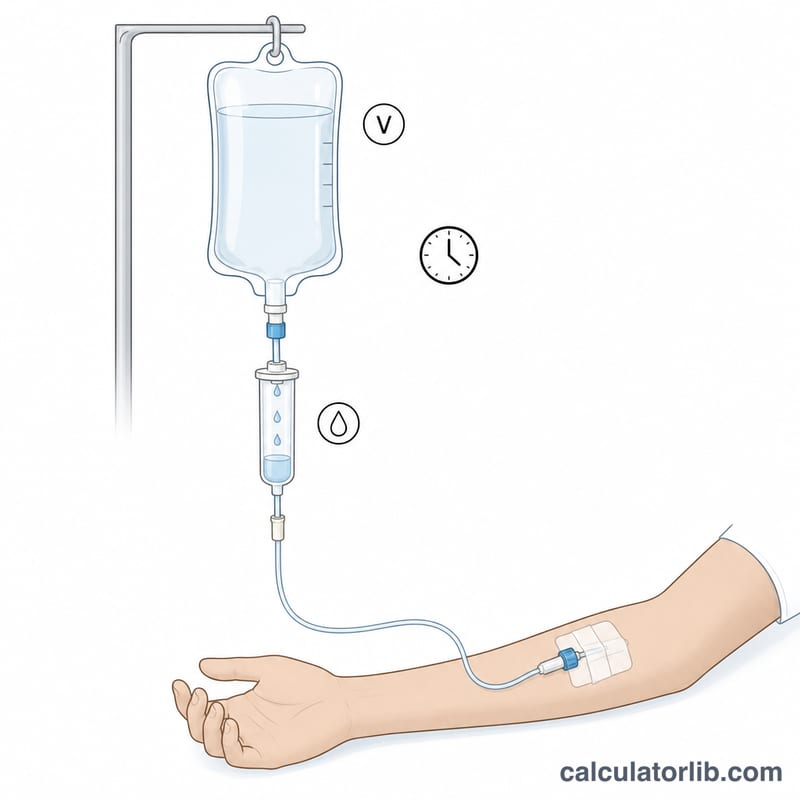
This calculator finds the IV drip rate in drops per minute (gtt/min) for a gravity-fed intravenous infusion. Given the total volume to infuse, the time over which it should run, and the tubing drop factor, it returns how many drops should fall per minute so you can manually set and verify the roller clamp on a gravity drip set.
How to use it
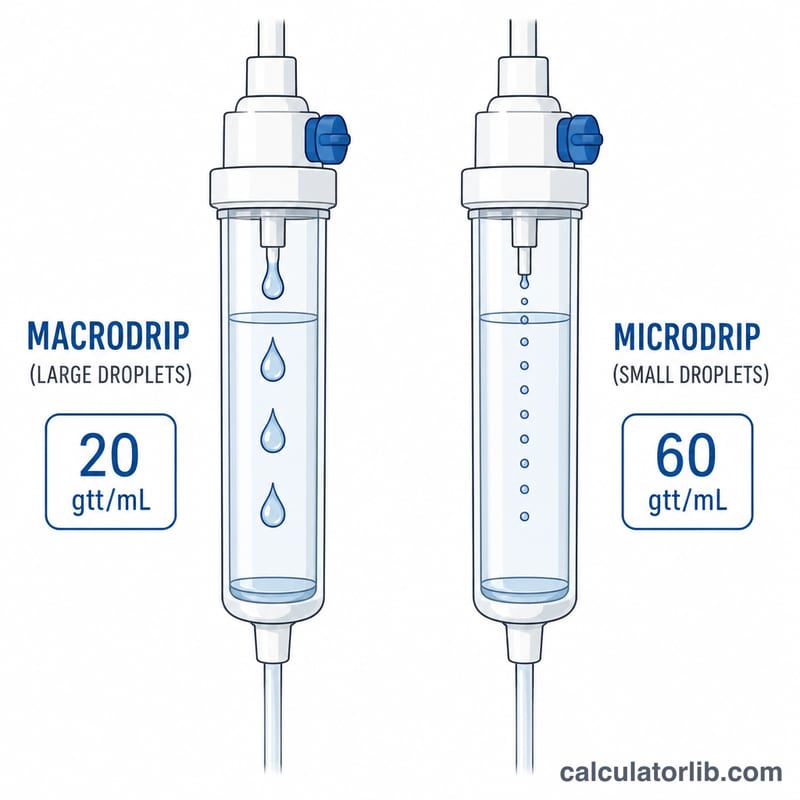
Enter the total volume in millilitres, the infusion time in minutes, and select the tubing drop factor printed on the IV set packaging. Common macrodrip sets are 10, 15, or 20 gtt/mL; microdrip (pediatric) sets are 60 gtt/mL. The result shows the drops per minute to count, plus the equivalent flow rate in mL per hour.
The formula explained
The core equation is $$\text{gtt/min} = \frac{\text{Volume in mL} \times \text{Drop Factor in gtt/mL}}{\text{Time in minutes}}$$ The volume times drop factor gives the total number of drops to deliver; dividing by minutes spreads those drops evenly across the infusion. If your time is given in hours, multiply by 60 to convert to minutes first.
Worked example
Infuse 1000 mL over 8 hours (480 minutes) using a 20 gtt/mL set: $$\text{gtt/min} = \frac{1000 \times 20}{480} = \frac{20000}{480} \approx 42 \text{ drops per minute.}$$ The flow rate is \(\frac{1000}{480} \times 60 = 125\) mL/hour.
FAQ
What is a drop factor? It is the number of drops the IV tubing delivers per millilitre, set by the equipment manufacturer and printed on the package.
Macrodrip vs microdrip? Macrodrip sets (10–20 gtt/mL) suit routine adult infusions; microdrip (60 gtt/mL) gives finer control for small or pediatric volumes.
Should I round the result? You cannot count a fraction of a drop, so round gtt/min to the nearest whole drop when setting the clamp. Always follow your facility protocol and pump settings.