
What Is the INR Calculator?
The International Normalized Ratio (INR) is a standardized measure of how long it takes blood to clot, derived from the prothrombin time (PT) test. Because different laboratories use different thromboplastin reagents, raw PT values are not directly comparable between labs. The INR corrects for this variability so results are consistent worldwide. This calculator computes INR from three inputs: the patient's PT, the laboratory's mean normal PT, and the reagent's International Sensitivity Index (ISI).
How to Use It
Enter the patient's measured prothrombin time in seconds, the mean normal prothrombin time for your lab (typically 11–13 seconds), and the ISI value printed on the thromboplastin reagent (often near 1.0). The calculator returns the dimensionless INR value. A typical healthy INR is around 1.0, while patients on warfarin therapy usually target a range of 2.0–3.0.
The Formula Explained
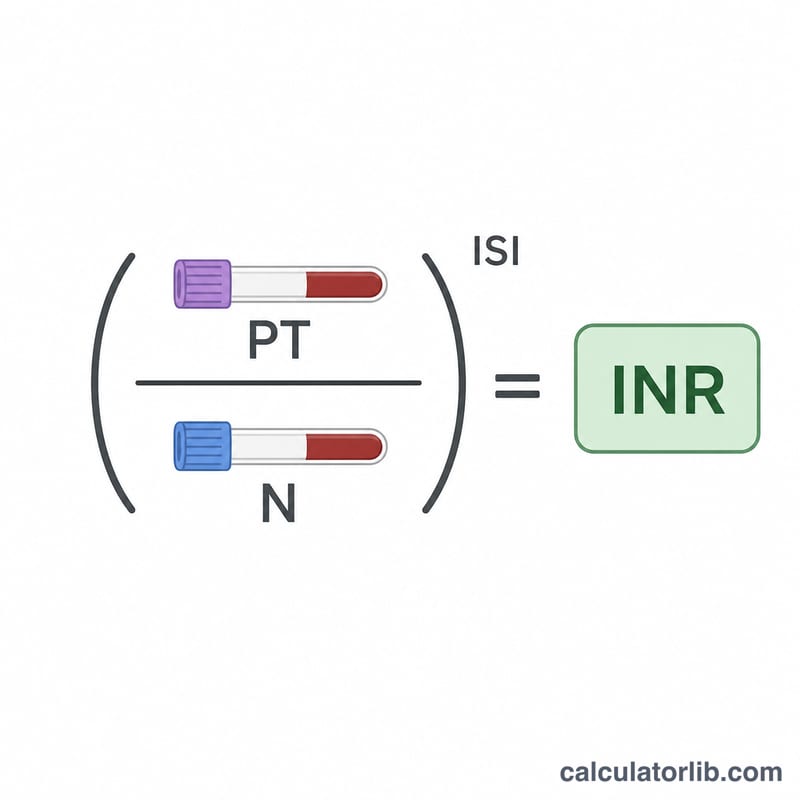
The equation is $$\text{INR} = \left( \frac{\text{Patient PT (s)}}{\text{Mean Normal PT (s)}} \right)^{\text{ISI}}$$ The ratio normalizes the patient's clotting time against the lab's baseline, and raising it to the ISI power adjusts for the sensitivity of the specific reagent used. An ISI of 1.0 means the ratio equals the INR directly.
Worked Example
Suppose a patient's PT is 18 seconds, the mean normal PT is 12 seconds, and the ISI is 1.0. The ratio is \(18 / 12 = 1.5\). Raised to the power 1.0, the $$\text{INR} = 1.5^{1.0} = 1.5$$
FAQ
What is a normal INR? For people not on anticoagulants, a normal INR is approximately 0.8–1.2.
What does a high INR mean? A higher INR indicates blood takes longer to clot, increasing bleeding risk; very low values increase clotting risk.
Where do I find the ISI? The ISI is supplied by the reagent manufacturer and is specific to each batch of thromboplastin used by the laboratory.