
What this calculator does
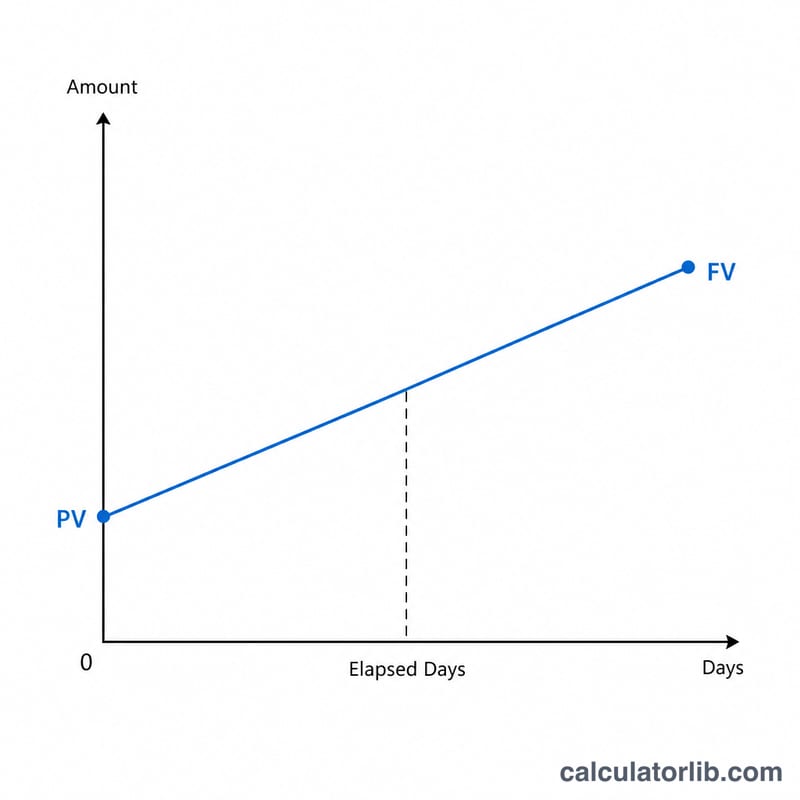
This tool inverts the simple-interest formula to answer a single question: how many days does it take for a principal (PV) to grow into a target final amount (FV) when interest does not compound? Simple interest accrues only on the original principal, so growth is strictly linear over time. The math is universal, but the "Rate Type" selector also supports a per-day rate convention (called "hibu" in Japan) that expresses the rate as a daily percentage.
How to use it
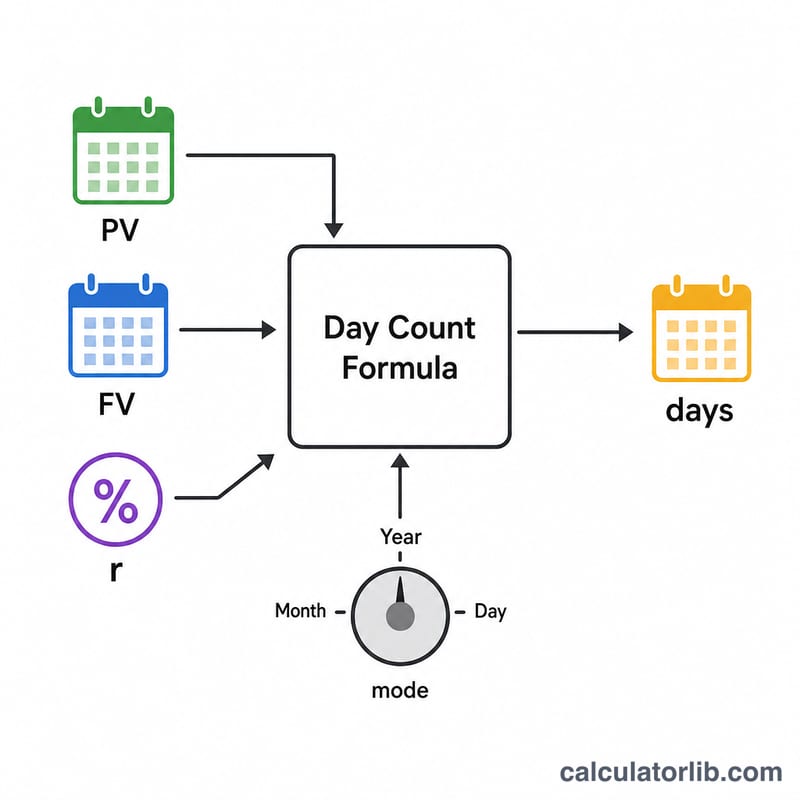
Pick a Rate Type to set the time basis (mode): an annual rate uses a 365- or 360-day year, a monthly rate uses 30 days per month, and a daily rate applies per single day. Enter the Interest Rate as a percent, the Principal you start with, and the Final Amount you want to reach (principal plus accrued interest). The calculator returns the number of elapsed days required.
The formula explained
Simple interest gives \( \text{FV} = \text{PV} \times (1 + r_{\text{frac}} \times \text{days} / \text{mode}) \), where \( r_{\text{frac}} = \text{rate} / 100 \). Solving for days yields:
$$\text{days} = \left(\frac{\text{FV}}{\text{PV}} - 1\right) \times \frac{\text{mode}}{r_{\text{frac}}}$$
The "mode" constant is the number of days in one full rate period: 365 or 360 for annual rates, 30 for monthly, and 1 for daily. Because the rate is divided by 100 internally, you enter 5 for 5%, not 0.05.
Worked example
Start with PV = 100,000 and target FV = 120,000 at a 5% annual rate on a 365-day basis. Then \( r_{\text{frac}} = 0.05 \), and \( \text{FV}/\text{PV} - 1 = 0.2 \). So $$\text{days} = 0.2 \times \frac{365}{0.05} = 0.2 \times 7300 = \mathbf{1460 \text{ days}},$$ exactly 4 years.
FAQ
Why does my result not match a compound-interest calculator? This tool models simple interest only, where interest never earns interest. Compound interest grows faster, so it would need fewer days.
What is the "daily rate (hibu)" mode? It is a per-day convention common in Japan; the rate you enter is treated as a daily percentage and mode = 1. As a rough guide, a per-day rate of 5 sen equals about 0.05% per day.
What if the final amount is below the principal? That would imply negative days, which is non-physical for positive interest, so the calculator flags it as invalid. A final amount equal to the principal yields 0 days.