
What this calculator does
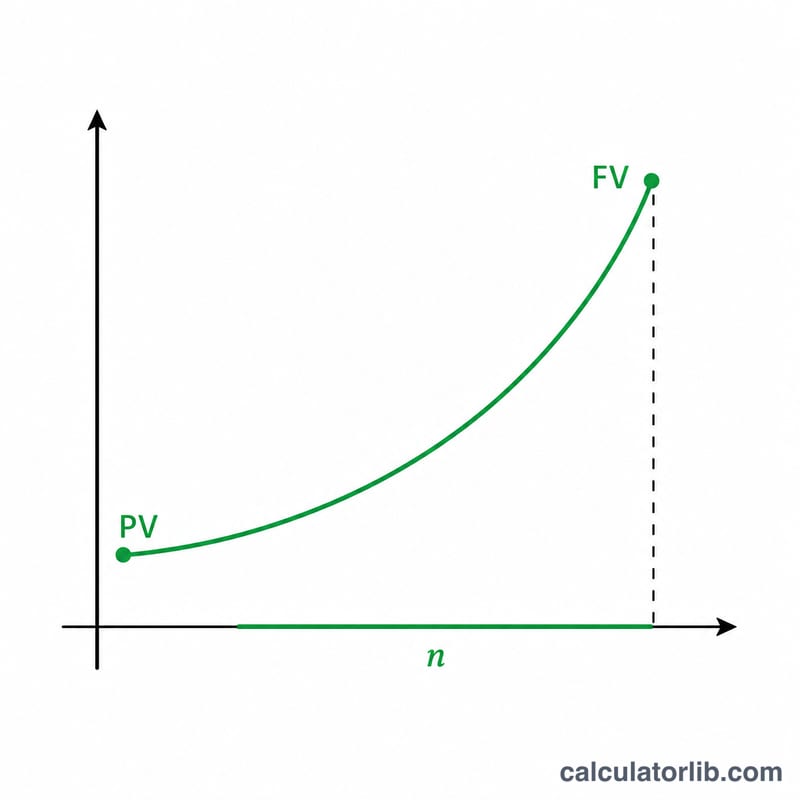
This tool solves the compound interest formula for time. Most compound interest calculators ask for principal, rate and number of years to find the future value. Here we work backwards: you supply the principal (present value, PV), the target future value (FV), the annual interest rate and the compounding frequency, and the calculator returns the number of years (n) required for the money to grow from PV to FV. This is universal financial mathematics with no country-specific rules.
How to use it
Enter the annual interest rate as a percent, choose whether that rate is a nominal (stated) rate or an effective annual rate, type the principal and the target future value, and pick a compounding period (annually, semi-annually, quarterly, monthly or daily). The compounding period only affects the result in nominal-rate mode. The answer is a continuous, fractional number of years displayed to high precision.
The formula explained
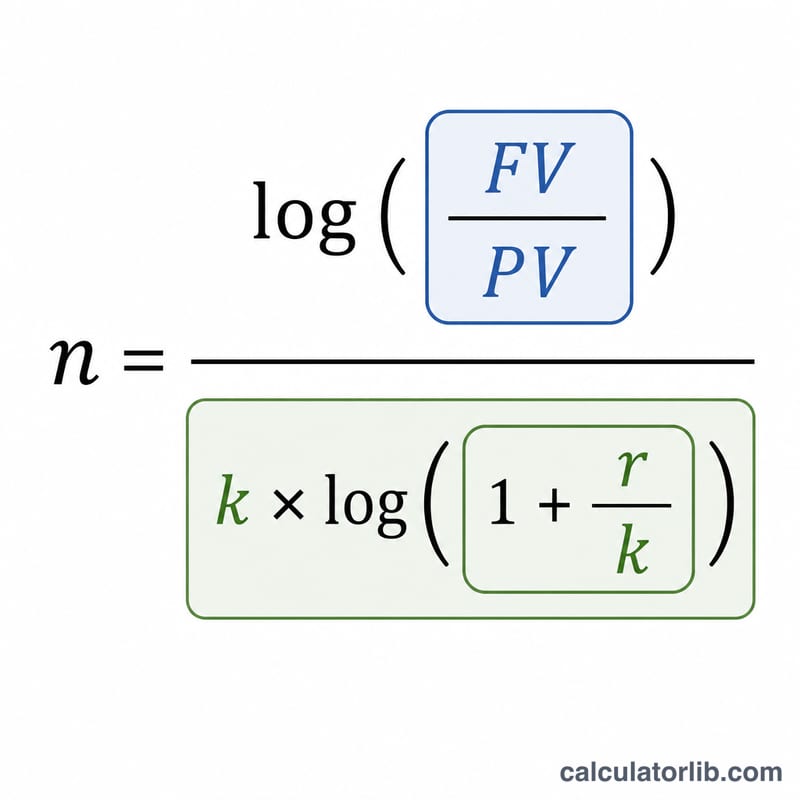
Under compounding, $$FV = PV \times (1 + r/k)^{k \cdot n}$$ where \(r\) is the decimal annual rate (rate/100) and \(k\) is the number of compounding events per year. Taking logarithms of both sides and isolating \(n\) gives $$n = \dfrac{\ln(FV / PV)}{k \cdot \ln(1 + r/k)}$$ For an effective annual rate \(R\), \(k\) is effectively 1 and the formula simplifies to $$n = \dfrac{\ln(FV / PV)}{\ln(1 + R)}$$ Any logarithm base works because the ratio of two logs is base-independent.
Worked example
Suppose PV = 100,000, FV = 150,000, rate = 5% (nominal), compounded annually (k = 1). Then $$n = \dfrac{\ln(1.5)}{1 \times \ln(1.05)} = \dfrac{0.405465}{0.048790} \approx 8.3104 \text{ years}$$ Switch to monthly compounding (k = 12) and the same growth happens slightly faster: $$n = \dfrac{0.405465}{12 \times \ln(1.0041667)} \approx 8.1262 \text{ years}$$
FAQ
Why is monthly compounding faster than annual? More frequent compounding means interest earns interest sooner, so the principal reaches the target in slightly less time at the same nominal rate.
What if the future value is less than the principal? With a positive rate the formula returns a negative number of years, which is mathematically valid but not physically meaningful for forward growth.
Why can't the rate be 0%? With no growth the denominator \(\ln(1) = 0\), making \(n\) undefined unless FV already equals PV.