
What This Calculator Does
The Simple Interest Percentage Calculator works out the annual interest rate when you already know how much interest was earned. Instead of solving for interest, you rearrange the simple-interest formula to solve for the rate. This is handy for comparing loans, savings accounts, or verifying the rate quoted on a statement.
How to Use It
Enter three values: the Principal (P) — the original amount of money; the Interest Earned (I) — the total interest accrued; and the Time (T) in years over which the interest was earned. The calculator instantly returns the simple annual interest rate as a percentage.
The Formula Explained
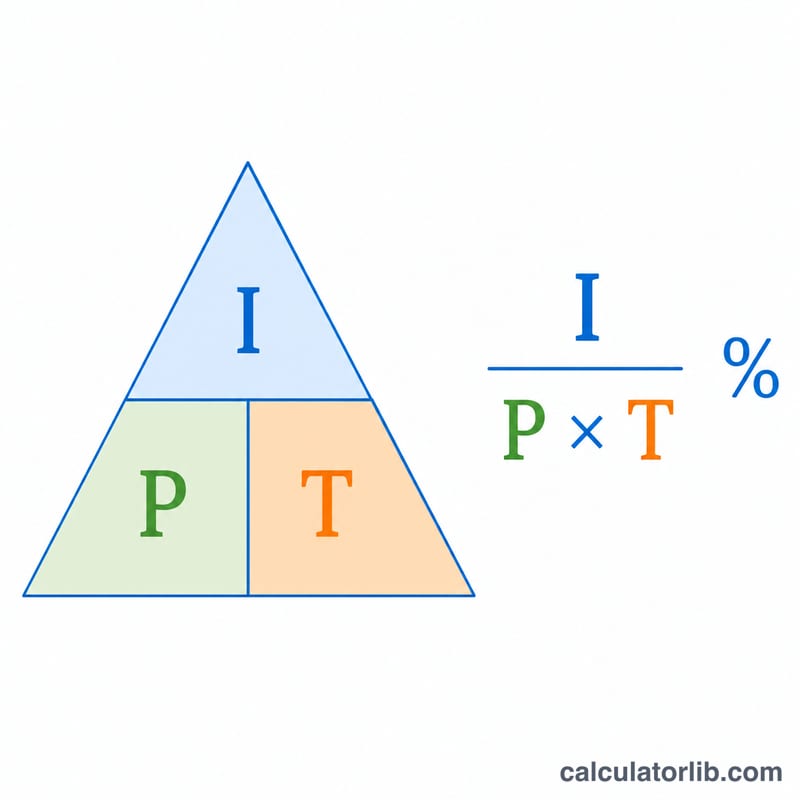
Simple interest is defined as \(I = P \times R \times T\), where R is the decimal rate. Solving for R and converting to a percentage gives:
$$\text{Rate (\%)} = \frac{\text{Interest (I)}}{\text{Principal (P)} \times \text{Time (T)}} \times 100$$
\(P \times T\) forms the denominator; if either is zero the rate is undefined, so the calculator guards against division by zero.
Worked Example
Suppose you invested a principal of 1,000 and earned 150 in interest over 3 years. The rate is:
$$\text{Rate} = \frac{150}{1{,}000 \times 3} \times 100 = \frac{150}{3{,}000} \times 100 = 0.05 \times 100 = \mathbf{5\% \text{ per year}}$$
FAQ
Does this use compound interest? No. This calculator assumes simple interest, where interest does not compound. For compounding, use a compound interest tool.
What units should time be in? Time must be in years to get an annual rate. If you have months, divide by 12 (e.g. 18 months = 1.5 years).
Why is my result undefined? If principal or time is zero, the formula divides by zero, so the rate cannot be computed.