What is Simple Interest?
Simple interest is a method of calculating interest where the interest amount is based solely on the principal sum, the interest rate, and the time period. Unlike compound interest, simple interest does not add previously earned interest to the principal for future interest calculations.
When to Use Simple Interest Calculator
A simple interest calculator is useful in the following scenarios:
- Calculating interest on short-term loans or investments
- Determining the total amount to be repaid on a fixed-rate loan
- Planning personal finances when dealing with simple interest-based financial products
How to Calculate Simple Interest
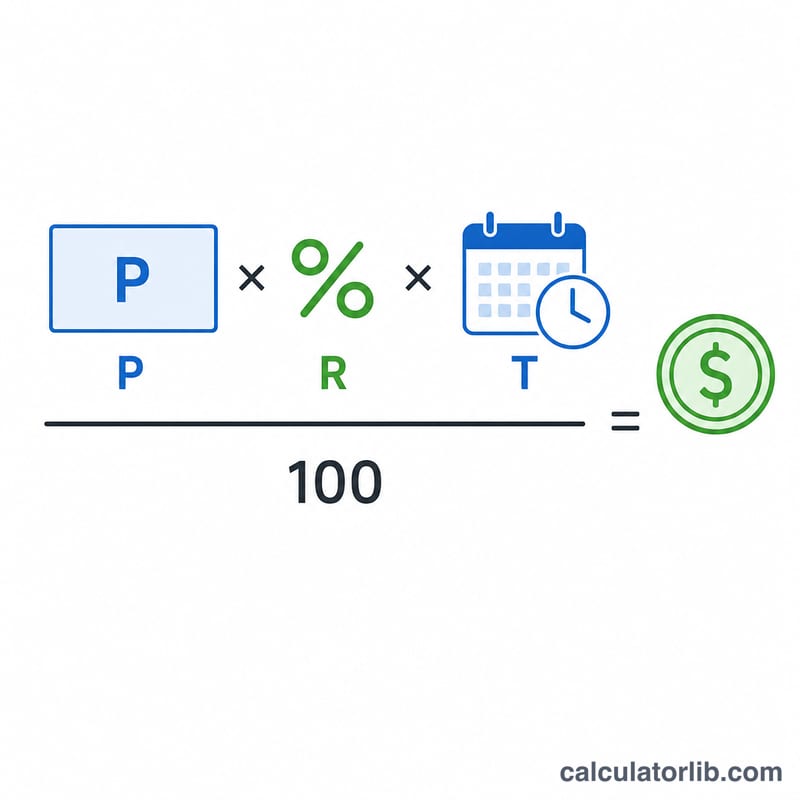
The formula for calculating simple interest is:
Simple Interest = (Principal × Rate × Time) / 100
Where:
- Principal: The initial amount of money (loan or investment)
- Rate: The interest rate per time period (in percent)
- Time: The time period (typically in years)
To calculate the total amount to be repaid or received:
Total Amount = Principal + Simple Interest
Simple Interest Examples
Example 1: Calculating Interest on a Loan
Calculate the simple interest and total amount to be repaid on a loan of $5,000 with an interest rate of 8% for 3 years.
| Variable | Value |
|---|---|
| Principal | $5,000 |
| Rate | 8% |
| Time | 3 years |
| Simple Interest | $1,200 |
| Total Amount | $6,200 |
Example 2: Calculating Interest on a Savings Account
Calculate the simple interest earned on a savings account with an initial deposit of $10,000 at an annual interest rate of 2.5% after 2 years.
| Variable | Value |
|---|---|
| Principal | $10,000 |
| Rate | 2.5% |
| Time | 2 years |
| Simple Interest | $500 |
| Total Amount | $10,500 |
Example 3: Calculating Interest for a Short-Term Investment
Calculate the simple interest and final amount for a 6-month investment of $2,500 with an annual interest rate of 6%.
| Variable | Value |
|---|---|
| Principal | $2,500 |
| Rate | 6% |
| Time | 0.5 years (6 months) |
| Simple Interest | $75 |
| Total Amount | $2,575 |
Simple Interest Rate Comparison
| Interest Rate | Interest Earned on $1,000 (1 year) | Interest Earned on $1,000 (5 years) |
|---|---|---|
| 1% | $10 | $50 |
| 3% | $30 | $150 |
| 5% | $50 | $250 |
| 7% | $70 | $350 |
| 10% | $100 | $500 |
Key Terms and Definitions
Simple interest uses a small set of terms, but each one has a precise meaning. The definitions below apply to the calculation performed here, where interest is charged or earned on the original principal only.
| Term | Definition |
|---|---|
| Principal (P) | The original sum borrowed, lent, deposited or invested, before any interest is added. In simple interest it never changes: interest is always computed on this same figure. |
| Nominal annual interest rate (r) | The stated yearly rate, quoted as a percentage (e.g. 6% per year) and not adjusted for compounding, fees or inflation. "Nominal" means it is the headline rate written in the contract, not the effective yield. |
| Term / time (t) | The length of the loan or deposit, expressed in the same time unit as the rate. Because the rate here is annual, the term must be in years: a period given in months becomes months ÷ 12 (9 months = 0.75 years), and a period in days becomes days ÷ 365 under an actual/365 convention. |
| Simple interest (I) | Interest calculated only on the principal, for the whole term: \(I = \dfrac{P \times r \times t}{100}\) with \(r\) as a percentage, or \(I = P \times r \times t\) with \(r\) as a decimal. It grows in a straight line with time. |
| Total amount (A) | Principal plus interest, \(A = P + I = P\left(1 + \dfrac{r \times t}{100}\right)\) — the amount repayable at maturity (or the balance of a deposit) if nothing is paid in or out along the way. |
| Compound interest | Interest calculated on the principal and on interest already accrued — "interest on interest". With annual compounding, \(A = P(1+i)^n\) where \(i\) is the periodic rate as a decimal and \(n\) the number of periods. It always exceeds simple interest for the same nominal rate once the term passes one compounding period. |
| APR (annual percentage rate) | A regulated disclosure figure that expresses the cost of credit per year including compounding and, depending on the jurisdiction, certain fees. The exact definition and which charges must be included differ by country (for example the US Truth in Lending Act / Regulation Z, or the EU Consumer Credit Directive). A simple interest rate is only the bare rate applied to the principal, so an APR on the same loan is usually higher. |
| Accrued interest | Interest that has been earned by the passage of time but not yet paid or capitalised. On a simple-interest instrument it builds up evenly day by day between payment dates. |
| Per diem interest | The interest that accrues in one day: \(\text{Per diem} = \dfrac{P \times r}{365}\) with \(r\) as a decimal. Note the day-count convention matters — many money-market and some loan contracts use a 360-day year (r ÷ 360), which produces a slightly larger daily figure; check which basis your agreement specifies. |
Simple vs. Compound Interest: Side-by-Side Comparison
The table compares a principal of $10,000 at a nominal 6% per year under two treatments: simple interest, \(A = P(1 + r t)\), and interest compounded once per year, \(A = P(1+i)^n\). No deposits, withdrawals or payments are assumed in either column, and taxes and fees are ignored.
| Years | Simple interest earned | Total (simple) | Total (compounded annually) | Difference |
|---|---|---|---|---|
| 1 | $600.00 | $10,600.00 | $10,600.00 | $0.00 |
| 3 | $1,800.00 | $11,800.00 | $11,910.16 | $110.16 |
| 5 | $3,000.00 | $13,000.00 | $13,382.26 | $382.26 |
| 10 | $6,000.00 | $16,000.00 | $17,908.48 | $1,908.48 |
| 20 | $12,000.00 | $22,000.00 | $32,071.35 | $10,071.35 |
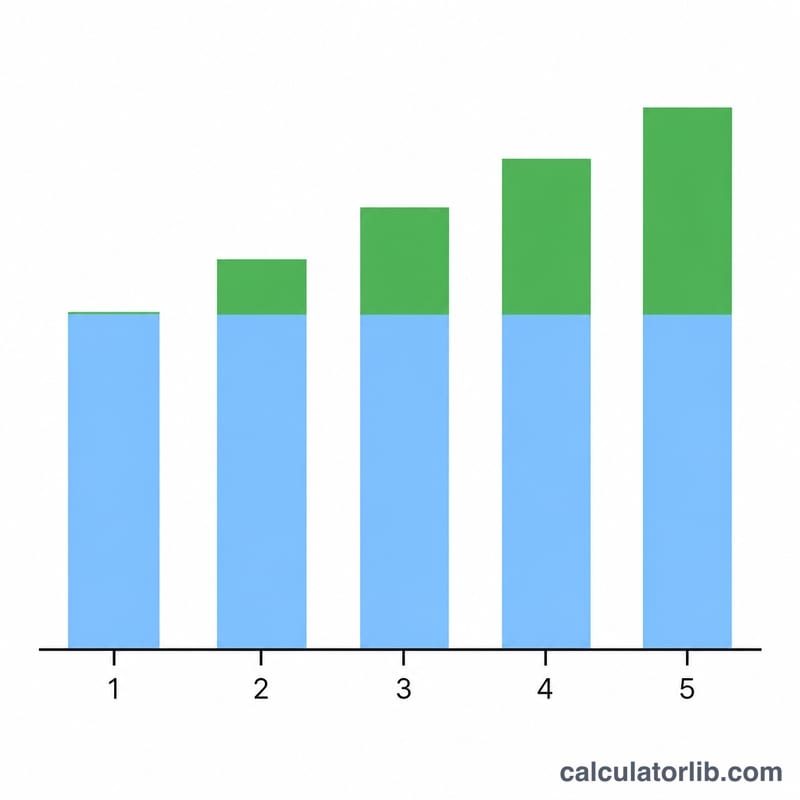
At exactly one compounding period the two methods agree — after one year both give $10,600. Beyond that they diverge, because compounding applies the 6% to a balance that already contains previous interest. The check for year 5 is \(10{,}000 \times 1.06^5 = 13{,}382.26\) versus \(10{,}000 + 10{,}000 \times 0.06 \times 5 = 13{,}000\).
Two things widen the gap: time and rate. Simple interest grows linearly while compound interest grows geometrically, so the difference accelerates — it is $382.26 at 5 years but $10,071.35 at 20 years on the same deposit. Raising the rate has the same amplifying effect, and compounding more often than yearly (monthly or daily) widens it further still. Currency symbols are used only as an example; the arithmetic is identical in any currency.
Understanding Your Simple Interest Result
The interest figure this calculator returns is the cost (if you are borrowing) or the earning (if you are lending or depositing) computed on the original principal only. Nothing is ever added to the base: an amount of $10,000 at 5% accrues $500 in the first year and $500 in the tenth year alike. The total amount shown is simply principal plus that interest, \(A = P + I\).
What the result assumes
- No payments, deposits or withdrawals during the term. Every unit of principal is assumed to sit in place for the full period.
- A constant rate for the whole term. Variable- or floating-rate agreements will not match this figure once the rate moves.
- No compounding. Interest is not capitalised, reinvested or added to the balance.
Where it is an approximation
Most mortgages and other amortising loans apply interest to a declining balance under a payment schedule; credit cards typically compound, often daily, on a revolving balance; and most savings accounts credit and compound interest periodically. For those products the simple-interest total is a rough upper- or lower-bound sketch rather than the contractual number — use the product's own amortisation schedule or APR/AER disclosure for the real figure.
Where simple interest genuinely applies
The model is not merely theoretical. Many auto loans are written as true simple-interest contracts where interest accrues daily on the outstanding balance; short-term and bridge loans, promissory notes and personal IOUs are commonly quoted this way; and bonds and certificates of deposit that pay their coupon or interest out to the holder — rather than reinvesting it — accumulate simple interest over the holding period. Per diem interest quoted on a loan payoff statement is the same idea expressed daily.
Matching the units
Because the rate is annual, the term must be in years. Six months is 0.5, three months is 0.25, 18 months is 1.5. For example, $8,000 held for 6 months at 5% per year:
$$I = \frac{8000 \times 5 \times 0.5}{100} = 200$$
That gives $200 of interest and a total of $8,200. Entering 6 instead of 0.5 would compute six years and overstate the interest twelvefold.
Gross figures
Both the interest and the total are gross amounts. They are stated before any income tax or withholding on interest earned, and before origination fees, service charges or early-repayment penalties on a loan — all of which vary by country and by contract. Your net outcome will therefore differ from the number shown.
This is general information for calculation purposes, not professional financial or tax advice. Rules on interest, disclosure and taxation differ between countries and products; consult a qualified adviser or the terms of your own agreement before acting on any figure.
Central bank policy rates today
The latest official policy rates of major central banks, updated automatically — the benchmark that bank deposit and loan rates follow.
- Federal Reserve · United States
- 3.88%
- As of
- 2026-11-12
- Change in 1 year
- +0.01 pp
Latest change Up +25 bp Federal Reserve changed its rate on 2026-09-17: from 3.50–3.75% to 3.75–4.00%.
| Central bank | Policy rate | As of | Change in 1 year |
|---|---|---|---|
| Banco Central do Brasil (Selic) · Brazil | 13.75% | 2026-11-16 | −1.25 pp |
| Banco de México · Mexico | 6.25% | 2026-11-10 | −1.00 pp |
| Federal Reserve · United States | 3.88% | 2026-11-12 | +0.01 pp |
| ECB | 2.50% | 2026-11-16 | +0.50 pp |
| Sveriges Riksbank · Sweden | 2.00% | 2026-11-16 | +0.25 pp |
| Saudi Central Bank (SAMA) · Saudi Arabia | 4.50% | 2026-10-29 | 0 pp |
| Reserve Bank of Australia · Australia | 4.60% | 2026-10-31 | +1.00 pp |
| Central Bank of the Republic of Türkiye · Türkiye | 36.00% | 2026-11-06 | −3.50 pp |
| Bank of Russia · Russia | 14.00% | 2026-11-10 | −2.50 pp |
| People’s Bank of China · China | 3.00% | 2026-11-10 | 0 pp |
| Bank of Canada · Canada | 2.50% | 2026-11-13 | +0.25 pp |
| Reserve Bank of India · India | 5.50% | 2026-10-19 | 0 pp |
| Bank of England · United Kingdom | 4.00% | 2026-11-16 | 0 pp |
| Bank of Japan · Japan | 1.25% | 2026-11-10 | +0.75 pp |
| Bank of Korea · South Korea | 3.00% | 2026-11-02 | +0.50 pp |
Federal Reserve: key rates and overnight market rates
The rates that frame monetary policy and the overnight market rate they steer, each with the date of its latest published value.
| Rate | Level | As of | Change in 1 year |
|---|---|---|---|
| Federal funds target range | 3.75–4.00% | 2026-11-13 | 0 pp |
| Effective federal funds rate (EFFR) | 3.88% | 2026-11-13 | 0 pp |
| Secured Overnight Financing Rate (SOFR) | 3.90% | 2026-11-13 | −0.10 pp |
Each rate keeps the date of its own latest published value; overnight market rates are published on the next business day.
Latest figure: 2026-11-12 Data last updated 2026-11-16 · current
Source: Banco Central do Brasil ODbL; Bank for International Settlements (BIS) Terms of permitted use of BIS statistics; Federal Reserve Bank of New York New York Fed Terms of Use; Board of Governors of the Federal Reserve System Public domain (U.S. government work); European Central Bank ECB reuse policy; Sveriges Riksbank Riksbank open data terms; The World Bank Group CC BY 4.0; Reserve Bank of Australia 2026 RBA copyright terms (Cash Rate); Bank of Canada Bank of Canada terms of use; Bank of England Open Government Licence v3.0
The one-year change is computed by CalculatorLib from these data. The EFFR and SOFR are subject to the Terms of Use posted at newyorkfed.org. The New York Fed is not responsible for publication of the EFFR and SOFR by CalculatorLib, does not sanction or endorse any particular republication, and has no liability for your use.
Source details and methodology
- Banco Central do Brasil
- Bank for International Settlements (BIS) — Central bank policy rates
- Federal Reserve Bank of New York — Reference rates (EFFR, SOFR)
- Board of Governors of the Federal Reserve System
- European Central Bank
- Sveriges Riksbank
- The World Bank Group — World Development Indicators (FR.INR.LEND, FR.INR.RINR)
- Reserve Bank of Australia 2026
- Bank of Canada
- Bank of England