
What Is Simple Interest?
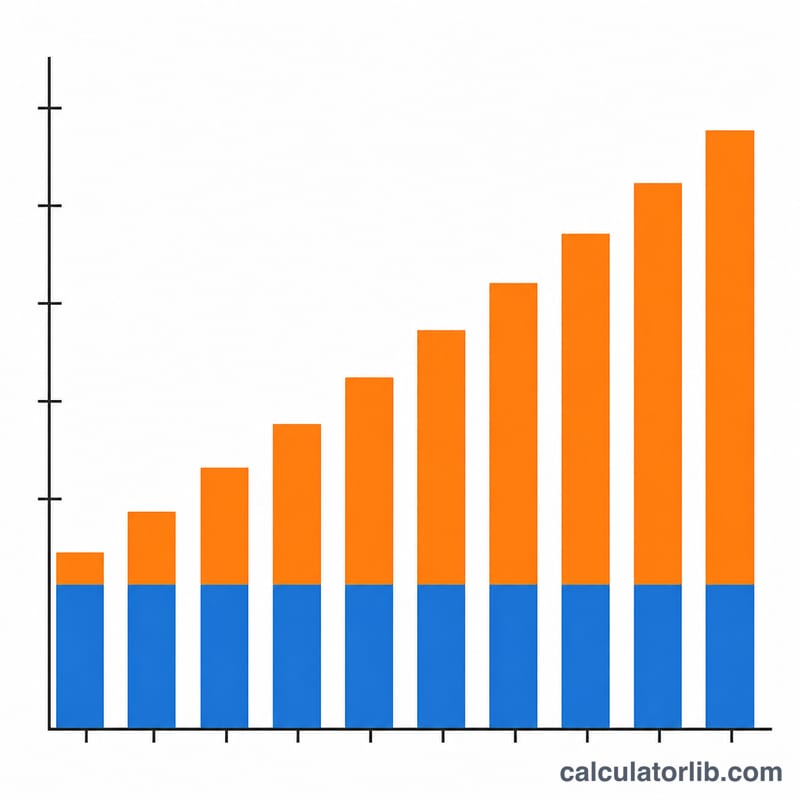
Simple interest is interest calculated only on the original principal, not on any interest already earned. It is widely used for short-term loans, car finance, certain savings products and bonds. Because the base never changes, the interest grows in a straight line over time, making it easy to predict.
How to Use This Calculator
Enter three values: the principal (\(P\)) — the initial amount invested or borrowed; the annual interest rate as a percentage; and the time in years (use decimals for partial years, e.g. 0.5 for six months). The calculator returns the total interest and the final amount.
The Formula Explained
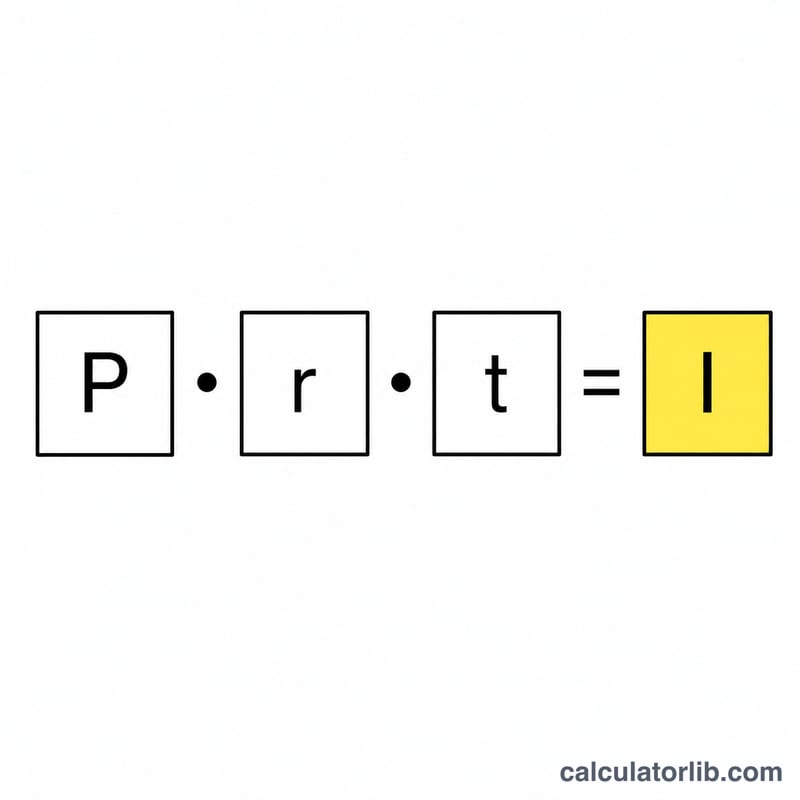
The core formula is $$I = P \cdot r \cdot t$$ where \(r\) is the rate written as a decimal (5% becomes 0.05). The total balance is $$A = P(1 + r t)$$ which simply adds the interest back to the principal. Unlike compound interest, no exponent is involved because interest is never reinvested.
Worked Example
Suppose you invest $1,000 at 5% per year for 3 years. Then \(r = 0.05\), so $$I = 1000 \times 0.05 \times 3 = \$150.$$ The total amount is $$A = 1000 \times (1 + 0.05 \times 3) = 1000 \times 1.15 = \$1{,}150.$$
FAQ
How is this different from compound interest? Simple interest is charged only on the principal, while compound interest is charged on principal plus accumulated interest, so it grows faster.
What if my time period is in months? Convert months to years by dividing by 12. For example, 18 months = 1.5 years.
Can the rate be entered as a decimal? Enter the rate as a percentage here (e.g. 5 for 5%). The calculator divides by 100 internally.