
What Is Simple Interest?
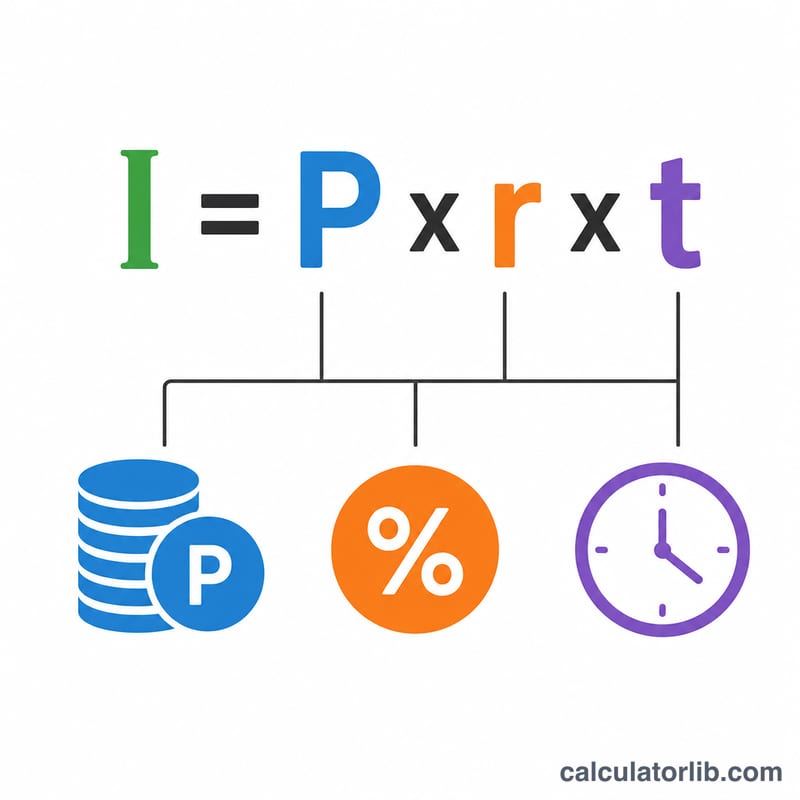
Simple interest is interest calculated only on the original principal — it does not compound on previously earned interest. It is widely used for short-term loans, car financing, and basic algebra coursework. This calculator applies the classic formula \(I = P \times r \times t\) and works for any currency, since it is a pure mathematical relationship.
How to Use This Calculator
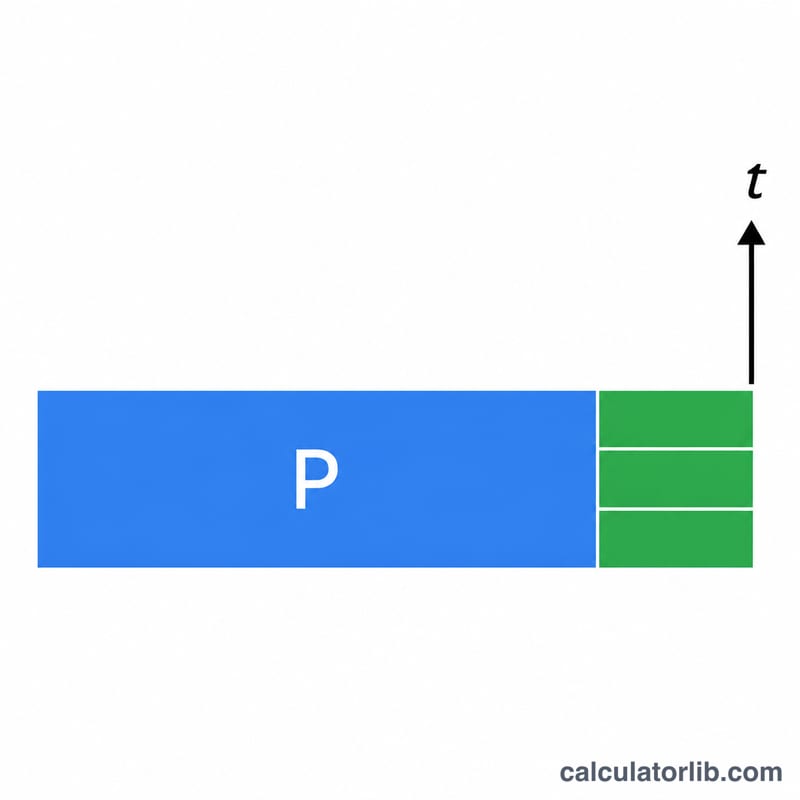
Enter three values: the Principal (P) you start with, the annual interest rate (r) as a percentage, and the time (t) in years. The calculator converts the rate to a decimal, multiplies the three terms, and reports the interest earned along with the total amount (principal plus interest).
The Formula Explained
The interest is given by \(I = P \cdot r \cdot t\), where r is the rate written as a decimal (for example, 5% becomes 0.05). The total balance is \(A = P + I = P(1 + rt)\). Because the rate is per year, time must also be expressed in years (use 0.5 for six months, or \(9/12 = 0.75\) for nine months).
Worked Example
Suppose you invest a principal of 1,000 at an annual rate of 5% for 3 years. Convert the rate: 5% = 0.05. Then $$I = 1{,}000 \times 0.05 \times 3 = 150.$$ The total amount becomes \(1{,}000 + 150 = 1{,}150\).
FAQ
How is simple interest different from compound interest? Simple interest is computed only on the principal, so it grows linearly. Compound interest adds earned interest back to the balance, so it grows faster over time.
What if my time is in months? Divide the number of months by 12. For example, 18 months = 1.5 years.
Can I find the principal or rate instead? Yes — rearrange the formula: \(P = I / (r \cdot t)\), \(r = I / (P \cdot t)\), and \(t = I / (P \cdot r)\).