
What Is the Percentage of 1RM Calculator?
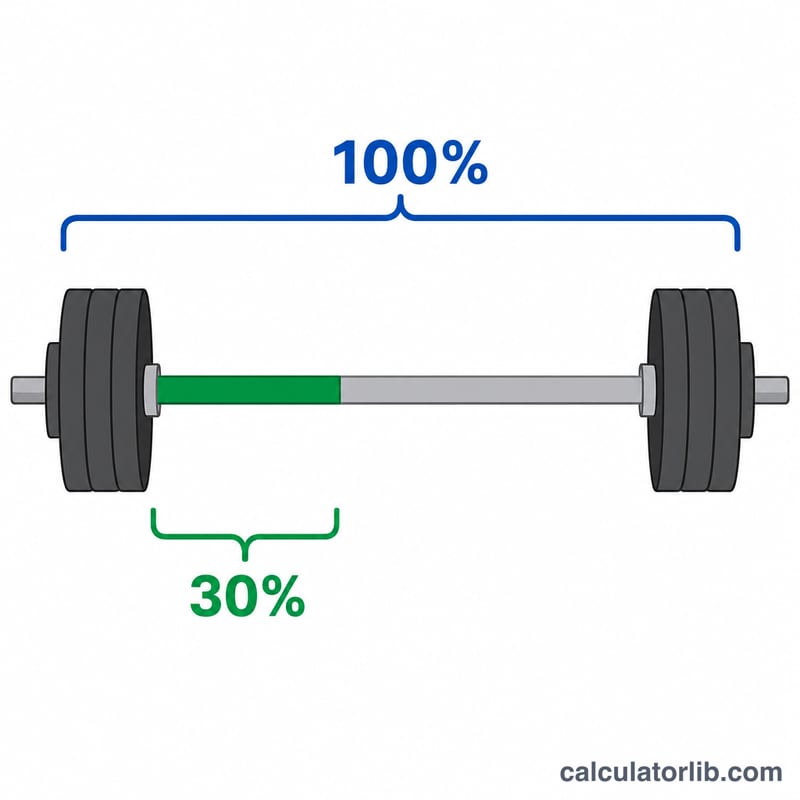
Your one-rep max (1RM) is the heaviest weight you can lift for a single repetition of an exercise. Most strength programs prescribe working sets as a percentage of this number — for example, "5 sets of 3 reps at 85% of 1RM." This calculator instantly converts any percentage into the actual weight you should load on the bar, taking the mental math out of your training.
How to Use It
Enter your one-rep max for a given lift (in pounds or kilograms — the unit is whatever you input). Then enter the target percentage from your program. The calculator multiplies them to return the exact training weight. The tool is unit-agnostic, so it works identically for kg or lb.
The Formula Explained
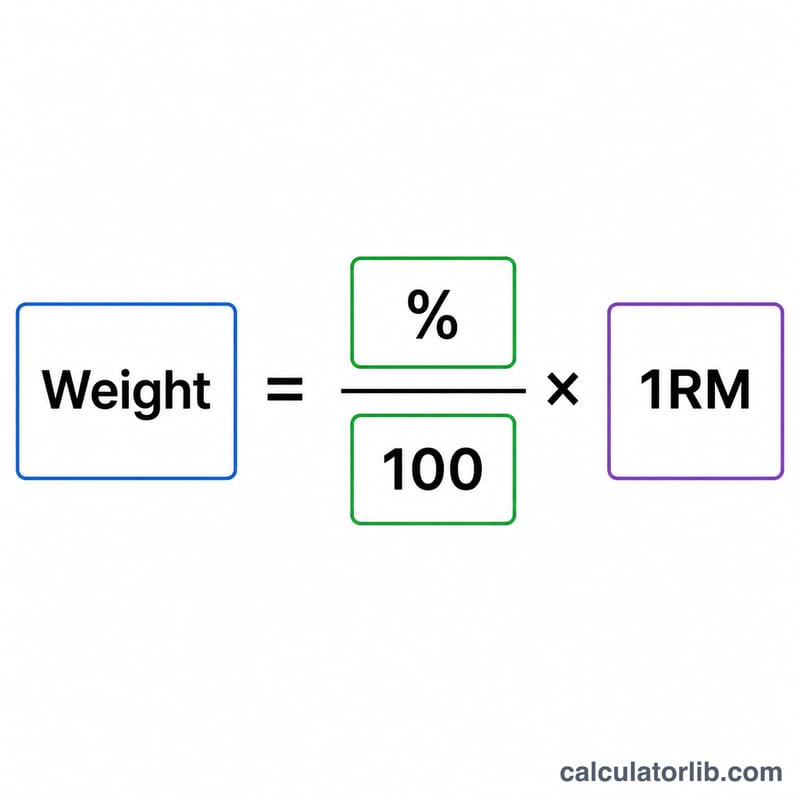
The math is straightforward: $$\text{Weight} = \frac{\text{Percent}}{100} \times \text{1RM}$$. The percentage is converted to a decimal fraction and multiplied by your max. A higher percentage means heavier weight and fewer reps; a lower percentage means lighter weight for higher-volume or technique work.
Worked Example
Suppose your squat 1RM is 200 kg and your program calls for 80%. The calculation is $$\left(\frac{80}{100}\right) \times 200 = 0.8 \times 200 = 160 \text{ kg}.$$ You would load 160 kg for those sets. For an accessory day at 60%, you would lift \(0.6 \times 200 = 120\) kg.
FAQ
What percentages should I use? Strength work often sits at 80–95% for low reps, hypertrophy around 65–80%, and endurance/technique below 60%. Always follow your specific program.
How do I find my 1RM? You can test it directly with a heavy single, or estimate it from a multi-rep set using a 1RM estimation formula.
Should I round the result? Round to the nearest available plate increment (e.g. 2.5 kg or 5 lb) for practicality.