
What Is a One Rep Max?
Your one rep max (1RM) is the most weight you can lift for a single repetition of a given exercise with good form. It is a key benchmark for strength athletes, powerlifters, and anyone programming progressive overload. Instead of risking injury by testing a true max under the bar, this calculator estimates your 1RM from a lighter set you can complete for multiple reps.
How to Use This Calculator
Enter the weight you lifted and the number of clean repetitions you completed (1–36). The tool returns three numbers: the Epley estimate, the Brzycki estimate, and the average of the two. Use the same unit (kilograms or pounds) for input and output. For best accuracy, use a set taken close to failure in the 2–10 rep range.
The Formulas Explained
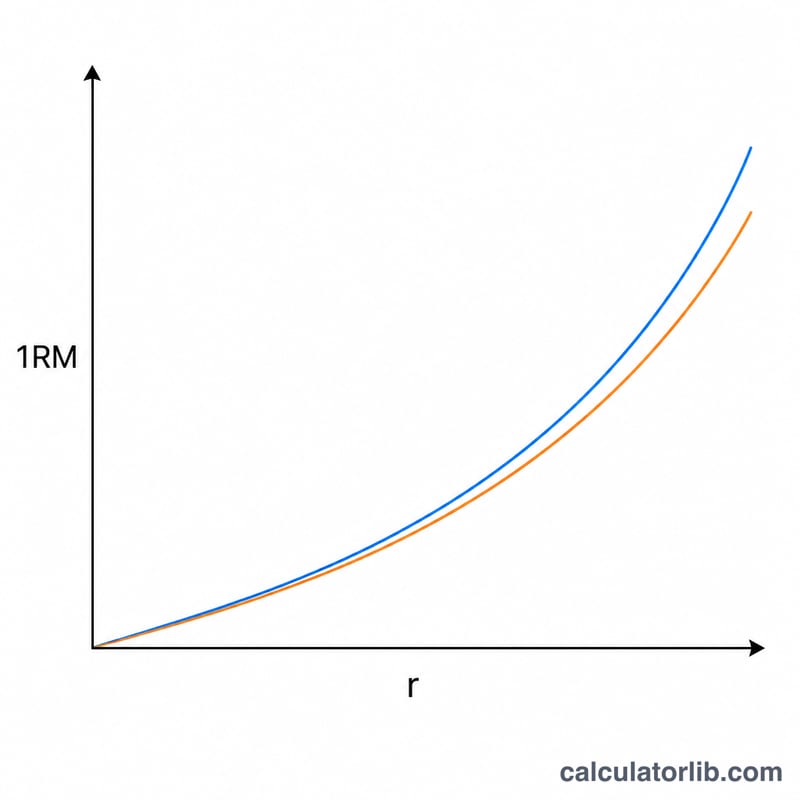
Two well-known equations are used. The Epley formula is \(\text{1RM} = w \times (1 + r/30)\), which scales the lifted weight up linearly with reps. The Brzycki formula is \(\text{1RM} = w \times 36 / (37 - r)\), which uses a hyperbolic relationship. Both give identical results at 1 rep and diverge slightly as reps increase — Epley typically reads a touch higher. Averaging them gives a balanced estimate.
Worked Example
Suppose you bench press 100 kg for 5 reps. Epley: $$100 \times \left(1 + \frac{5}{30}\right) = 100 \times 1.1667 \approx 116.67 \text{ kg}$$ Brzycki: $$\frac{100 \times 36}{37 - 5} = \frac{3600}{32} = 112.5 \text{ kg}$$ The average is $$\frac{116.67 + 112.5}{2} \approx 114.58 \text{ kg}$$ as your estimated 1RM.
FAQ
How accurate is a 1RM estimate? Estimates are most reliable for sets of 1–10 reps. Above 10 reps, fatigue and endurance factors make the prediction less precise.
Why do Epley and Brzycki differ? They use different mathematical models. Neither is "correct" — they bracket a likely range, so the average is a sensible single figure.
Does it work in pounds? Yes. The formulas are unit-agnostic, so enter pounds and you get pounds back.