
What Is a One-Rep Max (1RM)?
Your one-rep max (1RM) is the most weight you can lift for a single repetition of an exercise such as the deadlift, squat, or bench press. Knowing your 1RM is essential for designing training programs, since most strength routines prescribe loads as a percentage of it. Rather than risking injury by testing a true max, you can estimate your 1RM from a submaximal set using proven formulas.
How to Use This Calculator
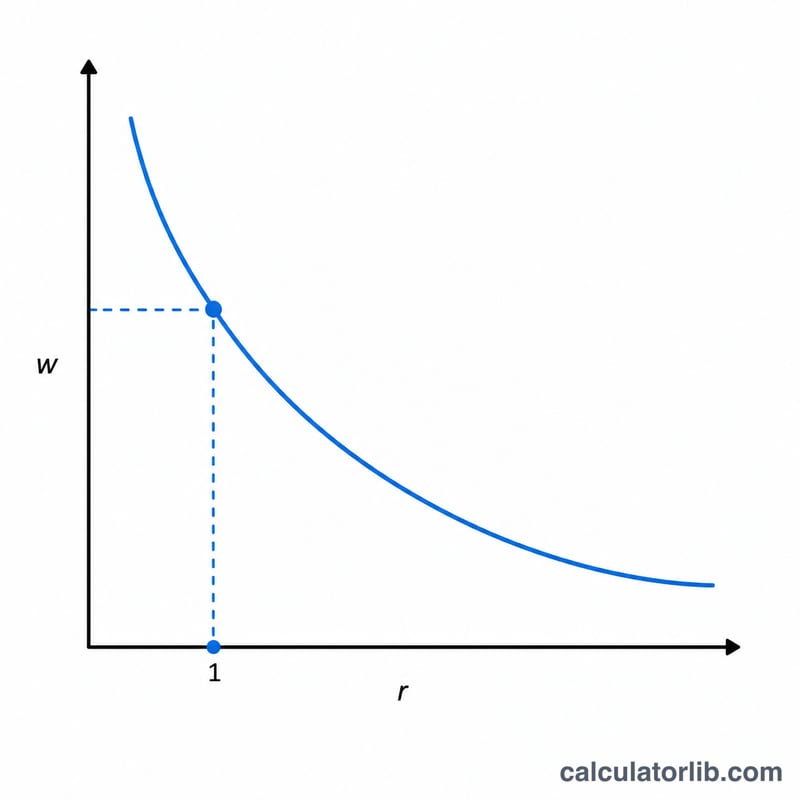
Enter the weight you lifted and the number of clean repetitions you completed before failure. The calculator returns your estimated 1RM using both the Epley and Brzycki equations, plus the average of the two. These estimates are most reliable for sets of 10 reps or fewer — accuracy drops as rep counts climb because fatigue and endurance become larger factors.
The Formulas Explained
The Epley formula is \(\text{1RM} = w \left(1 + \frac{r}{30}\right)\), where \(w\) is the weight and \(r\) is the reps. The Brzycki formula is \(\text{1RM} = w \cdot \frac{36}{37 - r}\). Both return exactly the lifted weight at a single rep and rise as reps increase. Brzycki tends to give slightly lower numbers at higher reps, so averaging the two provides a balanced estimate.
$$\text{1RM}_{\text{avg}} = \frac{\text{Epley} + \text{Brzycki}}{2}, \quad \begin{aligned} \text{Epley} &= \text{Weight} \left(1 + \frac{\text{Reps}}{30}\right) \\ \text{Brzycki} &= \text{Weight} \cdot \frac{36}{37 - \text{Reps}} \end{aligned}$$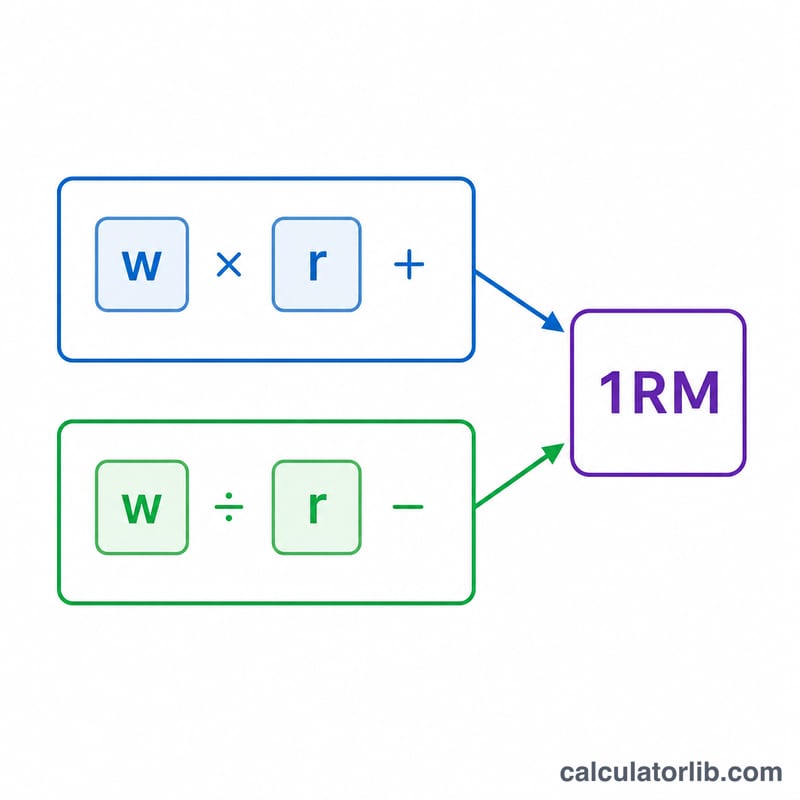
Worked Example
Suppose you deadlift 225 lbs for 5 reps. Epley: $$225 \times \left(1 + \frac{5}{30}\right) = 225 \times 1.1667 = 262.5 \text{ lbs}.$$ Brzycki: $$225 \times \frac{36}{37 - 5} = \frac{8100}{32} = 253.13 \text{ lbs}.$$ The average is $$\frac{262.5 + 253.13}{2} \approx 257.81 \text{ lbs},$$ your estimated one-rep max.
FAQ
Which formula is more accurate? Both are well validated. Epley is popular and simple; Brzycki is often preferred for sets of 2–10 reps. Using the average smooths out their differences.
Does it matter if I use kg or lbs? No — the formulas are unit-agnostic, so your result is in whatever unit you entered.
How many reps should I use? For best accuracy, test with a weight you can lift for 2 to 10 reps. Beyond 10 reps the estimate becomes less reliable.