
What Is the Brzycki 1RM Calculator?
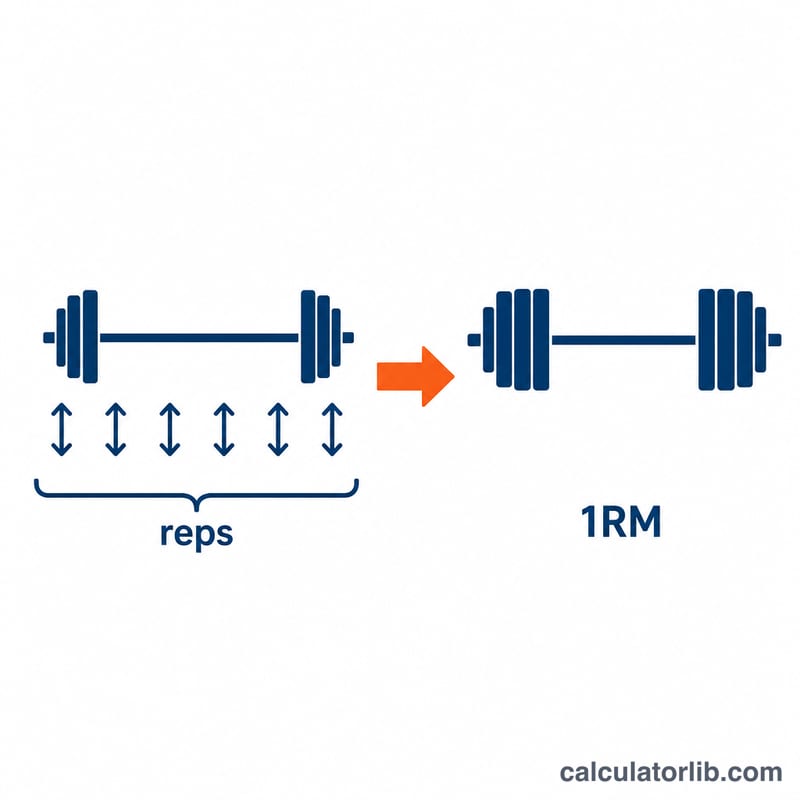
Your one-rep max (1RM) is the heaviest weight you can lift for a single repetition of an exercise. Testing it directly can be risky and fatiguing, so lifters often estimate it from a submaximal set. The Brzycki formula, developed by Matt Brzycki, is one of the most popular equations for this purpose. It uses the weight you lifted and the number of clean repetitions you completed to predict your true maximum.
How to Use It
Enter the weight you lifted for a set taken close to failure, then enter how many repetitions you completed with good form. The calculator returns your estimated 1RM in the same unit you entered (kg or lb). The formula is most accurate for sets of about 10 reps or fewer—the higher the rep count, the less reliable any 1RM estimate becomes.
The Formula Explained
The Brzycki equation is $$\text{1RM} = \text{Weight} \times \frac{36}{37 - \text{Reps}}$$ As reps increase, the denominator shrinks, scaling the lifted weight upward toward your true maximum. At a single rep, the formula returns the weight itself, since \(\frac{36}{37 - 1} = 1\).
Worked Example
Suppose you bench press 100 kg for 5 reps. Plugging in: $$\text{1RM} = 100 \times \frac{36}{37 - 5} = \frac{3600}{32} = 112.5 \text{ kg}$$ So your estimated one-rep max is about 112.5 kg.
Brzycki Rep-to-1RM Percentage Table
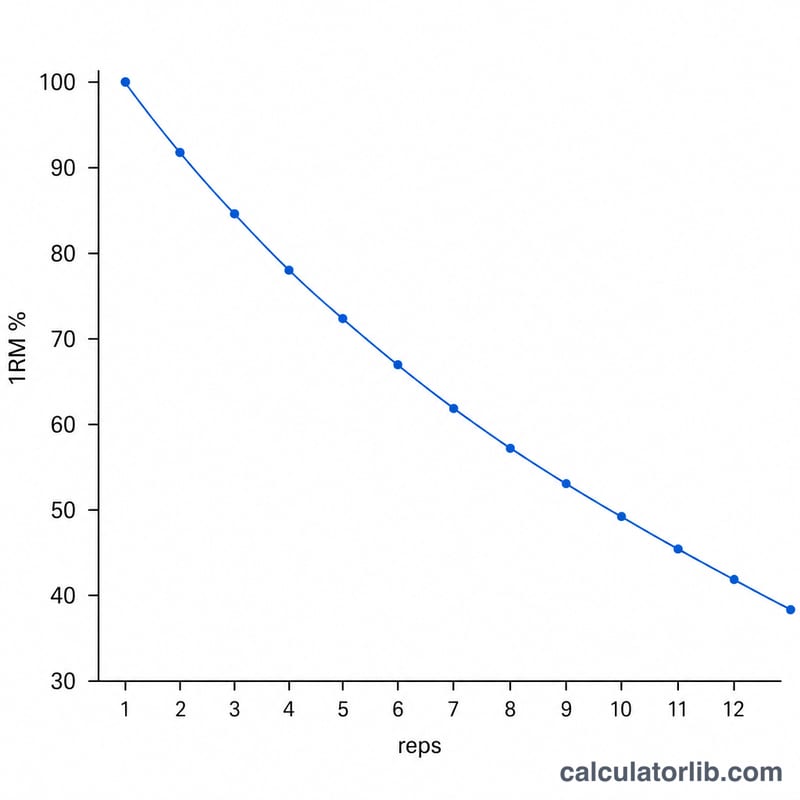
The Brzycki formula estimates your one-rep max as \(\text{1RM} = \text{Weight} \times \frac{36}{37 - \text{Reps}}\). For any given set, the weight you lifted represents a fixed percentage of your 1RM that depends only on the number of reps. That percentage is the reciprocal of the multiplier — i.e. \(\frac{37 - \text{Reps}}{36}\) — while the multiplier \(\frac{36}{37 - \text{Reps}}\) is what you scale the lifted weight by to reach your estimated max.
| Reps | % of 1RM | Multiplier 36/(37 − reps) |
|---|---|---|
| 1 | 100.0% | 1.000 |
| 2 | 97.2% | 1.029 |
| 3 | 94.4% | 1.059 |
| 4 | 91.7% | 1.091 |
| 5 | 88.9% | 1.125 |
| 6 | 86.1% | 1.161 |
| 7 | 83.3% | 1.200 |
| 8 | 80.6% | 1.241 |
| 9 | 77.8% | 1.286 |
| 10 | 75.0% | 1.333 |
| 11 | 72.2% | 1.385 |
| 12 | 69.4% | 1.440 |
For example, at 5 reps the multiplier is \(\frac{36}{37-5} = \frac{36}{32} = 1.125\), so a 5-rep set is performed at about 88.9% of your true maximum.
Interpreting Your 1RM Estimate
Your Brzycki result is a prediction of the single heaviest weight you could lift for one full repetition, inferred from a lighter set taken to or near failure. It is not a measured max — you never actually lifted that weight in the calculation — so treat it as a planning number rather than a verified performance.
Reliability is highest at low reps. The formula is most accurate in the roughly 1–10 rep range and is generally considered most reliable below about 10 reps. As reps climb toward and beyond 12, accuracy degrades quickly: factors like muscular endurance, technique breakdown, and breathing increasingly determine how many reps you complete, and these vary far more between individuals than maximal strength does. The Brzycki denominator \(37 - \text{Reps}\) also grows sensitive at high reps, and the formula is undefined at 37 reps, so estimates from very high-rep sets should be viewed with caution.
Brzycki tends to estimate lower than Epley at higher rep counts. The two agree closely at low reps but diverge as reps increase — for the same set, Epley's \(\text{Weight} \times (1 + \text{Reps}/30)\) typically returns a slightly higher 1RM than Brzycki for sets of about 6 or more reps. Comparing both can give you a sensible range rather than a single point estimate.
For the most useful results, base your estimate on a clean, hard set of around 2–6 reps performed close to failure with good form. If you need a true max for competition or precise programming, an actual tested 1RM under proper supervision remains the gold standard; the estimate is best used to set training loads, track progress over time, and avoid the risk of frequent maximal attempts.
FAQ
How accurate is the Brzycki formula? It is quite accurate for low rep ranges (1–10) but tends to underestimate at higher reps compared with other formulas like Epley.
Does the unit matter? No—the result is in whatever unit you input, whether kilograms or pounds.
What if I did only 1 rep? The formula returns the weight you lifted, which is your actual 1RM.