
What This Calculator Does
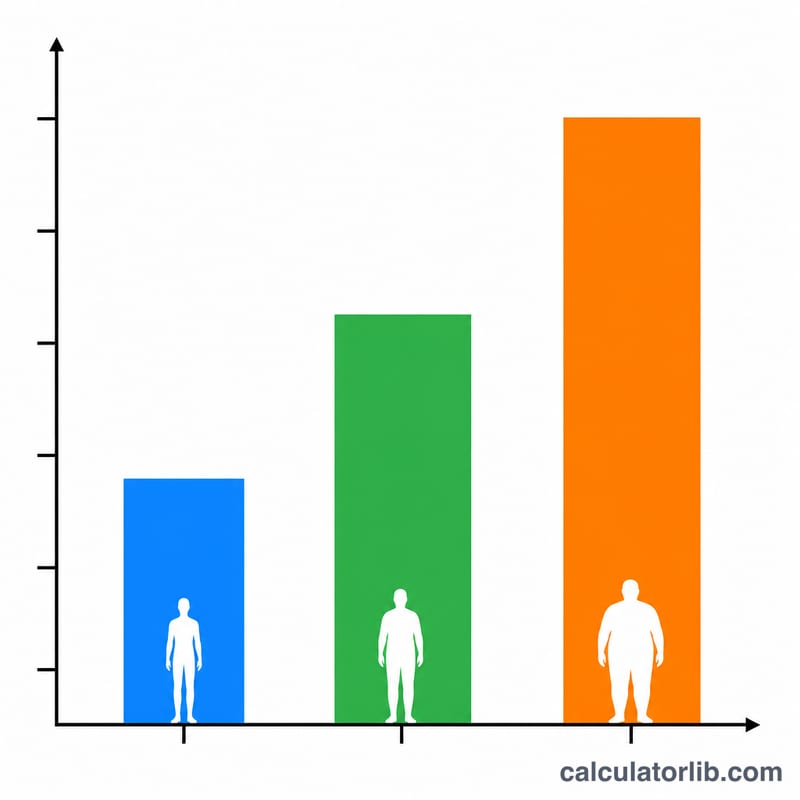
This tool estimates the number of calories you burn while running, based on two things that matter most: your body weight and the distance you cover. It relies on a well-known rule of thumb that the energy cost of running is roughly proportional to how heavy you are and how far you go — and is largely independent of pace, since covering the same ground faster simply burns the same energy in less time.
How to Use It
Choose your unit system, enter your body weight, and enter the distance you ran. The calculator returns the total estimated calories (kcal) for that run, plus the calories burned per mile or per kilometer so you can quickly scale it to other distances.
The Formula Explained
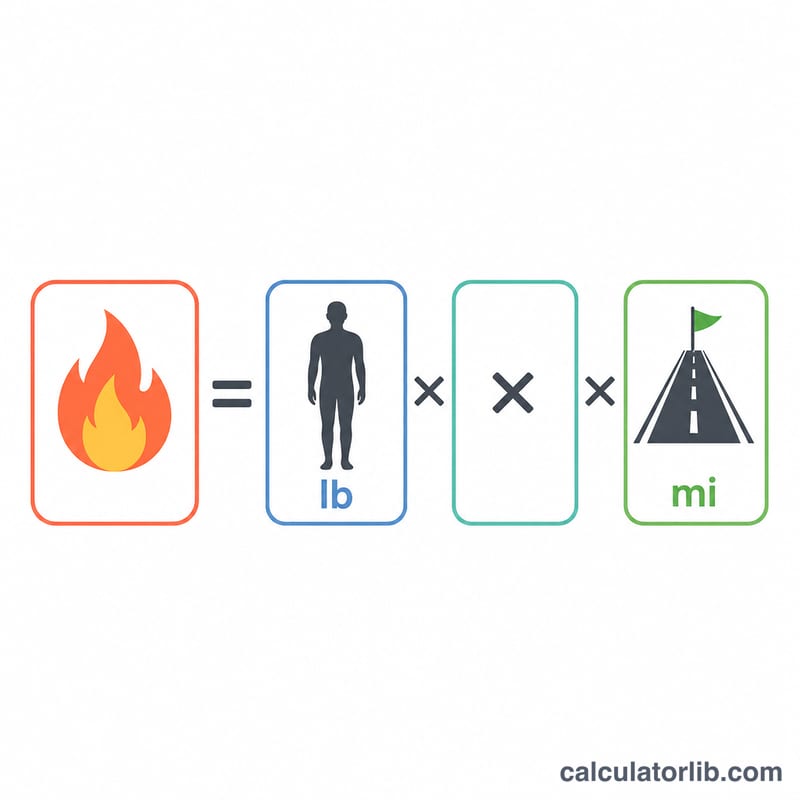
In imperial units the estimate is $$\text{kcal} \approx 0.75 \times \text{weight (lb)} \times \text{miles}$$. In metric units it becomes $$\text{kcal} \approx 1.036 \times \text{weight (kg)} \times \text{km}$$. The constant captures the gross energy cost of moving your body mass over distance. Heavier runners burn more because moving more mass requires more energy; longer runs scale linearly with distance.
Worked Example
A 160 lb runner completes a 5 mile run. Calories $$\approx 0.75 \times 160 \times 5 = 600 \text{ kcal}$$, or 120 kcal per mile. A 70 kg runner doing 10 km burns $$\approx 1.036 \times 70 \times 10 = 725 \text{ kcal}$$, about 72.5 kcal per kilometer.
FAQ
Does pace matter? Only slightly. The energy to move a given distance is fairly constant, so this estimate works for easy jogs and tempo runs alike.
Is this gross or net calories? It reflects gross energy expenditure. To find calories burned beyond resting, subtract your resting metabolic burn for the same time period.
Why is it different from a treadmill reading? Machines use their own algorithms and often assume a fixed weight. This calculator uses your actual weight for a more personal estimate.