
What Is the Life Expectancy Calculator?
This calculator gives an educational estimate of how long a person might live based on a gender-specific baseline and a series of lifestyle adjustments. It is not a medical or actuarial prediction — real life expectancy depends on genetics, healthcare, environment, and chance — but it illustrates how everyday habits can meaningfully shift the odds.
How to Use It
Enter your current age, select your gender, and answer the lifestyle questions: whether you smoke, your exercise level, and your alcohol consumption. The tool returns an estimated life expectancy in years, the lifestyle adjustment applied, and the number of years you may have remaining.
The Formula Explained
We start from a US average baseline (CDC, 2023) — about 76 years for men and 81 for women. Each lifestyle factor then adds or subtracts years. Smoking subtracts roughly 10 years. Some exercise (up to 75 minutes of brisk walking a week) adds 1.8 years, and being very active (450+ minutes a week) adds 4.5 years. Drinking 100–200 g of alcohol a week subtracts 0.5 years, 200–350 g subtracts 1.5 years, and more than 350 g subtracts 4.5 years. The total expectancy is the baseline plus all offsets, and years remaining is that figure minus your current age (never below zero).
$$\begin{gathered} E = B + \Delta - \text{Age} \\[1.5em] \text{where}\quad \left\{ \begin{aligned} B &= 76\ (\text{Male}),\quad 81\ (\text{Female}) \\ \Delta &= \Delta_{\text{smoke}} + \Delta_{\text{exercise}} + \Delta_{\text{alcohol}} \end{aligned} \right. \end{gathered}$$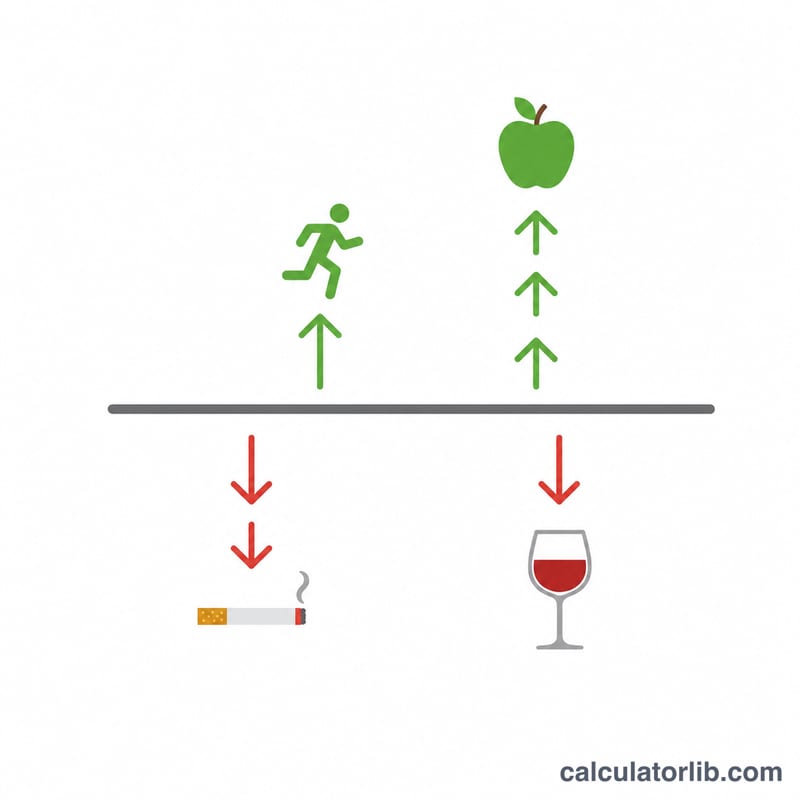
Worked Example
A 40-year-old woman who does not smoke, gets some exercise (+1.8), and drinks up to 100 g of alcohol a week (0) has a baseline of 81. Adding the offsets gives
$$81 + 1.8 = 82.8 \text{ years}$$With a current age of 40, her estimated years remaining is
$$82.8 - 40 = 42.8 \text{ years}$$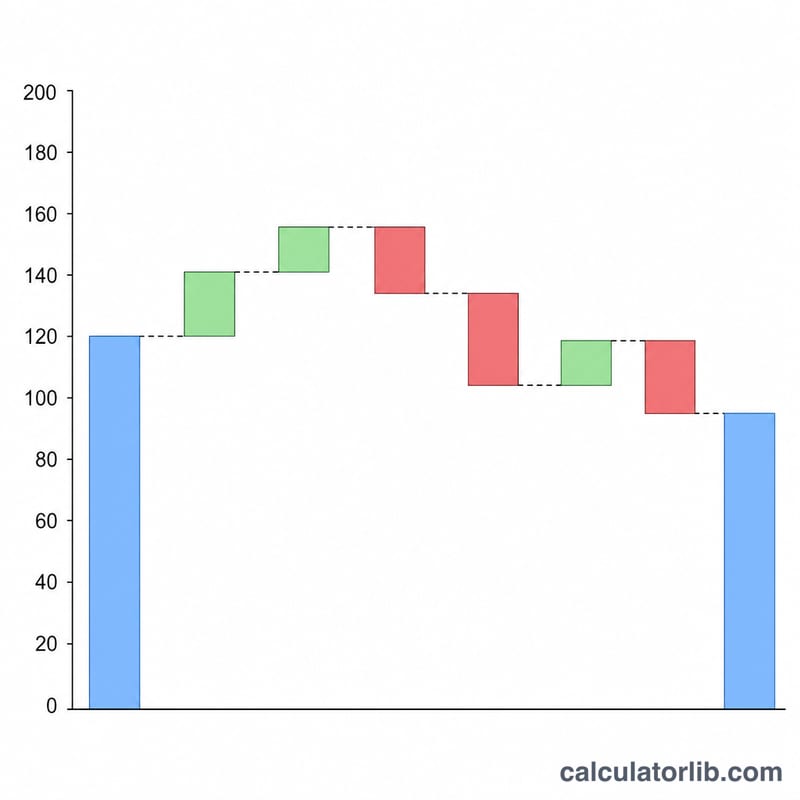
Lifestyle Adjustment Factors Used by This Calculator
This calculator uses a simple additive model: a gender-based baseline expectancy \(B\) in years, plus the sum of three lifestyle offsets \(\Delta\), minus your current age to give years remaining.
$$E = B + \Delta - \text{Age}, \qquad \Delta = \Delta_{\text{smoking}} + \Delta_{\text{exercise}} + \Delta_{\text{alcohol}}$$
The baselines below are the US average life expectancy at birth in 2023 (CDC): 75.8 years for men and 81.1 for women, rounded to 76 and 81; life expectancy varies substantially between countries. Every option is applied exactly as listed — the model does not weight factors by age or combine them in any other way.
| Input | Option selected | Offset applied (years) | How it enters the result |
|---|---|---|---|
| Gender | Male | Baseline \(B = 76\) | Starting value, not part of \(\Delta\) |
| Gender | Female | Baseline \(B = 81\) | Starting value, not part of \(\Delta\) |
| Smoking | Non-smoker | 0 | Added into \(\Delta\) |
| Smoking | Smoker | −10 | Added into \(\Delta\); largest single penalty in the model |
| Exercise | Very active (450+ min/week) | +4.5 | Added into \(\Delta\); largest single bonus |
| Exercise | Some (up to 75 min/week) | +1.8 | Added into \(\Delta\) |
| Exercise | None | 0 | Added into \(\Delta\) |
| Alcohol | Up to 100 g/week | 0 | Added into \(\Delta\); the neutral reference option |
| Alcohol | 100–200 g/week | −0.5 | Added into \(\Delta\) |
| Alcohol | 200–350 g/week | −1.5 | Added into \(\Delta\) |
| Alcohol | More than 350 g/week | −4.5 | Added into \(\Delta\) |
Two mechanical rules govern the output. First, all three lifestyle offsets are summed into a single \(\Delta\) — there is no cap, so selecting several unfavourable options stacks their penalties in full. Second, years remaining is floored at 0: if \(B + \Delta\) comes out at or below your entered age, the calculator reports 0 years remaining rather than a negative number. That floor is an output convention, not a prediction about the person.
Interpreting Your Estimate
The figure this calculator returns is a cohort-style average — roughly, the mean age at death you would expect across a large group of people who share the handful of characteristics you entered. It is not a forecast for you as an individual. Within any such group, actual ages at death are spread out over decades: some members die far earlier than the average and some live well past it. An average is the centre of a wide distribution, and the calculator shows you only the centre.
It also helps to understand what the number responds to. The output moves when you change a selection, not when your health changes. Choosing "very active" instead of "none" adds 4.5 years to the estimate because the model's table says so — the calculator has no information about your blood pressure, weight, cholesterol, family history, or any diagnosis. It cannot detect that you are currently healthy or currently unwell.
Several of the strongest real-world determinants of lifespan are not modelled at all:
- Genetics and family history, including inherited disease risk.
- Access to and quality of healthcare, which differs enormously between and within countries.
- Occupation and environment — physical hazard, shift work, air quality, road safety.
- Income, education and social circumstances, which in many countries track life expectancy more strongly than any single lifestyle item.
- Chance — accidents and acute illness are, by nature, unmodellable.
Because of that, the absolute number is the least reliable part of the result. What the model does more usefully is let you compare two scenarios. If you run your own inputs twice, changing one answer, the difference between the two results — the change in \(\Delta\) — reflects the relative weight the model assigns to that factor. A \(\Delta\) gap of 10 years between a smoking and a non-smoking profile is a meaningful statement about the model's ranking of risks; a specific output of "82.5" is not a meaningful statement about any one person's future.
One further distinction is worth keeping straight. Published "life expectancy" headlines are usually period life expectancy at birth: the average age at death implied by one year's mortality rates, applied to a hypothetical newborn. Remaining expectancy at an attained age is a different quantity and is normally higher in total, because you have already survived the earlier-life mortality that pulls the at-birth figure down. A 70-year-old in a country with a life expectancy at birth of 79 typically has an expected total lifespan above 79, not below it. This calculator's subtraction of your current age from \(B + \Delta\) is a simplification and does not reproduce that survivorship effect, so its results for older ages are especially approximate.
This tool is educational only. It is general information, not professional or medical advice, and it is not a substitute for clinical assessment, a risk score used by a clinician, or an insurer's underwriting model. It makes no recommendation about what you should do, and no result from it — high or low — should be read as a diagnosis, a reassurance, or a reason to start, stop or change any treatment. Questions about your own health belong with a qualified healthcare professional who can examine your actual history.
Life expectancy in United States
How long people in United States live on average from birth, compared with the world, from the World Bank.
- Life expectancy 2024
- 78.9 years
- World 2024
- 73.5 years
- Change since 1960
- +9.1 years
Latest change Up +0.5 years 2024: 78.9 years, against 78.4 years in 2023.
A child born in United States in 2024 can expect to live 78.9 years on average (world: 73.5 years).
| Year | United States | World |
|---|---|---|
| 2024 | 78.9 | 73.5 |
| 2020 | 77.0 | 72.2 |
| 2010 | 78.5 | 70.7 |
| 2000 | 76.6 | 67.7 |
| 1990 | 75.2 | 65.1 |
| 1980 | 73.6 | 62.2 |
| 1970 | 70.8 | 57.9 |
| 1960 | 69.8 | 50.9 |
Life expectancy at birth is an average for the whole population, not a personal prediction.
United States and other countries
Life expectancy at birth, in years — each country’s latest published year.
- Japan 84.0 years (2024)
- South Korea 83.6 years (2024)
- France 83.0 years (2024)
- Saudi Arabia 79.0 years (2024)
- United States 78.9 years (2024)
- China 78.0 years (2024)
- Türkiye 77.4 years (2024)
- Mexico 75.3 years (2024)
- Vietnam 74.7 years (2024)
- World 73.5 years (2024)
- Russia 73.4 years (2024)
- India 72.2 years (2024)
No published figure yet for Taiwan.
Years can differ between rows: each figure is shown with its own year. The same World Bank indicator for every country.
Latest figure: 2024 Data last updated 2026-10-18 · older figure
Source: The World Bank Group CC BY 4.0
Differences and changes are computed by CalculatorLib from these data.
Source details and methodology
- The World Bank Group — World Development Indicators (SP.DYN.LE00.IN)
FAQ
Is this a medical prediction? No. It is a simplified educational model using population averages and rough factor weights.
Why does gender change the baseline? Women statistically outlive men in nearly every country, so the model uses separate baselines.
Can my number exceed the baseline? Yes — strong positive habits (an active lifestyle) can push the estimate above the baseline figure.