
What is the caffeine half-life calculator?
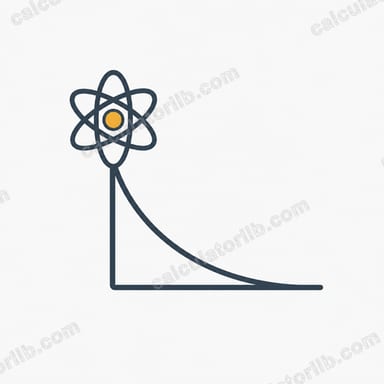
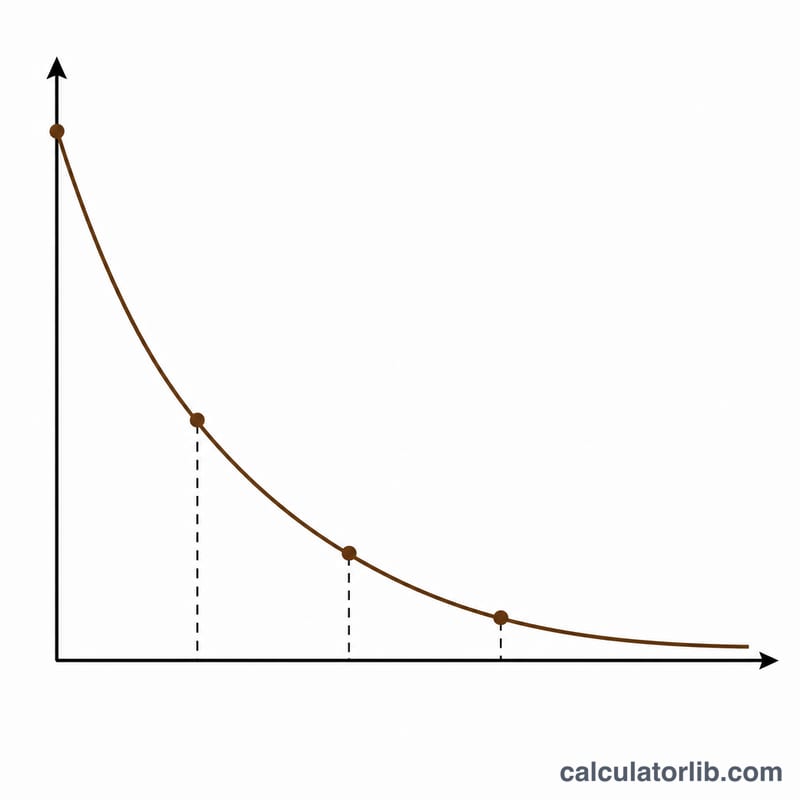
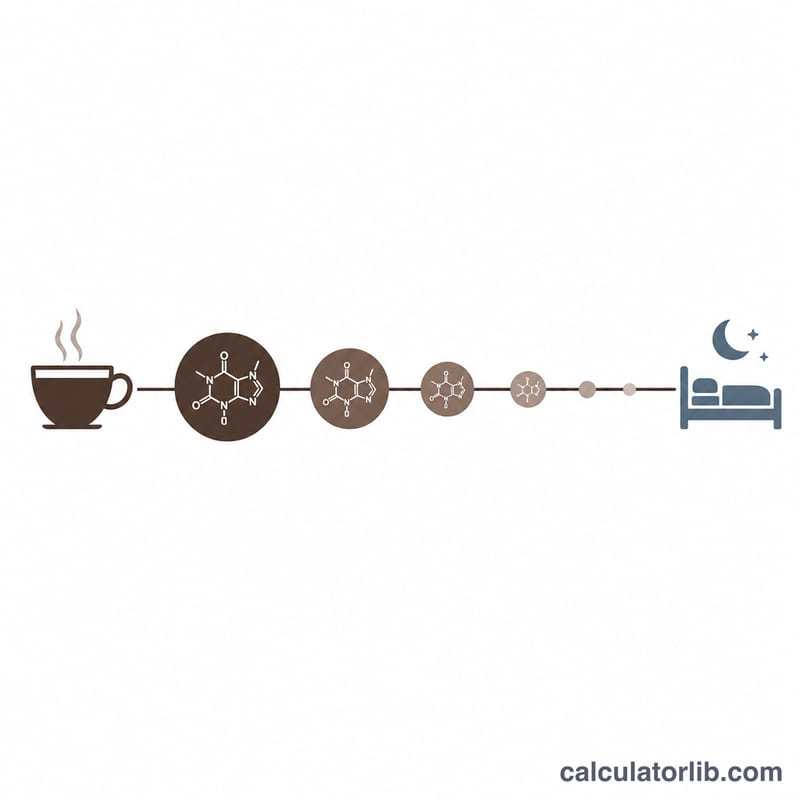
This tool estimates how much caffeine is still circulating in your body a given number of hours after you drank coffee, tea, soda, or an energy drink. Caffeine is cleared from the bloodstream following exponential decay, and the average adult's caffeine half-life is roughly 5 hours — meaning half of the dose is gone every 5 hours. By entering your dose and how long ago you had it, you can see whether enough remains to disturb your sleep at bedtime.
How to use it
Enter the caffeine consumed in milligrams (a typical 8 oz brewed coffee ≈ 95 mg, an espresso shot ≈ 64 mg, a 12 oz cola ≈ 35 mg). Enter how many hours have passed since you drank it. The half-life defaults to 5 hours; you can change it to model fast or slow metabolizers — smokers clear caffeine faster (≈3 hours) while pregnancy or some medications slow it dramatically (up to 9+ hours).
The formula explained
The calculator uses $$\text{remaining} = \text{initial} \times 0.5^{\frac{\text{hours}}{\text{half-life}}}$$ Each time the elapsed hours equal one half-life, the exponent increases by 1 and the remaining amount halves. The percent remaining is simply the remaining amount divided by the initial dose.
Worked example
Suppose you drink a 200 mg coffee and want to know what's left after 6 hours, using a 5-hour half-life: $$200 \times 0.5^{6/5} = 200 \times 0.5^{1.2} \approx 200 \times 0.43528 \approx 87.06 \text{ mg}$$ That's about 43.5% of the original dose — still enough to affect sleep in caffeine-sensitive people.
FAQ
What is a normal caffeine half-life? About 5 hours in healthy adults, but it ranges from 1.5 to 9.5 hours depending on genetics, smoking, pregnancy, and medications.
How much caffeine is safe before bed? Research suggests keeping caffeine under about 100 mg in the 6 hours before sleep, though sensitivity varies widely.
Is this medical advice? No. This is an educational estimate based on average pharmacokinetics and should not replace professional guidance.