

What Is the Cat Litter Box Calculator?
This calculator tells you how many litter boxes your household should have based on the number of cats you own. It applies the popular feline-care guideline often summarized as the "one plus one" rule: provide one litter box per cat, plus one extra. Having enough boxes reduces stress, territorial conflict, and litter-box avoidance — a leading cause of inappropriate elimination in cats.
How to Use It
Enter the total number of cats living in your home and the calculator instantly returns the recommended number of litter boxes. For multi-floor homes, it's also wise to place at least one box on each level. Spread boxes out in quiet, accessible locations rather than clustering them together.
The Formula Explained
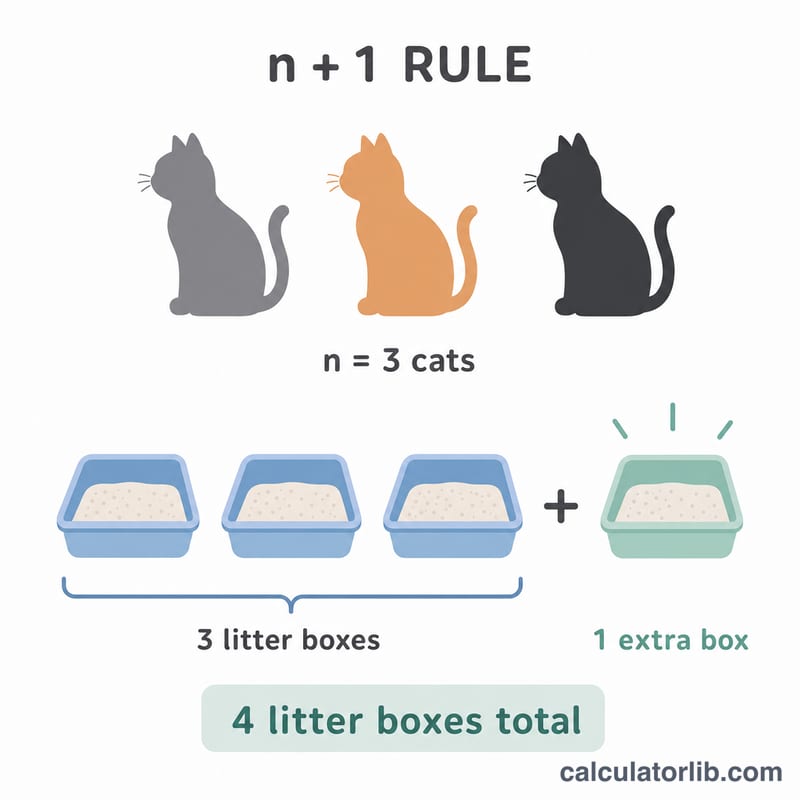
The math is simple: $$\text{Litter Boxes} = \text{Number of Cats} + 1$$ The "+1" extra box gives cats a choice and ensures a clean option is always available, which is especially important in multi-cat households where one cat may guard a resource. Some specialists scale this further in very large groups, but the plus-one rule is the standard baseline.
Worked Example
Suppose you have 3 cats. Using the formula: $$3 + 1 = 4$$ litter boxes. So you should maintain four boxes, ideally distributed across different rooms or floors so no cat has to travel far or compete for access.
FAQ
Why one extra box? The spare box prevents conflict and gives cats an alternative if one box is dirty or "claimed" by a dominant cat.
Can two cats share one box? They can, but sharing increases stress and accidents. Following the plus-one rule keeps everyone comfortable.
How often should I scoop? Scoop each box at least once daily and fully change the litter weekly to keep cats using their boxes reliably.