
What this calculator does
This tool estimates a starting insulin dose for a diabetic cat based on its body weight and a chosen per-kilogram dose. It is intended for educational reference only. Feline diabetes management is highly individual, and the actual dose must always be set and adjusted by a veterinarian using blood glucose curves and clinical monitoring. Never change your cat's insulin without veterinary guidance.
How to use it
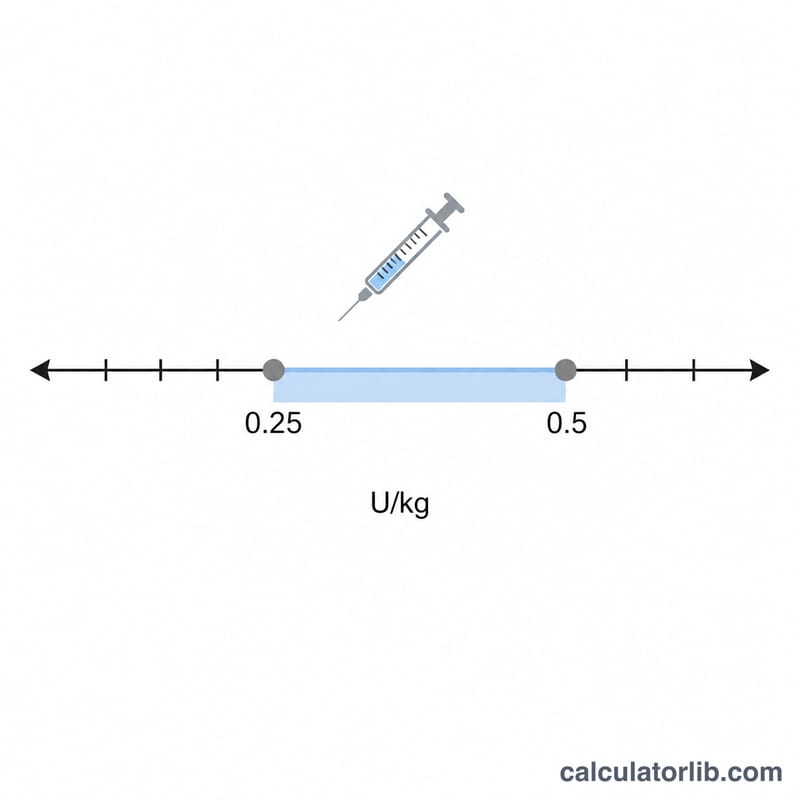
Enter your cat's weight in kilograms and a dose per kilogram (commonly 0.25–0.5 U/kg for intermediate or long-acting insulins such as glargine or PZI). The calculator multiplies the two values to estimate total units per injection and also shows the low and high ends of the typical range so you can see where your chosen dose falls.
The formula explained
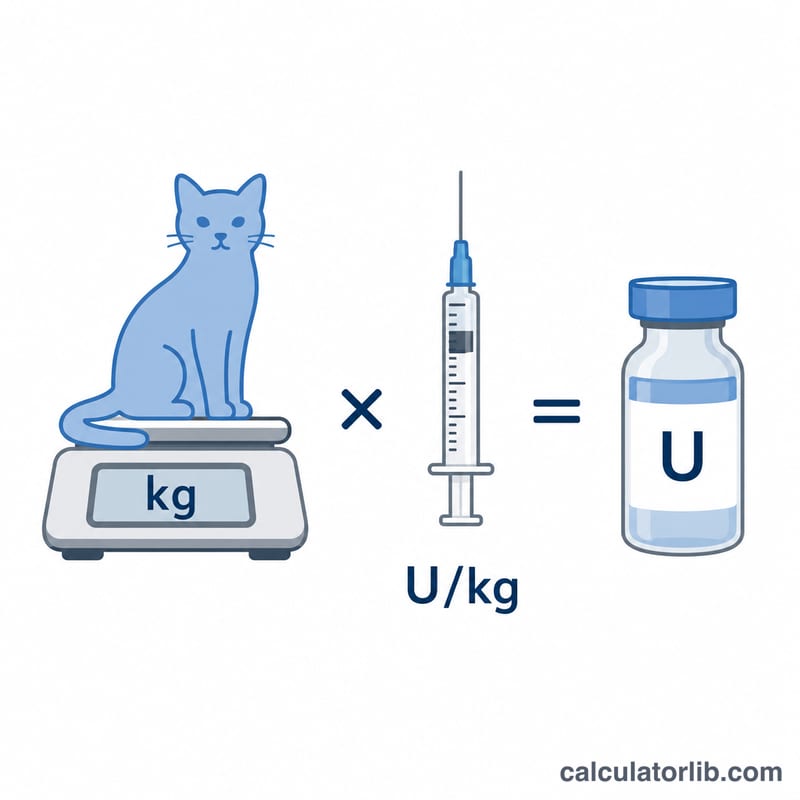
The core equation is simply $$\text{Units} = \text{Dose per kg} \times \text{Weight}$$ Because feline insulin needs vary, clinicians usually start conservatively, often at the lower 0.25 U/kg end, and titrate upward. The low-end and high-end figures shown are \(0.25 \times \text{weight}\) and \(0.5 \times \text{weight}\) respectively.
Worked example
For a 4 kg cat dosed at 0.25 U/kg: $$0.25 \times 4 = 1.0 \text{ unit}$$ per injection. The same cat at the 0.5 U/kg high end would be \(0.5 \times 4 = 2.0\) units. A 5 kg cat at 0.5 U/kg would be \(0.5 \times 5 = 2.5\) units.
FAQ
Is this a substitute for a vet? No. It is an educational estimate only. Insulin dosing must be individualized and monitored by a veterinarian.
How often is insulin given? Most cats receive insulin every 12 hours, but frequency and type are set by your vet.
Why a range? Cats vary widely in insulin sensitivity, so vets typically start low and adjust based on glucose curves.