What this calculator does
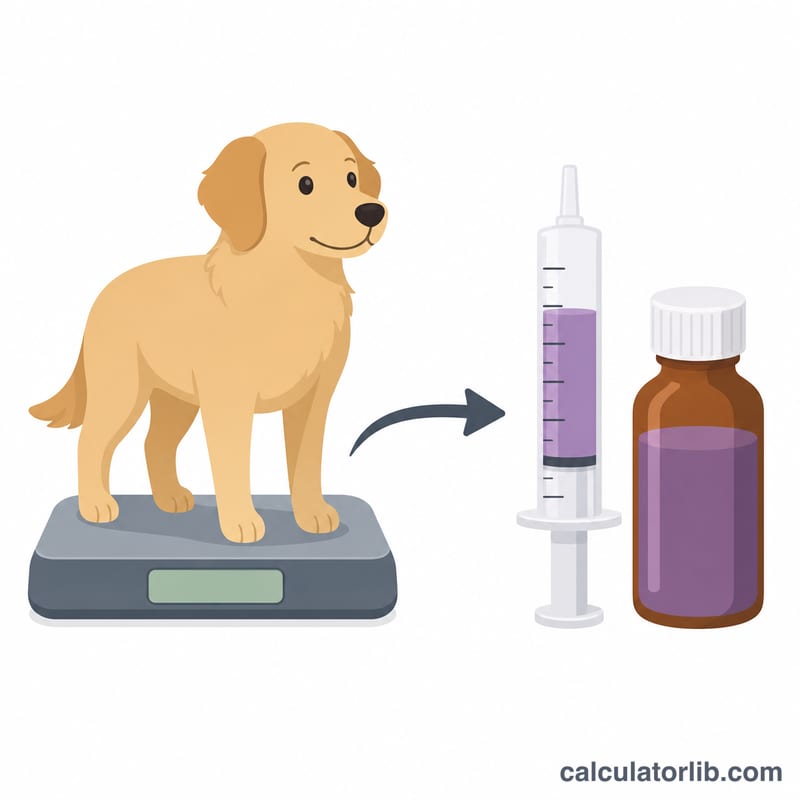
This tool estimates a reference dose of liquid Pepto-Bismol (bismuth subsalicylate) for a dog based on body weight. A commonly cited veterinary range for the regular-strength liquid is about 0.5 to 1.0 mL per kilogram of body weight, given every 6 to 8 hours for a short period (usually no more than 2–3 doses). It is intended for occasional, mild upset stomach or diarrhea. This is educational information only and is not a substitute for veterinary advice.
How to use it
Enter your dog's weight and choose kilograms or pounds. The calculator converts pounds to kilograms automatically and shows a low-end and high-end dose in milliliters, plus the recommended frequency. Start at the lower end and never exceed the high end without veterinary guidance.
The formula explained
The dose is simply a per-kilogram rate multiplied by weight: $$\text{dose\_mL} = (0.5 \text{ to } 1.0) \times \text{weight\_kg}$$ If you enter pounds, weight is first converted with \(\text{kg} = \text{lb} \times 0.45359237\). The result is a range because the appropriate amount depends on the dog and the situation.
Worked example
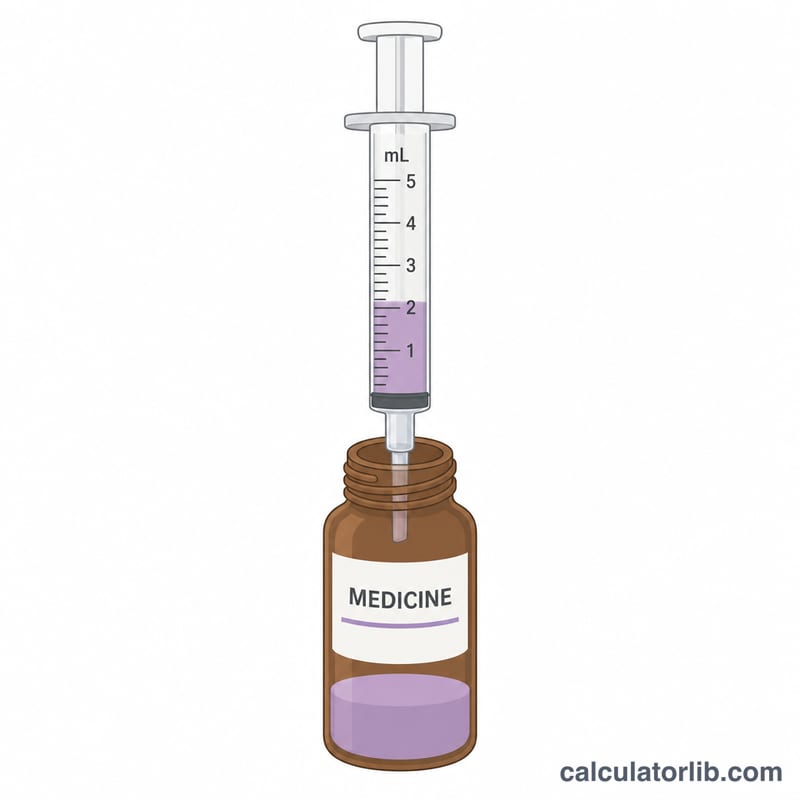
For a 10 kg dog: low end = $$0.5 \times 10 = 5 \text{ mL}$$ high end = $$1.0 \times 10 = 10 \text{ mL}$$ So roughly 5–10 mL of liquid Pepto-Bismol every 6–8 hours, with a maximum of a couple of doses.
Dose Comparison by Dog Weight
The table applies the calculator's formula, \(\text{Dose (mL)} = 0.5 \text{ to } 1.0 \times \text{Weight (kg)}\), to common dog weights. Pounds are converted to kilograms by multiplying by 0.45359237. Values are rounded to one decimal place for mL and two for kg.
| Dog weight (lb) | Dog weight (kg) | Low dose at 0.5 mL/kg | High dose at 1.0 mL/kg |
|---|---|---|---|
| 5 lb | 2.27 kg | 1.1 mL | 2.3 mL |
| 10 lb | 4.54 kg | 2.3 mL | 4.5 mL |
| 20 lb | 9.07 kg | 4.5 mL | 9.1 mL |
| 50 lb | 22.68 kg | 11.3 mL | 22.7 mL |
| 100 lb | 45.36 kg | 22.7 mL | 45.4 mL |
Example of the arithmetic for a 20 lb dog: \(20 \times 0.45359237 = 9.07\) kg, so the low value is \(0.5 \times 9.07 \approx 4.5\) mL and the high value is \(1.0 \times 9.07 \approx 9.1\) mL.
These are educational reference values only, not personal dosing advice. Your veterinarian should confirm whether this medication is appropriate for your dog and what the final dose should be.
Interpreting Your Result
The calculator returns two numbers. The low-end value uses 0.5 mL per kg of body weight and the high-end value uses 1.0 mL per kg. This is a commonly cited range for regular-strength Pepto-Bismol liquid (bismuth subsalicylate, typically about 262 mg per 15 mL in the United States). Formulations differ between countries and brands, so check the label.
Why a range? Published guidance varies, and individual dogs differ in size, health, age and other medications. A range reflects that variation. It does not mean any value in the range is right for a given dog.
Frequency and limits. Each result is a single-dose amount. Commonly cited guidance repeats a dose no more often than every 6 to 8 hours, and stops after about 2 to 3 doses. Multiplying the result by more doses does not create a larger single dose. Total exposure is limited because bismuth subsalicylate contains a salicylate, related to aspirin.
24-hour limit. The Merck Veterinary Manual gives 1–3 mL/kg in 24 hours, in divided doses, and says there is no precise dose for animals. The result shows this range for your dog's weight next to the 24-hour total of the doses you entered.
Product type. The figures apply only to regular-strength liquid. Extra-strength liquid, chewable tablets, caplets and other products have different concentrations or ingredients. This formula does not apply to them.
Warning signs to stop and contact a veterinarian:
- Symptoms that last more than 24 to 48 hours
- Symptoms that get worse
- Black or tarry stool. Bismuth can darken stool harmlessly, but the same sign can also indicate bleeding, so it is hard to tell them apart at home.
- Ongoing or repeated vomiting
- Lethargy, weakness, refusal to drink, or signs of dehydration
Veterinarians often advise against this product for some dogs, including those taking NSAIDs or aspirin, puppies, pregnant dogs, and dogs with bleeding disorders or certain other conditions. Cats should not be given it. This is general information, not veterinary advice. Always confirm with your veterinarian before giving any medication.
FAQ
Can I give Pepto-Bismol to cats? No. The salicylate component is dangerous for cats — never use it without a veterinarian's direction.
How long can my dog take it? Only for a short time. If symptoms persist beyond 24–48 hours or worsen, stop and see your vet.
Are there risks? It can darken the stool (which may mask blood), interact with other medications, and is not suitable for dogs with bleeding disorders, salicylate sensitivity, or that are pregnant. Always confirm with your vet first.