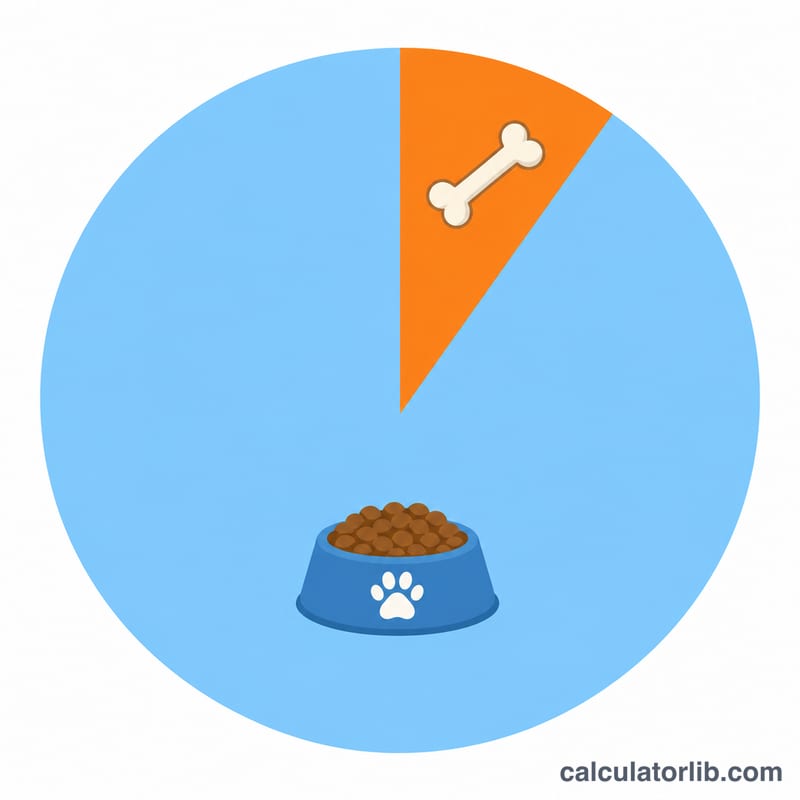
The Dog Treat Calorie Limit Calculator estimates the maximum number of calories your dog should get from treats each day, following the widely recommended veterinary 10% rule: treats should never exceed 10% of a dog's total daily calorie intake. The remaining 90% should come from a complete and balanced diet so your dog gets proper nutrition.
How to Use It
Enter your dog's body weight in kilograms and choose the activity or life-stage option that best matches your pet. The calculator first estimates daily calorie needs, then returns 10% of that figure as the safe treat budget. Compare this number to the calorie content printed on your treat packaging to know how many treats are okay.
The Formula Explained
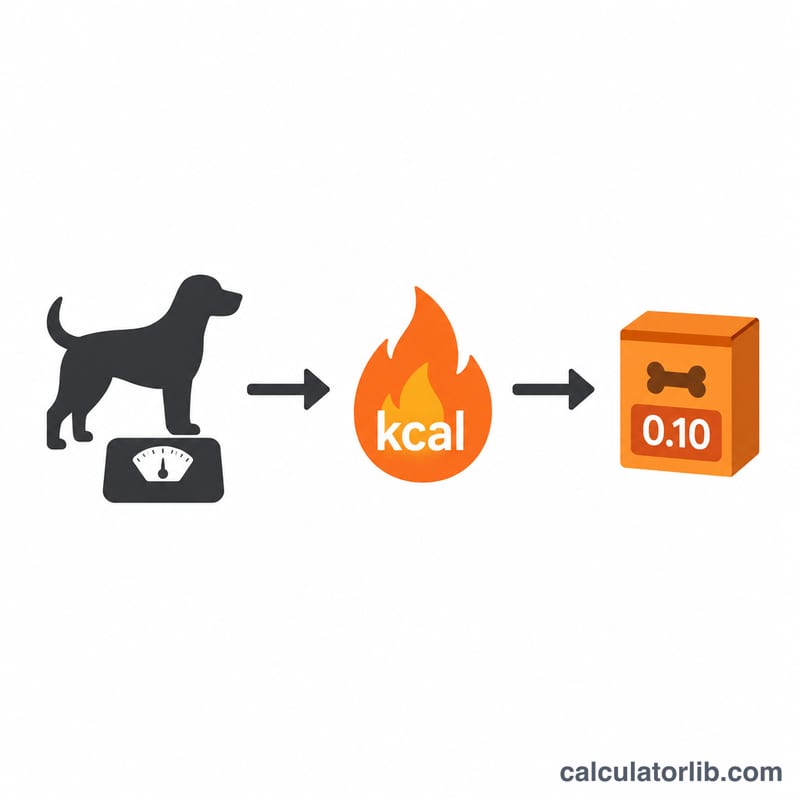
We start with the Resting Energy Requirement: \( \text{RER} = 70 \times \left(\text{weight in kg}\right)^{0.75} \). We multiply RER by an activity factor (k) to get the Maintenance Energy Requirement (MER), the dog's total daily calorie need. The treat limit is simply \( 0.10 \times \text{MER} \).
The 10% rule: treats should make up no more than a tenth of a dog's daily calories.
Worked Example
A 15 kg neutered adult dog (activity factor 1.6):
$$ \text{RER} = 70 \times 15^{0.75} = 70 \times 7.622 \approx 533.6 \text{ kcal} $$ $$ \text{MER} = 533.6 \times 1.6 \approx 853.7 \text{ kcal} $$ $$ \text{Treat limit} = 0.10 \times 853.7 \approx 85.4 \text{ kcal per day from treats} $$
From a dog's weight to its daily calorie needs, then ten percent for treats.
FAQ
Why only 10%? Treats are usually not nutritionally complete. Keeping them under 10% prevents nutritional imbalance and weight gain.
Is this a substitute for vet advice? No. These are general estimates. Always consult your veterinarian, especially for puppies, pregnant dogs, or pets with health conditions.
Do I subtract treat calories from meals? Yes. To avoid overfeeding, count treats toward the daily total and reduce meal portions accordingly.
Sources & References
Nutrition in Disease Management in Small Animals — Merck Veterinary Manual (Merck & Co., Inc.). Most treats are not complete and balanced: keep them under 10% of total daily calories. · Verified 2026-11-07
Nutritional Requirements of Small Animals — Merck Veterinary Manual (Merck & Co., Inc.). RER = 70 x kg^0.75; dog MER: intact 1.8, neutered 1.6, obesity prone 1.4, puppies 3 (over 4 months 2) x RER. · Verified 2026-11-07
WSAVA Nutritional Assessment Guidelines — WSAVA Nutritional Assessment Guidelines Task Force; Freeman L et al., J Small Anim Pract 2011;52:385-396. WSAVA assesses body fat with a 9-point body condition score; the goal for most pets is 4 to 5 of 9. · Verified 2026-11-07
Checked against these sources on . Not reviewed by a clinician. For general information only, not veterinary advice. Ask a veterinarian about your animal's health and before giving it any medicine.
Estimate a pregnant dog's daily calorie needs from her weight and week of pregnancy: maintenance for weeks 1 to 6, then 20% to 30% more in weeks 7 to 9.
Enter age, gender, height, weight, and activity to get daily calories. See your BMR, maintenance, and targets for weight loss or gain. Metric/imperial.
Calculate calories burned during burpee exercises with this Burpee Calorie Calculator. Input weight, number of burpees, and time to accurately estimate your calorie burn for effective workout planning.
Estimate Clavamox (amoxicillin/clavulanate) dosage for dogs by weight. Calculates mg per dose every 12 hours using the US label rate, 6.25 mg/lb (about 13.78 mg/kg).