
What is the Dog Litter Size Calculator?
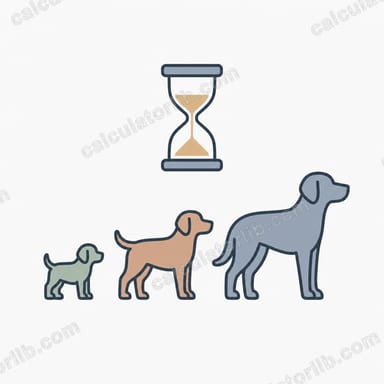
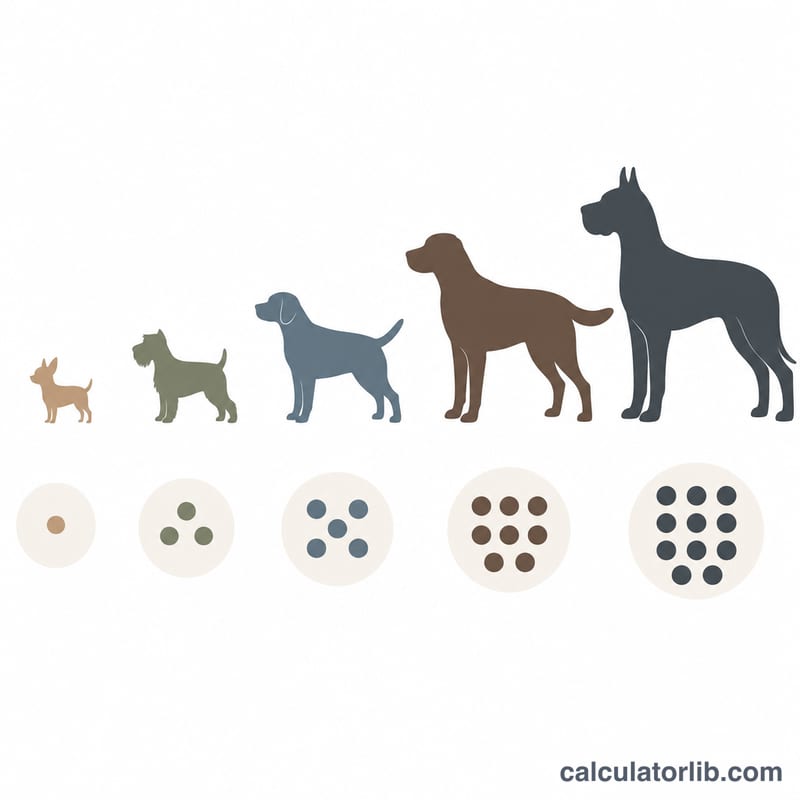
The Dog Litter Size Calculator gives a rough estimate of how many puppies a pregnant dog may deliver. Litter size in dogs depends heavily on breed size: small breeds tend to have a few puppies, while large and giant breeds often have much bigger litters. This tool combines a breed-size factor with the dog's body weight to produce a quick, friendly estimate and a likely range.
How to use it
Pick the breed size category that best matches your dog — toy, small, medium, large or giant — then enter the dog's body weight in kilograms. The calculator returns an estimated number of puppies plus a likely range one puppy above and below the estimate.
The formula explained
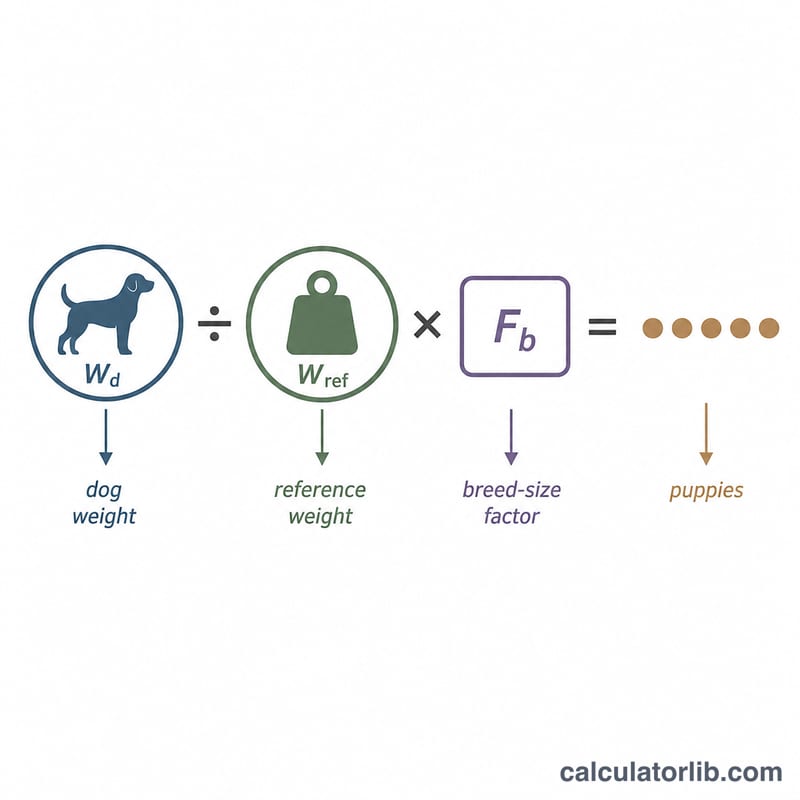
Each size category has an average litter factor (toy ~3, small ~4, medium ~6, large ~8, giant ~10) and a typical reference weight. The estimate scales the factor by how the dog's weight compares to a typical dog of that size:
$$\text{Puppies} = \text{round}\!\left( f \times \frac{\text{Weight (kg)}}{W_{ref}} \right)$$
This means a heavier-than-average dog in a category nudges the estimate up, and a lighter one nudges it down. The result is always at least one puppy.
Worked example
A medium-breed dog weighing 18 kg uses a factor of 6 and a reference weight of 18 kg: $$\text{Puppies} = \text{round}\!\left( 6 \times \frac{18}{18} \right) = 6 \text{ puppies}.$$ A large-breed dog at 35 kg uses factor 8 and reference 35: $$\text{Puppies} = \text{round}\!\left( 8 \times \frac{35}{35} \right) = 8 \text{ puppies}.$$
FAQ
How accurate is this estimate? It is a ballpark only. Actual litter size also depends on the dam's age, health, genetics, the number of mating sessions and breeding history. An ultrasound or X-ray from your veterinarian gives a far more reliable count.
Does first litter affect size? Yes — a dog's first litter is often smaller than later litters, and very young or older dams tend to have fewer puppies.
Should I use this for medical decisions? No. This calculator is for general guidance and education. Always consult a veterinarian for whelping planning, prenatal care and any health concerns.