
What is the Half-Life Decay Calculator?
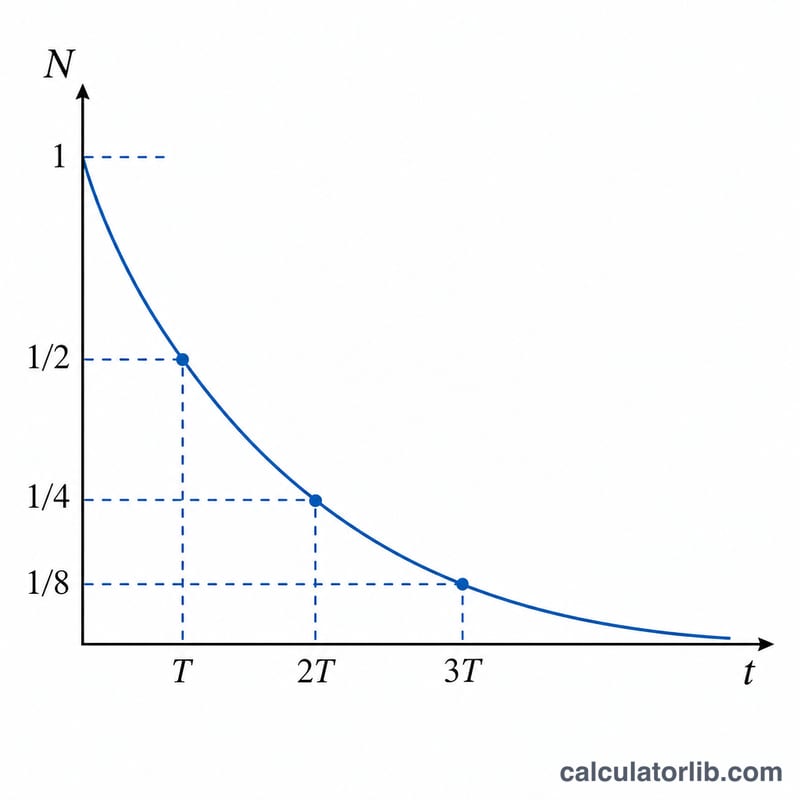
This calculator models exponential decay — the process by which a quantity decreases by half over each fixed interval called the half-life. It is most famous in radioactive decay, but the same maths applies to drug elimination (pharmacokinetics), capacitor discharge, cooling, and any process governed by a constant decay rate. Given an initial amount, a half-life, and an elapsed time, it returns the remaining quantity along with several related properties.
How to use it
Enter the initial quantity (N₀) — this can be a mass, a number of atoms, a concentration, or any positive amount. Enter the half-life (T) and the elapsed time (t). Crucially, the half-life and elapsed time must be expressed in the same unit (both in seconds, both in years, etc.). The calculator then reports how much remains, the percentage remaining, the amount that has decayed, and the decay constant and mean lifetime.
The formula explained
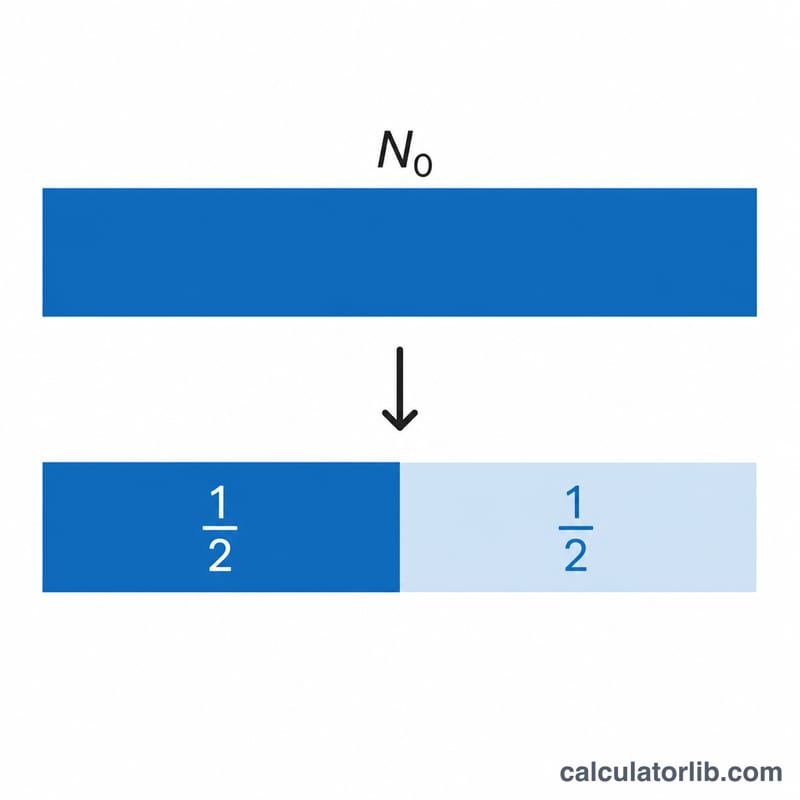
The core equation is $$N(t) = \text{N}_0 \times \left(\frac{1}{2}\right)^{\frac{\text{Elapsed time (t)}}{\text{Half-life (T)}}}$$ Each time \(t\) advances by one half-life \(T\), the exponent increases by 1 and the quantity is multiplied by \(\tfrac{1}{2}\). The decay constant \(\lambda = \frac{\ln(2)}{T}\) gives the instantaneous fractional decay rate, and the mean lifetime \(\tau = \frac{T}{\ln(2)}\) is the average time a particle survives — about 1.4427 half-lives.
Worked example
Carbon-14 has a half-life of about 5730 years. Starting with \(N_0 = 1000\) atoms, after \(t = 5730\) years exactly one half-life has passed, so $$N = 1000 \times \left(\tfrac{1}{2}\right)^1 = 500 \text{ atoms}$$ remain. The fraction remaining is 50%, the decay constant is \(\frac{\ln(2)}{5730} \approx 0.000121\) per year, and the mean lifetime is \(\frac{5730}{\ln(2)} \approx 8267\) years.
FAQ
Does the unit matter? Only that \(T\) and \(t\) share the same unit; the ratio \(t/T\) is dimensionless, so the result stays in the same unit as \(N_0\).
What if t equals zero? The remaining amount equals the full initial quantity, since \(\left(\tfrac{1}{2}\right)^0 = 1\).
Can I use it for medication dosing? Yes — drug levels in the body often follow first-order kinetics, so plug in the drug's elimination half-life and the time since the dose.