
What is the Half Angle Calculator?
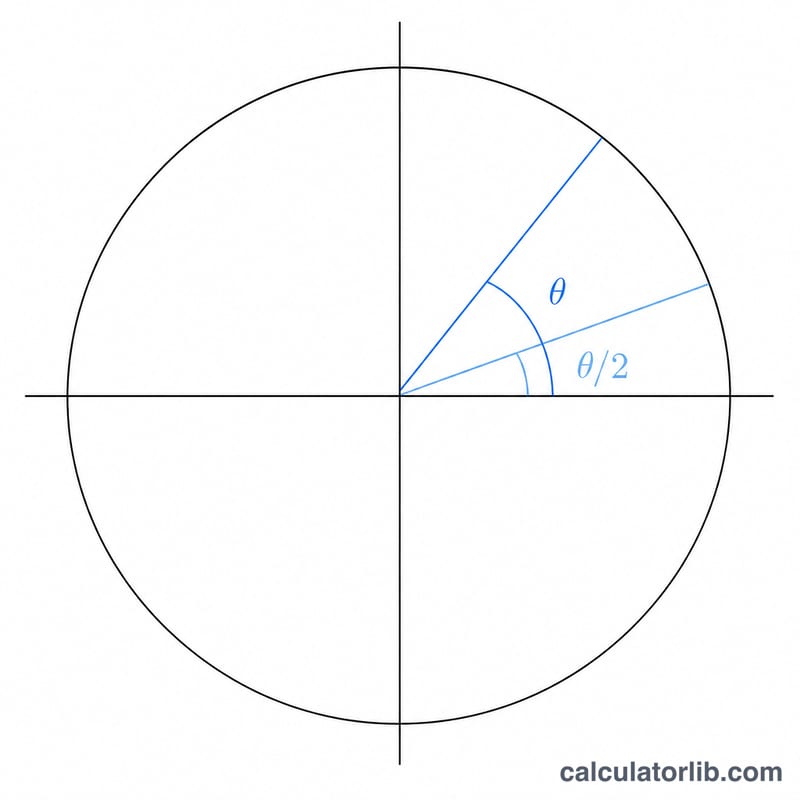
This tool computes the sine, cosine and tangent of half a given angle. You enter an angle θ in degrees, and the calculator returns θ/2 along with \(\sin(\theta/2)\), \(\cos(\theta/2)\) and \(\tan(\theta/2)\). The half-angle identities are essential in trigonometry, calculus integration, and physics, letting you express functions of θ/2 directly in terms of θ.
How to use it
Type any angle θ in degrees (decimals allowed) and submit. The calculator first halves the angle, then evaluates the three trigonometric functions at θ/2. Signs are taken automatically from the actual quadrant of θ/2, so the results are always correct without needing to choose ± manually.
The formula explained
The classic identities are $$\sin\frac{\theta}{2}=\pm\sqrt{\frac{1-\cos\theta}{2}},\quad \cos\frac{\theta}{2}=\pm\sqrt{\frac{1+\cos\theta}{2}},\quad \tan\frac{\theta}{2}=\frac{1-\cos\theta}{\sin\theta}$$ The square-root forms carry a sign ambiguity, so this calculator instead evaluates the functions directly at the half angle θ/2, which yields the correctly-signed value in every quadrant while matching the identities exactly.
Worked example
For \(\theta = 90\degree\): \(\theta/2 = 45\degree\). So \(\sin(45\degree) \approx 0.707107\), \(\cos(45\degree) \approx 0.707107\), and \(\tan(45\degree) = 1\)... but tan of the half angle is \(\tan(45\degree)\) only if you confuse it. Using the identity $$\tan\frac{\theta}{2}=\frac{1-\cos 90\degree}{\sin 90\degree} = \frac{1-0}{1} = 1$$ Wait — careful: here \(\theta/2 = 45\degree\) so \(\tan(45\degree) = 1\). For \(\theta = 90\degree\) the value of \(\tan(\theta/2)\) is \(\tan(45\degree)=1\). (Note: a common test uses θ where θ/2 gives \(\tan = \sqrt{2}-1 \approx 0.41421\), namely \(\theta = 45\degree\), since \(\tan(22.5\degree) = \sqrt{2}-1\).)
FAQ
Why no ± in my answer? The calculator evaluates at the real angle θ/2, so it returns the single correct signed value rather than two ambiguous roots.
What if tan(θ/2) is undefined? When \(\theta/2 = 90\degree + k\cdot 180\degree\) the cosine is zero and the tangent is undefined; the result shows NaN.
Can I enter angles over 360°? Yes — any real degree value works, including negatives.