半角计算器是什么?
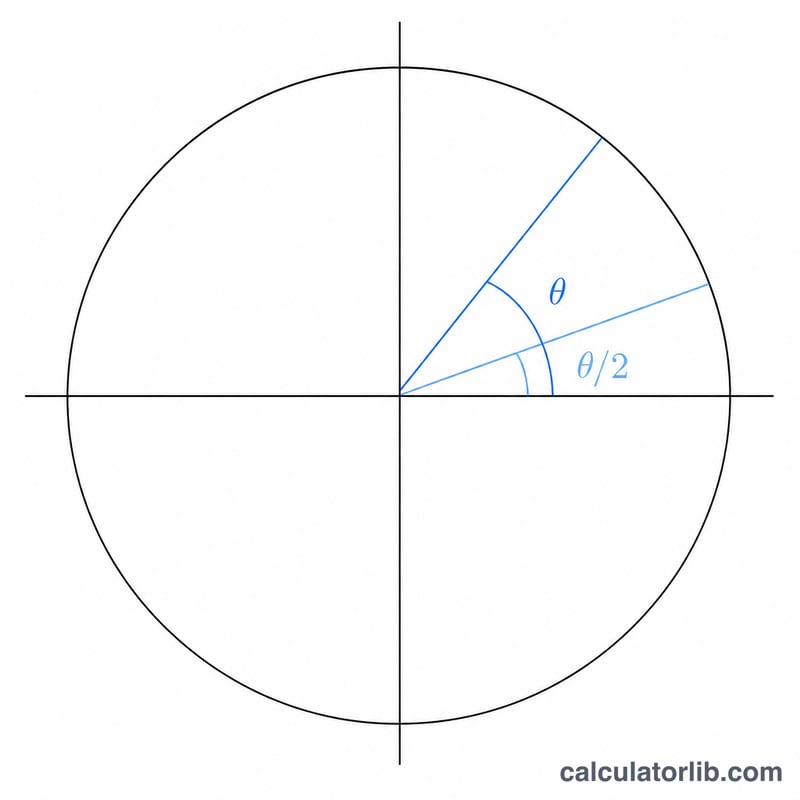
这个工具可以计算某个角度一半的正弦、余弦和正切值。你只需输入一个以度为单位的角度 \(\theta\),计算器就会返回 \(\theta/2\),并同时给出 \(\sin(\theta/2)\)、\(\cos(\theta/2)\) 和 \(\tan(\theta/2)\)。半角公式在三角学、微积分中的积分运算以及物理学里都不可或缺,它让你能够直接用 \(\theta\) 来表示 \(\theta/2\) 的各个三角函数。
使用方法
输入任意以度为单位的角度 \(\theta\)(支持小数),然后提交即可。计算器会先将角度减半,再分别求出 \(\theta/2\) 处的三个三角函数值。正负号会根据 \(\theta/2\) 实际所在的象限自动确定,因此结果始终正确,你无需手动选择 \(\pm\) 号。
公式详解
经典的半角公式为:$$\sin\frac{\theta}{2} = \pm\sqrt{\frac{1-\cos\theta}{2}},\quad \cos\frac{\theta}{2} = \pm\sqrt{\frac{1+\cos\theta}{2}},\quad \tan\frac{\theta}{2} = \frac{1-\cos\theta}{\sin\theta}$$带根号的形式存在正负号的不确定性,因此本计算器改为直接在半角 \(\theta/2\) 处求值,这样既能在每个象限都得到正确的带符号结果,又与上述公式完全吻合。
实例演算
以 \(\theta = 90\degree\) 为例:\(\theta/2 = 45\degree\)。于是 \(\sin(45\degree) \approx 0.707107\),\(\cos(45\degree) \approx 0.707107\),\(\tan(45\degree) = 1\)。这里要特别留意:\(\tan(\)半\(角)\)等于 \(\tan(45\degree)\),前提是不要把它和原角混淆。用公式验证 $$\tan\frac{\theta}{2} = \frac{1-\cos 90\degree}{\sin 90\degree} = \frac{1-0}{1} = 1$$结果一致。(提示:另一个常见的测试题是取 \(\theta = 45\degree\),此时 \(\theta/2 = 22.5\degree\),\(\tan(22.5\degree) = \sqrt{2}-1 \approx 0.41421\)。)
更多求解示例
每个示例都使用半角公式 \(\sin\frac{\theta}{2}=\pm\sqrt{\frac{1-\cos\theta}{2}}\)、\(\cos\frac{\theta}{2}=\pm\sqrt{\frac{1+\cos\theta}{2}}\) 以及 \(\tan\frac{\theta}{2}=\frac{1-\cos\theta}{\sin\theta}=\frac{\sin\theta}{1+\cos\theta}\)。符号由 \(\theta/2\) 所在的象限决定。
示例 1:θ = 60°
这里 \(\theta/2=30^\circ\)(第一象限,因此所有符号均为正),且 \(\cos 60^\circ=0.5\)。
- \(\sin 30^\circ=\sqrt{\frac{1-0.5}{2}}=\sqrt{0.25}=0.5\)
- \(\cos 30^\circ=\sqrt{\frac{1+0.5}{2}}=\sqrt{0.75}\approx 0.866025\)
- \(\tan 30^\circ=\frac{1-0.5}{\sin 60^\circ}=\frac{0.5}{0.866025}\approx 0.577350\)
示例 2:θ = 45°
这里 \(\theta/2=22.5^\circ\)(第一象限),且 \(\cos 45^\circ=\frac{\sqrt2}{2}\approx 0.707107\)。
- \(\sin 22.5^\circ=\sqrt{\frac{1-0.707107}{2}}=\sqrt{0.146447}\approx 0.382683\)
- \(\cos 22.5^\circ=\sqrt{\frac{1+0.707107}{2}}=\sqrt{0.853553}\approx 0.923880\)
- \(\tan 22.5^\circ=\frac{\sin 45^\circ}{1+\cos 45^\circ}=\frac{0.707107}{1.707107}\approx 0.414214=\sqrt2-1\)
示例 3:θ = 300°
这里 \(\theta/2=150^\circ\),位于第二象限:正弦为正,余弦和正切为负。另外 \(\cos 300^\circ=0.5\),且 \(\sin 300^\circ\approx -0.866025\)。
- \(\sin 150^\circ=+\sqrt{\frac{1-0.5}{2}}=\sqrt{0.25}=0.5\)
- \(\cos 150^\circ=-\sqrt{\frac{1+0.5}{2}}=-\sqrt{0.75}\approx -0.866025\)
- \(\tan 150^\circ=\frac{1-\cos 300^\circ}{\sin 300^\circ}=\frac{0.5}{-0.866025}\approx -0.577350\)
正切形式 \(\frac{1-\cos\theta}{\sin\theta}\) 不需要选择 ±,因为 \(\sin\theta\) 的符号已经决定了结果的符号。
常见半角值
| θ | θ/2 | sin(θ/2) | cos(θ/2) | tan(θ/2) |
|---|---|---|---|---|
| 30° | 15° | (√6−√2)/4 ≈ 0.258819 | (√6+√2)/4 ≈ 0.965926 | 2−√3 ≈ 0.267949 |
| 45° | 22.5° | √(2−√2)/2 ≈ 0.382683 | √(2+√2)/2 ≈ 0.923880 | √2−1 ≈ 0.414214 |
| 60° | 30° | 1/2 = 0.5 | √3/2 ≈ 0.866025 | √3/3 ≈ 0.577350 |
| 90° | 45° | √2/2 ≈ 0.707107 | √2/2 ≈ 0.707107 | 1 |
| 120° | 60° | √3/2 ≈ 0.866025 | 1/2 = 0.5 | √3 ≈ 1.732051 |
| 180° | 90° | 1 | 0 | 无定义 |
| 270° | 135° | √2/2 ≈ 0.707107 | −√2/2 ≈ −0.707107 | −1 |
| 360° | 180° | 0 | −1 | 0 |
第一行给出 15° 的值:sin 15° ≈ 0.258819,cos 15° ≈ 0.965926。当 θ/2 为 90° 或 270° 时,即 θ = 180° 和 θ = 540°(以及之后每隔 360° 的位置),半角的正切无定义,因为此时 cos(θ/2) = 0。
结果的象限符号
半角公式中含有 ± 号,其符号由 \(\theta/2\) 所在的象限决定,而不是由 \(\theta\) 所在的象限决定。
| θ/2 所在象限 | θ/2 的范围 | 正弦 | 余弦 | 正切 |
|---|---|---|---|---|
| I | 0°–90° | + | + | + |
| II | 90°–180° | + | − | − |
| III | 180°–270° | − | − | + |
| IV | 270°–360° | − | + | − |
θ 与 θ/2 所在象限的对应关系
- θ 从 0° 到 180°,θ/2 从 0° 到 90°:第一象限。
- θ 从 180° 到 360°,θ/2 从 90° 到 180°:第二象限。
- θ 从 360° 到 540°,θ/2 从 180° 到 270°:第三象限。
- θ 从 540° 到 720°,θ/2 从 270° 到 360°:第四象限。
超过 360° 的角与负角
超过 360° 的角对 θ 本身会绕回,但对 θ/2 却不会。例如 θ = 400° 与 40° 终边相同,这似乎表明 θ/2 = 20° 位于第一象限。但实际的 θ/2 是 200°,位于第三象限,因此正弦和余弦都为负。一般来说,θ 与 θ + 360° 得到的半角相差 180°:正弦和余弦变号,而正切保持不变。负角的情况类似:θ = −60° 得到 θ/2 = −30°,它等价于第四象限的 330°。
常见问题
为什么我的结果里没有 \(\pm\) 号? 计算器是在真实的角度 \(\theta/2\) 处直接求值,因此返回的是唯一正确的带符号数值,而不是两个含糊不清的根。
如果 \(\tan(\theta/2)\) 没有定义怎么办? 当 \(\theta/2 = 90\degree + k\cdot 180\degree\) 时,余弦为零,正切无定义,此时结果会显示 NaN。
可以输入大于 \(360\degree\) 的角度吗? 可以——任何实数度数都行,包括负数。